
Leveraging AI, AR, VR, XR, and emerging technologies to create richer community-centric brand experiences
By Kristina McCoobery, CEO & Co-Founder, INVNT
The Rise of Phygital
The walls between physical and digital are crumbling. What once felt like parallel universes are now one continuous reality. Phygital experiences, where in-person presence meets digital possibility, have become the heartbeat of modern brand storytelling.
Audiences don’t just want to watch, they want to feel, to belong, to co-create. For brands, that means delivering both the trust and tangibility of real-world interaction and the infinite possibility of digital technology.
A Changing Landscape for Brand Storytelling
Brands and marketers are doubling down on experiences to reach customers and get “more bang for their bucks.” The market is on fire with global growth as businesses lean into branded events to overcome audience fragmentation and shifting consumer behaviours.
At INVNT, we see this growth first-hand. With clients such as Amex, Oracle, General Motors, Netflix, Samsung, PepsiCo., Geely,Lamborghini, Microsoft and Xero contributing to a global business pool north of $150M USD, it is clear: the future belongs to brands that move beyond campaigns and create living, breathing worlds of engagement.
Audiences are tougher to reach, content is everywhere, and loyalty is fleeting. The challenge is to be unforgettable and not simply seen.
What Experiential Means Today
Experiential used to mean events. Now, it means creating brand moments that move markets and rewrite culture, alongside fully immersive experiences.
At INVNT, we define it as storytelling engineered to engage, cut through noise, and dent history. It spans live, digital, hybrid, AI-powered, XR-enabled, and immersive formats, all designed to spark emotion and drive action.
In today’s world of “is it real, or is it not?” AI-generated content, experiential stands as the last frontier of authenticity. It is intimate, emotional, and utterly unreplicable.
Unlike other agencies, we scale faster, integrate deeper, and innovate bolder.
Why Phygital, and Why Now?
As the boundaries between physical and digital dissolve, brands are reimagining what it means to connect. From augmented reality installations at live events to digital artefacts with real-world value, phygital is not a trend, it is the inevitable future of brand experience.
Phygital delivers the trust of the tangible and the power of the infinite.
A digital campaign might scroll past in seconds, but a phygital experience lingers in the body and the mind. It allows audiences to hold the brand in their hands while engaging with its digital twin through a screen, headset, or connected space. That fusion creates deeper engagement, lasting memory, and stronger emotional connection.
Technology Is the Enabler, Not the Story
At INVNT, we leverage emerging technologies like AI, AR, VR, and Web3 to elevate human experience, not replace it.
- AR turns products and environments into portals to new worlds.
- VR dissolves time and geography, transporting audiences into immersive brand narratives.
- XR integrates all realities into a single continuum, expanding the canvas for what’s humanly possible at scale
But the tools are only powerful when used in service of storytelling.
Emerging digital world-building technologies reshape ownership, participation, and community, creating new ways for audiences to not just engage with brands, but to live inside them.
But technology alone is never the story, the story is what outlives the platform.
Innovation in Action
INVNT has pioneered some of the world’s most exciting phygital campaigns:
- Lamborghini: Designed the world’s first metaverse-inspired NFT supercar with twin physical car – auctioning for $1.6M, in partnership with Steve Aoki, Krista Kim, and RM Sotheby’s – marking the automotive brand’s pivot to an all-electric future.
- COP28: Brought the Tree of Life to life using AI, enabling people to speak with “Mother Nature” and create personal climate pledges visualised through generative art, driving global impressions across social media.
- Xero: Built the AI Music Factory at Xerocon, a GenAI-powered activation where attendees created custom songs and vinyl records in real time.
- ABB: Created ABB-e, a fully interactive, AI-powered brand mascot built with GPT-4 and Unreal Engine, now a global standard for intelligent brand engagement.
- Microsoft: Launched CoPilot globally, blending legacy, innovation, and cultural storytelling, leading up to the celebration of Microsoft’s 50th Anniversary.
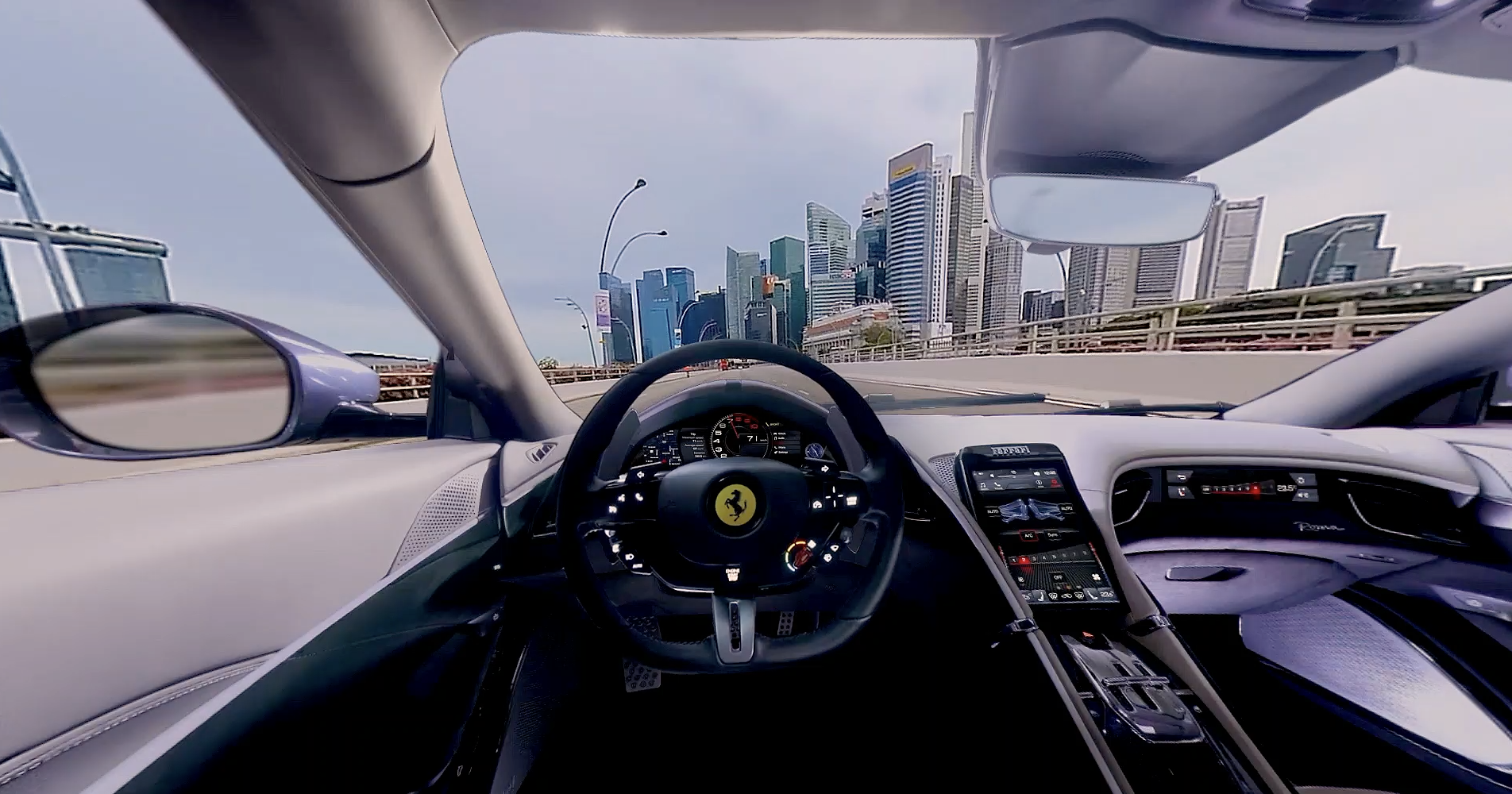
- Ferrari: The “It’s Virtually Yours” campaign blended the real and digital worlds by transforming empty global streets into immersive test tracks – inviting VIPs into local showrooms to slip on VR headsets and experience a mixed-reality test drive that fused the physical Roma with a virtual journey through their own city’s landmarks.
These examples show that phygital isn’t just creative, but measurable, scalable, and impactful.
What Brands Should Consider
- Begin with the story: Technology must serve a purpose.
- Design for both presence and participation: Whether in-person or remote, everyone should feel equally involved.
- Create utility, not spectacle: AI, AR, VR, XR, and even NFTs should enhance the journey, not just impress.
- Think long-term: Phygital experiences are chapters in a brand’s larger narrative.
The Future Is Hybrid…and Human
Our industry’s biggest challenge remains proving ROI, but advances in data now make it possible to measure who attends, what they engage with, and what value is created. Combined with social amplification and in-person energy, the ROI of experiences is clearer than ever.
The global pandemic reinforced a simple truth: in-person connection is irreplaceable. But when layered with innovation, we have seen firsthand that its impact multiplies.
In conclusion, phygital is showing up in the ways that matter most, showing up with creativity, consistency, and human depth.
For more information, visit www.invnt.com

