celebpeek
  • Home
  • Bollywood
  • Hollywood
  • Lifestyle
  • Fashion
celebpeek
  • Music
  • Celebrity News
  • Events
  • TV & Streaming
Home » Ronan
Tag:

Ronan

Ronan Day-Lewis on Directing His Father, Daniel Day-Lewis
TV & Streaming

Ronan Day-Lewis on Directing His Father, Daniel Day-Lewis

by jummy84 October 3, 2025
written by jummy84

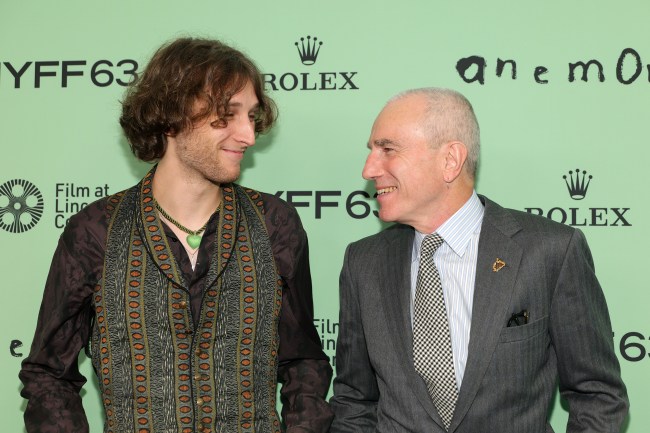
Situated above Ronan Day-Lewis, the writer/director of “Anemone” and son of Rebecca Miller and the film‘s star Daniel Day-Lewis, in his apartment is a painting of a luminescent creature you’ll meet in the film during a particularly dreamy sequence. Day-Lewis, 27, is a painter himself, having shown work in New York, Los Angeles, Hong Kong, and beyond. He spoke to me over Zoom from his place in New York, where he just premiered “Anemone” at the New York Film Festival.

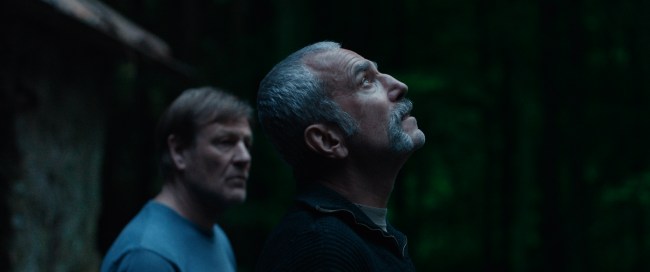
The drama stars Daniel Day-Lewis, who came out of retirement for his first film role since Paul Thomas Anderson’s “Phantom Thread” (2017) to specifically help his son get his directing debut off the ground, as a former English soldier who served during the Troubles of Northern Ireland — deployed to neutralize conflict between the IRA and paramilitary groups —  and is haunted by his memories. Twenty years prior to the present day of the movie, Ray Stoker (Day-Lewis) abandoned his family to live off the grid in a hut in the woods after a scarring incident during the conflict, which pitted Catholics against Protestants within Northern Ireland, and union loyalists against republicans. He’s also evolved into an alcoholic recluse who can barely take care of himself due to traumas he shared with his brother Jem (Sean Bean) at the literal hands of a Catholic priest.

1984, (aka NINETEEN EIGHTY-FOUR), from left: John Hurt, Suzanna Hamilton, 1984. ©Atlantic Releasing/courtesy Everett Collection

Now married to Ray’s former girlfriend (Samantha Morton) and raising Ray’s haunted son (Samuel Bottomley), Jem shows up at Ray’s doorstep (of sorts, as his living quarters are truly a shack) hoping to bring him out of the woods, back to the city, and to talk some sense into his kid who’s headed into the military and recently attacked a fellow serviceman. The Day-Lewises shot the film primarily on location in Wales and in Manchester, England last year, and it’s now headed into awards season touting Day-Lewis’ triumphant return to the screen. (It’s a searing performance built on a series of extended monologues in which Ray slowly starts to reveal the nature of his wounds.) Will we see him in another movie? That’s unclear, as Day-Lewis wouldn’t have re-emerged without the assist from his son, with whom he co-wrote the script over a period of years.

Below, IndieWire talks to Ronan Day-Lewis about his father’s infamous Method acting style (which involves Daniel never breaking character on or off the set), how the mercurial English weather ended up dictating parts of the story, and avoiding the pitfalls of flashbacks to tell a dense story steeped in recent history.

This interview has been edited for clarity and length.

IndieWire: Daniel Day-Lewis is known for staying in character even off-set throughout a production. What does that look like when you’re also his son and you’re already spending a lot of time together outside shooting hours?

Ronan Day-Lewis: Some of my experiences of seeing him work were as a kid, and at that point, he would have a bit more of a divide when he would come home because it would be confusing for a five-year-old. [Laughs] This was maybe the most I had seen him really staying in character on- and off-set in all the times I’ve seen him work, and it was pretty amazing to see it from that different vantage point.

'Anemone'
‘Anemone’Courtesy of Focus Features

What does that look like off-set?

It was mainly to do with his voice and manner of speech and phrasing of things. It’s kind of a strange double thing because it’s still him, but it’s almost like two people superimposed over each other at times when we weren’t on set and dialed into that world.

But it’s not like you’re out to dinner, and he’s ordering off the menu in the voice of Ray Stoker. Or is it?

It actually was like that in this case. [Laughs]

The writing process took a while as you’re also a busy painter with work being exhibited during that time. You were able to write the script in bursts going back to the pandemic. Did the germ of the idea begin with you? And at one point did it become clear your father would also act in this film?

It’s hard to pinpoint because, for years, I had an independent inclination to do something about brothers. I was writing other scripts and never found a way into it because I was thinking it might have been a coming-of-age story that would have been more in my world. When he came to me with the idea that we could try to find something to do together, at that point, we weren’t talking about a specific idea. A couple years later, it turned out he had this fascination with brotherhood, and the silence and negative space between siblings. Once we locked into that, the ball just started rolling very slowly. We didn’t go in with any kind of outline. It was very intuitive.

How did Plan B, with producers Dede Gardner and Jeremy Kleiner, become the chosen partners for this film?

My dad’s dear friend and agent, Tor Belfrage, put us in touch with them early on. She spoke so highly of them as collaborators and the way they foster filmmakers and the spirit by which they operate. Obviously, the films that they have produced were some of my favorite films, “The Tree of Life” and “Moonlight,” and so many others. We were pretty nervous to send them the script because not many people had read it at that point, and they just really understood the film’s blend of the intimate and mythic, and the way that those can dovetail together in a way that was so encouraging to us. We weren’t sure at that point whether that would feel harmonious or if those elements would clash for other people.

ANEMONE, from left: Daniel Day-Lewis, Sean Bean, 2025. © Focus Features / courtesy Everett Collection
‘Anemone’©Focus Features/Courtesy Everett Collection

When Jem locates his brother, Ray has been living off the grid for 20 years, having fled the family nest. How much of the production mirrored that off-the-gridness of the story? You shot those sequences on location in Wales.

We were really reckoning with real, natural environments and weather, and that became a huge part of the film’s visual identity. There are moments of wind written into the script, but certain things happened when we were shooting that ended up making the wind into a far bigger character and narrator in the film. The combination of being forced to embrace the chaos of those environments — we were shooting in the woods, when it rained the mud was just insane, so we were trudging through mud — and then we shot in this abandoned copper mine where we were wading through knee-deep water that was filled with jagged rocks. But also having the artifice of the soundstage was really important. Chris Oddy, the production designer, meticulously recreated the hut on the stage down to matching floorboards with similar blemishes in similar places to have this seamless match. There were certain shots that required moving a wall or operating a crane inside the hut that ended up allowing it to go beyond the claustrophobia of the literal setting and giving it a bit more of that cosmic background.

This movie asks you to listen closely to the dialogue, as there are a number of extended monologues that provide historical backdrop. But there’s no visual affirmation in the form of flashbacks. Were you tempted to include them?

That was definitely what we were wrestling with during the entire writing process. So much of the film almost takes place before the film begins, so much of the story, so much is about the weight of the past on the present. That ended up meaning that the performances had a huge brunt to bear in terms of communicating not just 20 years but these entire lives within this moment in the present. Whether or not to have a flashback, we always knew we wanted to avoid them at all costs because it felt like somehow it would just betray the tone of the film in a way that we couldn’t quite put our fingers on. There are moments you could call flashbacks, but they have a slightly hallucinatory quality and the kind of wooziness of a distant, fragmented memory. It was important to me that when the past came in, it wasn’t in a literal way because that felt like an easy way out.

You lived in Ireland for a decent stretch of time as a kid. What brought you there?

My dad was living in Ireland by the time he met my mom. She’s a New Yorker, so they ended up basically striking a deal where the first half of me and my brother’s upbringing would be in Ireland, and then we’d move to the States. I was there from seven to 13, but I was born in New York. It was definitely formative years. I went to Catholic school there, and we learned about the Troubles, of course, and they really loomed large in my imagination since then, which was part of the reason why we gravitated toward that as a historical framework for the film.

My understanding of the Troubles came out of film and television. It’s not often taught, at least it wasn’t in my American school.

Neither when I was here. It was really important to me that you didn’t have to know anything about the Troubles to watch the film. I don’t want to take away from the specificity of that as the past of the characters, but the film also has that mythic quality … among many other things, I think of it as an antiwar film. I felt like the more that the details of the conflict are revealed in this seemingly incidental way, the less an audience would feel they need to understand something where they don’t come in with a preset knowledge. At a certain point we were like, do we need to put in title cards to give some backstory? It always felt like the film rejected anything that felt too explanatory like that. It felt like it betrayed the spirit of the silence and the mystery of the film and the more spiritual aspect of it.

You’ve directed a short and have done some music, but you are foremost a painter. Are you hoping to continue doing both, or do you want to pivot toward filmmaking now?

If I get the chance, I would love to make more films and also continue painting in equal capacity. That would be the dream. I was working on a show of paintings that just opened, which I was making during the edit, and that was a really intense experience. I’m glad it worked out that way this time because they ended up influencing each other in mysterious ways, but I was basically working full days on the film and going upstairs and painting until late at night. They gave me this little room above the cutting room to paint in, which was amazing. Then, on the weekends, painting, and it ended up feeling like in the future, I need to plan my time better if I do end up continuing with both. [Laughs] It was cool to see how they could coexist so closely.

I don’t know if you’ve seen “All That Jazz,” but that is a cautionary tale about multitasking. Roy Scheider’s character is mounting a Broadway production while editing a Hollywood movie, and it takes him down.

I’ve been meaning to watch that forever. [In my case, that experience] is I think a one time thing.

“Anemone” opens in theaters from Focus Features on Friday, October 3, 2025.
October 3, 2025 0 comments
0 FacebookTwitterPinterestEmail
Ronan Day-Lewis' Debut Suggests Nepotism Is... Good?
TV & Streaming

Ronan Day-Lewis’ Debut Suggests Nepotism Is… Good?

by jummy84 September 29, 2025
written by jummy84

That a movie like “Anemone” could only have been made by the forces of nepotism that govern it — it’s directed by Ronan Day-Lewis, and co-written by his father and the film‘s star Daniel Day-Lewis — is not something to ignore, but this dark, dense, deep two-hander about the Troubles in Ireland turns out to be quite better than you’d expect from that notion.

Daniel Day-Lewis stars as a former British soldier who defected from the Irish Republican Army after a particularly traumatizing incident involving a dead civilian, with his brother, played by Sean Bean, taking over his life in the process: his wife (Samantha Morton) and son (Samuel Bottomley), who in the present day has become a traumatized beater.

NEW YORK, NEW YORK - SEPTEMBER 26: Andrew Garfield attends the "After The Hunt" Red Carpet during the 63rd New York Film Festival at Alice Tully Hall, Lincoln Center on September 26, 2025 in New York City. (Photo by Jamie McCarthy/Getty Images for FLC)

“Anemone” is a miserable movie top to toe, but it’s directed with enough promising skill to suggest actual smarts and talent on the part of its director/writer. Ones that aren’t only linked to its star, who comes back out from the acting retirement hole to deliver a performance that is typically great, with a monologue about taking an actual shit on a priest that formerly abused him (and spared his brother, Sean Bean) that goes up in the Daniel Day-Lewis hall of fame.

Or did he really do that? We are ever meant to question the narrative reliability here. While “Anemone” stutters in its final gasp of breath, with a closing segment that too tidily binds up its prickly narrative branches, the movie does manage to suck you into a whirlpool of pain and suffering that becomes oddly addictive.

“Anemone” isn’t destined for box office gold, despite its star’s seasoned imprimatur, the movie too cold to the touch and reliant on Irish-British history that forces you to listen closely to plot details expounded in drawn-out speeches. It’s scored by Bobby Krilic, aka Ari Aster’s composer Haxan Cloak, with what sounds like the indie-rock acoustic-and-synth tools of someone at the nadir of their life on the cold tile floor of the world’s most depressing bathroom. It’s shot by cinematographer Ben Fordesman with the style and grayed-out flourish of a supernatural horror movie, even as Ray Stoker’s (Daniel Day-Lewis) traumas are completely grounded in the real world. He’s contending with “a crack in the ice that wouldn’t heal over” after fleeing, some years ago, to the woods to live out the rest of his days after being deemed a war criminal by his compatriots.

His brother Jem (Sean Bean) took on duties of caring for Ray’s abandoned wife and child in the process, and now that grown-up son Brian (Bottomley) has himself been conscripted into the military, and was recently sent home for attacking a fellow serviceman for daring to speak his father’s name. Or daring to speak the rumors around him, as Brian is not aware of the fact that the man he thinks is his father is actually his uncle. Ray lives in filth in a hovel outpost in the middle-of-nowhere woods of North England, filthy enough that it’s noticed by Jem, who’s been jettisoned to recover him in order to speak some sense into Brian after his latest brush with pain, that he can barely wipe his own ass. And even refuses to. “You’re going to hell,” Jem tells Ray. “Family reunion!” Ray replies.

“Ever hear about the Troubles?” Nessa (Morton) bluntly asks her son after he brings a box of Ray’s former war correspondences down from the attic. “Anemone” does not proceed to give us a history lesson about the particulars of the thorny battles between Catholics and Protestants, royalists and independents. In fact, if you’re not caught up on your 20th-century European history, “Anemone” might not mean a whole hell of a lot to you, though Ronan Day-Lewis harks back to a bombing that emotionally scarred Ray with spareness and reserve.

There are also shots of Daniel Day-Lewis contemplating his own despair against the flickering flames of a bonfire that will bring “There Will Be Blood” and Daniel Plainview to mind, a man who has built up his hatred little by little over the years, and now has only venom to spew. “I did the crime, and I’m still serving the time,” Ray says at one point amid a spiky, literary screenplay that appreciates the lusciousness of good dialogue.

There is a hallucinatory late sequence in which Ray encounters a translucent dream creature that may or may not resemble his son; then, there is a hailstorm whose ensemble-linking gravitas recalls just a bit too closely that final frog-raining scene in “Magnolia,” a deus ex machina event tacked on to tie the whole thing together, but less pungent here.

While “Anemone,” which effectively captures the feeling of dropping a shot of coffee into your Guinness or the reverse, uppers and downers combined to maximal effect, is often too damp and dreary to a fault, the confidence behind the camera justifies the miserable ends. It’s a movie about lost souls, and how abuse begets further abuse and violence, even as Ray, the self-styled fugitive, has abandoned his life to try and prevent his son from absorbing his worst aspects.

This is a dense, unforgiving movie in the classic sense, an adults-only drama that doesn’t placate despite its stylistic overreaches. It’s disappointing that in its final moments, the movie has come so far off its own hinges, so deconstructed its own rivets, that it can’t put them back together again. But everything that’s come before is so rich that you’re ready to forgive it. The title, by the way, comes from the flowers that bloomed from Ray’s own father’s planting. Ronan Day-Lewis seems to have plucked and pruned the best lessons from them, too.

Grade: B

“Anemone” premiered at the 2025 New York Film Festival. Focus Features releases it Friday, October 3.

Want to stay up to date on IndieWire’s film reviews and critical thoughts? Subscribe here to our newly launched newsletter, In Review by David Ehrlich, in which our Chief Film Critic and Head Reviews Editor rounds up the best new reviews and streaming picks along with some exclusive musings — all only available to subscribers.

September 29, 2025 0 comments
0 FacebookTwitterPinterestEmail
Saoirse Ronan in a Very Dark Classroom Comedy
TV & Streaming

Saoirse Ronan in a Very Dark Classroom Comedy

by jummy84 September 24, 2025
written by jummy84

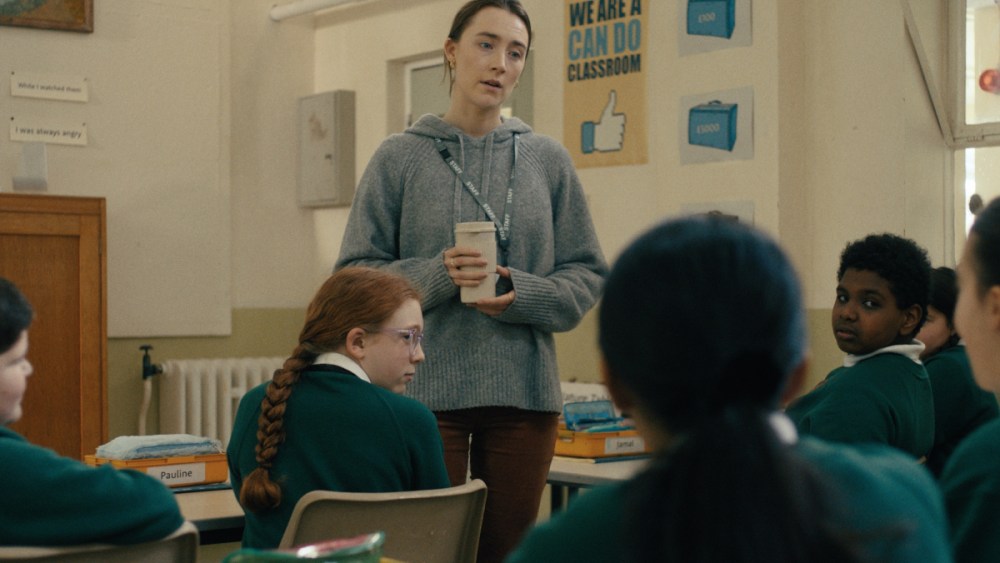
Children learn some things at school, sure, but others they just collectively know from the moment they set foot in class — and one of them is how to immediately size up a teacher as friend or foe, authority or pushover. Sweetly earnest young Maria Spencer (Saoirse Ronan) is one of those unfortunate educators who, through no real fault of her own, has been placed in the latter column by her perceptive pre-teen students: She’s kind, dedicated and full of ideas, but can barely speak over the room, much less command it. A daringly discomfiting black comedy from Swedish director Jonatan Etzler, “Bad Apples” initially appears to be that rare classroom movie that courts more sympathy for adult than child — at least until Maria discovers her unlikely inner disciplinarian, and our allegiances ricochet all over the shop.

A Toronto premiere that has since opened San Sebastian’s New Directors competition (and will also compete at next month’s London Film Festival), “Bad Apples” has been picked up for release by Paramount’s indie-oriented Republic Pictures label, though it’s a trickier commercial proposition than outward appearances might suggest. Films that visit harm upon underage characters are never the surest of sells with general audiences; that goes double for films that invite us to wonder, at least fleetingly, if the kids had it coming. Still, at least one scene of malicious child endangerment in “Bad Apples” was met with raucous audience applause at its San Sebastian premiere — as good a sign as any that Etzler’s warped, needling and sometimes bitterly funny second feature (following his Swedish-language, Netflix-distributed 2023 debut “One More Time”) will find its own cult.

No one’s reservations about the film are likely to include Ronan, an actor still less than a decade away from her own days of playing thorny, complicated children — and who, on the heels of her gutsy turn in last year’s “The Outrun,” keeps demonstrating an impressive aversion to easy adult material. “Bad Apples” depends heavily on her naturally sympathetic sincerity as a performer: Any more resistible a screen presence wouldn’t carry us far through the list of eminently questionable decisions made by Maria in the course of a brazenly credibility-testing script by first-time feature writer Jess O’Kane, adapting a novel by Swedish writer Rasmus Lindgren.

Between that source and Etzler’s cool, jaundiced directorial eye, you can detect a certain deadpan Scandi sangfroid in proceedings, even if they’ve been relocated to a drab rural village in English cider country. There, surrounding apple orchards and clumps of fallen, rotting fruit furnish the film with a rather literal visual metaphor, to which Etzler returns a bit too often. Yet the real bad apple, or so it initially seems, is Danny (riveting newcomer Eddie Waller), a violent, near-feral 10-year-old whose loud, foul language and physical attacks on adults and children alike have made Maria’s class just about unmanageable. The school’s harried principal (Rakie Ayola) offers little support, while Danny’s single father Josh (Robert Emms) has more or less given up on him.

That leaves Maria to take matters into her own hands when the boy’s latest outburst lands meek would-be teacher’s pet Pauline (Nia Brown, another gifted first-timer) with a broken arm. Yet just as “Bad Apples” seems to shaping up as a tart satire of dysfunctional public education, Maria’s next move pulls focus away from the systemic and toward her own individual pathology — no one else is to blame, after all, for her first abducting Danny, then chaining him in her cellar, then saying nothing as the ensuing missing-person case drags on for months.

For those who don’t part ways with “Bad Apples” at this crucial point, the film has a good deal of acrid comic juice left, as Danny’s sudden victimization leaves room for other villains to emerge: Maria, for one, but also a fiercely self-interested PTA, and perhaps even Pauline, quite brilliantly played by Brown as equal parts Little Miss Sunshine and very bad seed.

When “Bad Apples” is centered on Maria and her increasingly panicked negotiations with these two small but complex antagonists — one perhaps less vicious than he appears, the other far more so — it’s queasily tense and unpredictable, with a whiff of real danger as to what they might do to each other, minus any real authority figure in the room. Ronan’s young co-stars meet her gradually emerging guile with artful about-faces of their own: It’s a testament to Waller’s genuinely unnerving presence that his later moments of calm always feel tautly conditional.

When in the realm of the grownups, however, “Bad Apples” plays broader, safer and altogether less believably, albeit not without stabs of cynical truth. Less honest and more suggestible than their children, adults tend to plump not for the fairest solution to a dilemma but the one that inconveniences the fewest among them — so the film ultimately says, though it requires an almighty number of procedural blind spots to reach that conclusion. Ultimately, this odd, wicked little amorality tale winds up siding with no one: The children are indeed the future, we’re left to conclude, but will they make it any better than the present?

September 24, 2025 0 comments
0 FacebookTwitterPinterestEmail
Saoirse Ronan on Her Wild, Darkly Funny Role in 'Bad Apples' INTERVIEW
TV & Streaming

Saoirse Ronan on Her Wild, Darkly Funny Role in ‘Bad Apples’ INTERVIEW

by jummy84 September 5, 2025
written by jummy84

TIFF: In Jonatan Etzler’s darkly funny “Bad Apples,” the actress plays a harried teacher who does something really crazy to a naughty student. As the pair explain to IndieWire, that’s not the wildest part: It’s how disarmingly funny Ronan gets to be.

September 5, 2025 0 comments
0 FacebookTwitterPinterestEmail

Social Connect

Facebook Twitter Instagram Pinterest Youtube Snapchat

Recent Posts

  • 2009 feels like a whole other world away

  • Watch Ariana Grande and Jimmy Fallon Perform a History of Duets

  • Spotify’s Joe Hadley Talks ARIA Awards Partnership

  • Nick Offerman Announces 2026 “Big Woodchuck” Book Tour Dates

  • Snapped: Above & Beyond (A Photo Essay)

Newsletter

Subscribe my Newsletter for new blog posts, tips & new photos. Let's stay updated!

Categories

  • Bollywood (1,929)
  • Celebrity News (2,000)
  • Events (267)
  • Fashion (1,605)
  • Hollywood (1,020)
  • Lifestyle (890)
  • Music (2,002)
  • TV & Streaming (1,857)

Recent Posts

  • Shushu/Tong Shanghai Fall 2026 Collection

  • Here’s What Model Taylor Hill Is Buying Now

  • Julietta Is Hiring An Assistant Office Coordinator In Dumbo, Brooklyn, NY (In-Office)

Editors’ Picks

  • 2009 feels like a whole other world away

  • Watch Ariana Grande and Jimmy Fallon Perform a History of Duets

  • Spotify’s Joe Hadley Talks ARIA Awards Partnership

Latest Style

  • ‘Steal This Story, Please’ Review: Amy Goodman Documentary

  • Hulu Passes on La LA Anthony, Kim Kardashian Pilot ‘Group Chat’

  • Hannah Einbinder Slams AI Creators As “Losers”

  • Facebook
  • Twitter

@2020 - celebpeek. Designed and Developed by Pro


Back To Top
celebpeek
  • Home
  • Bollywood
  • Hollywood
  • Lifestyle
  • Fashion
celebpeek
  • Music
  • Celebrity News
  • Events
  • TV & Streaming