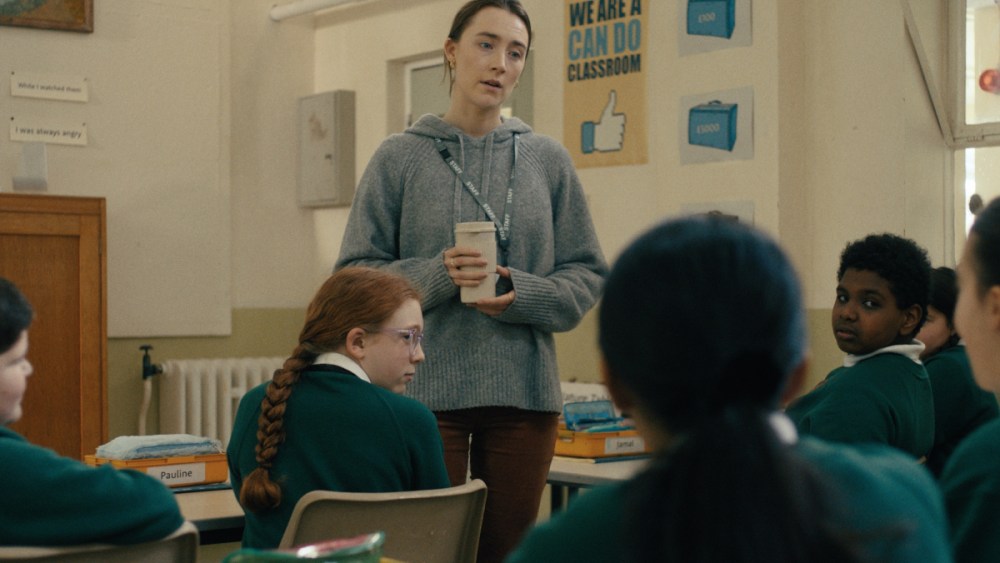
Children learn some things at school, sure, but others they just collectively know from the moment they set foot in class — and one of them is how to immediately size up a teacher as friend or foe, authority or pushover. Sweetly earnest young Maria Spencer (Saoirse Ronan) is one of those unfortunate educators who, through no real fault of her own, has been placed in the latter column by her perceptive pre-teen students: She’s kind, dedicated and full of ideas, but can barely speak over the room, much less command it. A daringly discomfiting black comedy from Swedish director Jonatan Etzler, “Bad Apples” initially appears to be that rare classroom movie that courts more sympathy for adult than child — at least until Maria discovers her unlikely inner disciplinarian, and our allegiances ricochet all over the shop.
A Toronto premiere that has since opened San Sebastian’s New Directors competition (and will also compete at next month’s London Film Festival), “Bad Apples” has been picked up for release by Paramount’s indie-oriented Republic Pictures label, though it’s a trickier commercial proposition than outward appearances might suggest. Films that visit harm upon underage characters are never the surest of sells with general audiences; that goes double for films that invite us to wonder, at least fleetingly, if the kids had it coming. Still, at least one scene of malicious child endangerment in “Bad Apples” was met with raucous audience applause at its San Sebastian premiere — as good a sign as any that Etzler’s warped, needling and sometimes bitterly funny second feature (following his Swedish-language, Netflix-distributed 2023 debut “One More Time”) will find its own cult.
No one’s reservations about the film are likely to include Ronan, an actor still less than a decade away from her own days of playing thorny, complicated children — and who, on the heels of her gutsy turn in last year’s “The Outrun,” keeps demonstrating an impressive aversion to easy adult material. “Bad Apples” depends heavily on her naturally sympathetic sincerity as a performer: Any more resistible a screen presence wouldn’t carry us far through the list of eminently questionable decisions made by Maria in the course of a brazenly credibility-testing script by first-time feature writer Jess O’Kane, adapting a novel by Swedish writer Rasmus Lindgren.
Between that source and Etzler’s cool, jaundiced directorial eye, you can detect a certain deadpan Scandi sangfroid in proceedings, even if they’ve been relocated to a drab rural village in English cider country. There, surrounding apple orchards and clumps of fallen, rotting fruit furnish the film with a rather literal visual metaphor, to which Etzler returns a bit too often. Yet the real bad apple, or so it initially seems, is Danny (riveting newcomer Eddie Waller), a violent, near-feral 10-year-old whose loud, foul language and physical attacks on adults and children alike have made Maria’s class just about unmanageable. The school’s harried principal (Rakie Ayola) offers little support, while Danny’s single father Josh (Robert Emms) has more or less given up on him.
That leaves Maria to take matters into her own hands when the boy’s latest outburst lands meek would-be teacher’s pet Pauline (Nia Brown, another gifted first-timer) with a broken arm. Yet just as “Bad Apples” seems to shaping up as a tart satire of dysfunctional public education, Maria’s next move pulls focus away from the systemic and toward her own individual pathology — no one else is to blame, after all, for her first abducting Danny, then chaining him in her cellar, then saying nothing as the ensuing missing-person case drags on for months.
For those who don’t part ways with “Bad Apples” at this crucial point, the film has a good deal of acrid comic juice left, as Danny’s sudden victimization leaves room for other villains to emerge: Maria, for one, but also a fiercely self-interested PTA, and perhaps even Pauline, quite brilliantly played by Brown as equal parts Little Miss Sunshine and very bad seed.
When “Bad Apples” is centered on Maria and her increasingly panicked negotiations with these two small but complex antagonists — one perhaps less vicious than he appears, the other far more so — it’s queasily tense and unpredictable, with a whiff of real danger as to what they might do to each other, minus any real authority figure in the room. Ronan’s young co-stars meet her gradually emerging guile with artful about-faces of their own: It’s a testament to Waller’s genuinely unnerving presence that his later moments of calm always feel tautly conditional.
When in the realm of the grownups, however, “Bad Apples” plays broader, safer and altogether less believably, albeit not without stabs of cynical truth. Less honest and more suggestible than their children, adults tend to plump not for the fairest solution to a dilemma but the one that inconveniences the fewest among them — so the film ultimately says, though it requires an almighty number of procedural blind spots to reach that conclusion. Ultimately, this odd, wicked little amorality tale winds up siding with no one: The children are indeed the future, we’re left to conclude, but will they make it any better than the present?
