celebpeek
  • Home
  • Bollywood
  • Hollywood
  • Lifestyle
  • Fashion
celebpeek
  • Music
  • Celebrity News
  • Events
  • TV & Streaming
Home » tells
Tag:

tells

Sunjay Kapur's mother tells Delhi HC Priya Kapur made every move to take control of his assets instead of mourning death
Bollywood

Sunjay Kapur’s mother tells Delhi HC Priya Kapur made every move to take control of his assets instead of mourning death

by jummy84 December 1, 2025
written by jummy84

Published on: Dec 01, 2025 10:43 pm IST

Sunjay Kapur’s mother’s statement arrives amid the ongoing legal dispute over his will. He died in June this year.

Priya Sachdev Kapur, Sunjay Kapur’s widow, is involved in a legal dispute over his multimillion-dollar estate. The trouble began when his children, with his former wife and actor Karisma Kapoor, approached the Delhi High Court, claiming Priya forged Sunjay’s will. On Monday, Sunjay Kapur’s mother told the Delhi High Court that instead of grieving his death, Priya Kapur made every move to take control of his assets. (Also read: ‘₹95 lakh per semester paid’: Priya Kapur slams claim of Karisma Kapoor’s daughter’s unpaid fees, shows receipt in court”> ₹95 lakh per semester paid’: Priya Kapur slams claim of Karisma Kapoor’s daughter’s unpaid fees, shows receipt in court)

Amid a row over his inheritance, Sunjay Kapur’s mother (middle) also made submissions to the court. (LinkedIn/Sunjay Kapur)

What Sunjay’s mother claimed

As per the latest update shared by news agency PTI, the Delhi High Court on Monday heard allegations from Rani S Kapur. She said she was never told about her son’s will. The submissions were made before Justice Jyoti Singh during the hearing of a suit of Karisma Kapoor’s children. The court listed the matter for further arguments on December 3.

More details

Meanwhile, senior advocate Vaibhav Gaggar, representing Rani, said that marital discord between Sunjay and Priya started in May 2023 and there were constant fights. The plea read that it was “highly unlikely and improbable that Sunjay would make Priya the sole beneficiary of his personal estate”. It went on to add that her late son shared “a deep bond and equal affection with all his children, his mother and other members of the Kapur family”. Furthermore, Gaggar claimed that instead of grieving Sunjay’s death, Priya made every possible move to take control of his assets, and alleged that the daughter-in-law concealed massive assets belonging to him.

Sunjay Kapur was the chairman of Sona Comstar, a leading auto parts manufacturer. He died in June in London while playing a polo match. Sunjay was married to Karisma from 2003 to 2016, and they had two children together. He married Priya in 2017.

December 1, 2025 0 comments
0 FacebookTwitterPinterestEmail
First Lady Michelle Obama Hilariously Tells White People What It Means When Black People Wear Braids
Celebrity News

First Lady Michelle Obama Hilariously Tells White People What It Means When Black People Wear Braids

by jummy84 November 14, 2025
written by jummy84

First Lady Michelle Obama Hilariously Tells White People What It Means When Black People Wear Braids

Former First Lady Michelle Obama has a funny, yet serious explanation as to why black people wear braids.

View this post on Instagram


  • Facebook


  • Twitter


  • Linkedin

  • Google

November 14, 2025 0 comments
0 FacebookTwitterPinterestEmail
Oasis end Australian reunion tour as Liam Gallagher tells fans: "See you again"
Music

Oasis end Australian reunion tour as Liam Gallagher tells fans: “See you again”

by jummy84 November 10, 2025
written by jummy84

The Australian leg of Oasis’ huge ‘Live ‘25’ tour came to an end on Saturday (November 8) in Sydney.

  • Read More: Oasis live in Cardiff review: a supersonic reunion for a new generation

Over 320,000 fans saw the Britpop icons on their stops in the country as part of their reunion tour. They played three nights at Melbourne’s Marvel Stadium on October 31 and November 1 and 4 before two nights at Sydney’s Accord Stadium on November 7 and 8, supported by Brisbane indie rockers Ball Park Music on all dates. 

“Thanks for putting up with us. We know we were dickheads sometimes,” Liam Gallagher told the audience in Sydney (via Billboard). “Your support has put us back on the map. Respect! You’ve got a lovely fucking country. See you again.”

While no shows for 2026 have been announced yet, Liam has previously teased the potential for more gigs. On September 27, he told gig-goers at Wembley Stadium – near the end of their most recent UK show, “I wanna thank you lot for keeping the faith and putting this band back on the map. See you next year.”

Oasis have almost finished touring for the year with a few South American dates remaining. And rumours of more shows have been rife in recent months – particularly that the band could play Knebworth or the Etihad Stadium next year, with the 30th anniversaries of their huge Knebworth and Maine Road falling in 2026.

Remarkably, a British peer in the House of Lords seemed to accidentally reveal that Oasis would play Knebworth next summer last month before backtracking. On October 22, Lady Taylor of Stevenage stood up and claimed that the band would play five back-to-back anniversary gigs at Knebworth House next year.

She then told The Guardian, “I was speaking hypothetically following speculation that they would play Knebworth again as they did in August 1996. I understand the band have not confirmed this.”

The Australia tour, meanwhile, became one of the highest-attended in Australia this year, and sensors at the Seismology Research Centre in Melbourne reportedly even picked up tremors during the shows (per 7NEWS Melbourne).

James Young, the owner of Cherry Bar, one of Melbourne’s most iconic music venues – which Noel Gallagher reportedly wanted to buy himself in 2002 (per The Age) – praised the band on social media too, calling the week of Oasis’ Melbourne dates the bar’s “biggest weekend and biggest week on record.”

He said: “The darkest hour is before the dawn, Melbourne and Cherry Bar needed a hero and who knew that it would come in the shape of a couple of ‘no f#cks given’ Mancunian larrikins?!”

A moment at the first Melbourne show, however, caused controversy with a fan launching a flare into the crowd. Liam later took to X (Twitter) to call the fan in question a “massive c**t”, adding: “You are 1 seriously fucked up individual and you will get yours trust me.”

Oasis are off to South America later this week, with two shows at Estadio Mâs Monumental in Buenos Aires, Argentina on November 15 and 16. They’re then playing Estadio Nacional Julio Martínez Prádanos in Santiago, Chile, on November 19, before two gigs at MorumBIS in São Paulo on November 22 and 23 to round off the year.

Bonehead will be rejoining them after the guitarist, real name Paul Arthurs, took a break from the tour to continue his cancer treatment. He was given the all-clear from tonsil cancer back in 2022, but shared at the start of October that he was diagnosed with prostate cancer earlier this year, and would sit out of Oasis’ Asia and Australia shows so he could have “the next phase of care”. 

During those shows, the band performed with an honorary cut-out of Bonehead. In his absence, Mike Moore from Liam’s solo band filled in.

November 10, 2025 0 comments
0 FacebookTwitterPinterestEmail
Jeffrey Epstein Survivor, Lisa Phillips, Tell-All: "I'd Never Speak Out If He Were Still Alive"
Celebrity News

Lisa Phillips, Survivor Tells All (Exclusive)

by jummy84 November 6, 2025
written by jummy84

On this episode of ‘Stepping Into The Shade Room,’ Lisa Phillips, a former model, survivor, and now advocate, sits down to detail her experience with Jeffrey Epstein and his global trafficking network. Phillips explains it all — from how she was introduced to Epstein, to his infamous island, the public figures attached to him, and how she’s healing from the trauma she endured. Scroll below to watch as Lisa Phillips exposes it all while speaking with host Thembi.

Lisa Phillips, Jeffrey Epstein Survivor, Tells All: Explains How They Met

According to Phillips, she met Jeffrey Epstein in 2000, back when she was working as a model. A fellow model reportedly informed her that she had a friend who owned an island. What initially appeared as an innocent evening turned into her and her friend being summoned to massage Epstein. Per Phillips, that night, Epstein physically and sexually abused her and her friend.

“Jeffrey had a way of abusing girls. It was a massage that turned into abuse, and he liked to use objects and things,” Phillips explained to Thembi.

In the time that followed, Phillips says she was consistently contacted by Epstein’s cohorts and “reeled” back into his proximity. This, reportedly because of the famous figures she had spotted on the island. Furthermore, Phillips explained that Epstein even helped forward her modeling career, even landing her a deal with Katie Ford of Ford Models.

“Naively, I thought, ‘Yeah, you did something bad to me. [Now,] you’re doing something nice for me. Thank you,’ and that was going to be the end of it — stupidly thinking that way. [But] when you get involved with somebody like that, they don’t let you out of the circle… I know this now. I didn’t know this then,” Phillips explained.

More On What The Woman Shared

Scroll above to watch as Lisa Phillips details the abuse she experienced at the hands of Jeffrey Epstein. Additionally, she explains whether or not she believes he committed suicide, and more.

RELATED: Who’s That Girl?! Eve Is Stepping In And Talking Nicki Minaj, Therapy, Leaked Tape, Marriage & More | SITSR (Exclusive)

What Do You Think Roomies?

November 6, 2025 0 comments
0 FacebookTwitterPinterestEmail
Angry Gaurav Khanna gets another betrayal, tells Farrhana Bhatt ‘finale mein taali bajayegi mere liye’
Bollywood

Angry Gaurav Khanna gets another betrayal, tells Farrhana Bhatt ‘finale mein taali bajayegi mere liye’

by jummy84 November 6, 2025
written by jummy84

Television actor Gaurav Khanna has been trying for a long time to become the captain in the Bigg Boss 19 house. However, despite becoming a contender almost every time, he loses the main task to someone else. The new promo shows Gaurav facing yet another betrayal during the captaincy task, which leads to his emotional and angry outburst.

Gaurav Khanna bursts out in anger over Farrhana Bhatt’s poking in captaincy task.

Gaurav Khanna gets angry as Tanya Mittal, Farrhana Bhatt poke him

The new promo shows Tanya Mittal saying, “Shehbaz did very wrong with Gaurav.” This is followed by Tanya and Neelam Giri dancing and singing, “GK kya karega what will GK do?” while poking fun at him for losing the task. This is followed by an emotional and angry Gaurav saying, “No matter how much they clap, I will still stay in this show and you all will also see.”

Farrhana Bhatt then enters the frame to further provoke Gaurav and asks him, “Kaun ho aap? (Who are you)?” Gaurav responds in anger, “I will now show you the power of television.” Farrhana adds, “See what has happened with TV’s superstar.” Gaurav responds, “Main hoon TV ka superstar aur yahan ka (I am the superstar of TV and of Bigg Boss too).” When Farrhana further calls him “darpok”, Gaurav says, “Finale main khadi hoke taali bajayegi mere liye dekhna. Tu pehchani jaayegi ki tu mere season main aayi thi (You’ll stand and clap for me in the finale. You’ll be known for being a contestant on my season).”

Fans were happy to see Gaurav giving it back to Farrhana, Tanya and Neelam. One of the comments read, “GK’s each and every word is true in this video. This season will be known as GK’s season.” Another wrote, “GK is on fire.” Another commented, “GK in his winner era.” Another comment read, “Abh ayega maza 🔥🔥, finally lion roars…” Another wrote, “GK’s Siddharth moment.”

About Bigg Boss 19’s recent developments

Last Weekend Ka Vaar, there was no eviction as Pranit More had to exit the show because of his health issues. This week, Abhishek Bajaj, Ashnoor Kaur, Gaurav Khanna, Neelam Giri and Farrhana Bhatt are nominated for eviction. While Salman said that Pranit would not be coming back to the house, reports say that the comedian may re-enter after his recovery. Since Pranit’s exit, the dynamics of the house have changed. A new group now seems to be forming, including Farrhana, Tanya, Kunickaa and Neelam, as the whole house has been against Tanya since the last Weekend Ka Vaar.

November 6, 2025 0 comments
0 FacebookTwitterPinterestEmail
Ibrahim Ali Khan accepts Nadaaniyan was ‘really bad’, tells haters: ‘If I now give a blockbuster in the future…’
Bollywood

Ibrahim Ali Khan accepts Nadaaniyan was ‘really bad’, tells haters: ‘If I now give a blockbuster in the future…’

by jummy84 October 20, 2025
written by jummy84

Ibrahim Ali Khan, who made his Bollywood debut with Nadaaniyan, has called it a “really bad film.” Speaking with Esquire India, Ibrahim said that he and his film were trolled “nonstop.” He added that if he gives a “blockbuster in the future, I want the same kind of response” and that people “should go mad after” him.

Khushi Kapoor and Ibrahim Ali Khan in a still from their Netflix film Nadaaniyan.

Ibrahim Ali Khan talks about his film Nadaaniyan

The son of Saif Ali Khan and Amrita Singh recalled how people waited in anticipation for Nadaaniyan’s release. He said, “Not too long ago, they were all waiting for my launch, and after Nadaaniyan, the hype has dropped real bad. They’ve trolled me nonstop. ‘He won’t be able to do it only.’ It’s a massive low… and I constantly feel bad about it. I’m just gonna go on record and say that it was a really bad film.”

Ibrahim talks about featuring in a blockbuster

Ibrahim Ali Khan added, “It was really bad. It became a sort of culture to, ‘Oh, let’s troll that film’. There were people who were trolling it just because they heard that some other person was trolling it. That’s uncalled for, but if I now give a blockbuster in the future, I want the same kind of response. They should go mad after me.”

All about Nadaaniyan, its review

Nadaaniyan, a teen romantic comedy film, was directed by Shauna Gautam and produced by Karan Johar, Apoorva Mehta and Somen Mishra under Dharmatic Entertainment. The film also stars Khushi Kapoor, Mahima Chaudhry, Suniel Shetty, Dia Mirza, and Jugal Hansraj.

The Hindustan Times review of the film read, “Ibrahim is faithful- not to the art but to that one constant confused/disgusted expression he has on his face. It’s his first film, okay. Then he should have prepared more. Who gives an exam without preparing? It’s a disappointing debut. Khushi Kapoor fares slightly well, as she has a tougher story arc, overcoming a broken family. She handles emotional scenes well, but her dialogue delivery needs more nuance.”

Ibrahim’s films

Ibrahim was last seen in Kayoze Irani’s Sarzameen alongside Kajol and Prithviraj Sukumaran. Fans will see him next in Diler, directed by Kunal Deshmukh. The film will reportedly feature Sreeleela in the female lead.

October 20, 2025 0 comments
0 FacebookTwitterPinterestEmail
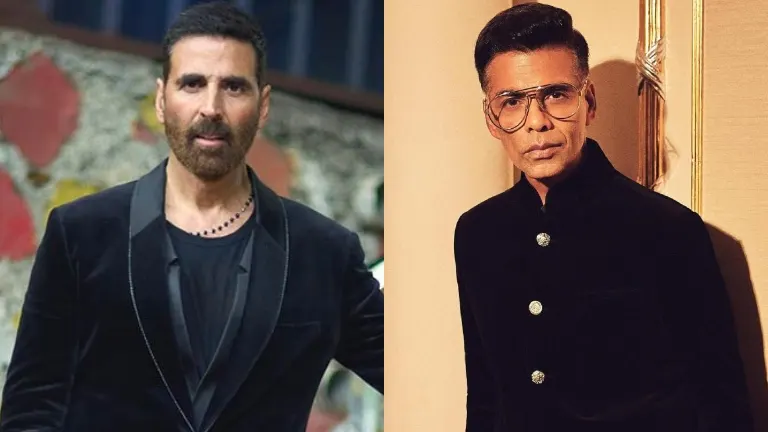
Akshay Kumar Takes A Dig At Lakshya Signing 3 Films With Karan Johar
Bollywood

Akshay Kumar Advices Newcomers To Stay Away From 3 Films Deals; Tells Karan Johar

by jummy84 October 13, 2025
written by jummy84

Akshay Kumar shared his insights on the challenges faced by newcomers in the film industry, particularly warning against signing three-film contracts early in their careers. He praised Aryan Khan’s directorial debut, The Ba***ds of Bollywood, for humorously highlighting these issues and bringing attention to the pitfalls that rookies should avoid.

Akshay Kumar Warns Newcomers Not To Sign 3 Films With One Producer

During his candid remarks, Akshay advised aspiring actors to be cautious and not to rush into long-term deals with producers. He specifically emphasised that new actors should steer clear of signing three-film contracts at the outset, as such commitments can sometimes backfire.

Referring to Aryan Khan’s The Ba***ds of Bollywood, Akshay stated, “I want to tell all the newcomers and upcoming talents—never sign a three-film deal with any producer.” He continued, “You must have seen The Ba*ds of Bollywood and seen what our hero had to go through. The film clearly shows what a debutant should and shouldn’t do.”

Turning his advice toward Karan Johar, Akshay added, “Don’t sign a three-movie deal. Give your debutants the freedom to explore. Let them run away if they want to. As the saying goes, ‘Let them be free, and if they belong to you, they will come back.’”

About Ba***ds Of Bollywood

Aryan Khan makes his directorial debut with The Ba***ds of Bollywood on Netflix. Produced by Gauri Khan under Red Chillies Entertainment, the series features an ensemble cast including Bobby Deol, Raghav Juyal, Sahher Bambba, Lakshya Lalwani, Anya Singh, Mona Singh, Manoj Pahwa, and Manish Chaudhari. Premiering on September 18, 2025, the seven-episode series has been praised for its performances, writing, and direction.

For more news and updates from the entertainment world, stay tuned to Bollywood Bubble.

Also Read: Shah Rukh, Aryan Khan Launch India’s FIRST Ever Secret Reel Partnership With Meta For Ba***ds Of Bollywood- Check Post

Akankshya Mukherjee

Akankshya Mukherjee is a dynamic and ambitious individual poised to make waves in the realm of Media and Communication. With a passion for creativity and a drive to contribute to forward-thinking organizations, Akankshya embodies adaptability and a hunger for learning. Having already garnered experience through involvement in various organizations, she has honed the skill of quickly adapting to new environments and challenges. She sees each opportunity as a chance for personal and professional growth, eagerly embracing roles in communications and content writing.

October 13, 2025 0 comments
0 FacebookTwitterPinterestEmail
'Love & Hip Hop: Atlanta' Star Kirk Frost Tells Son Kannon, "I Refuse to Be a Deadbeat Dad," Praises Wife Rasheeda for Standing by Him
Celebrity News

‘Love & Hip Hop: Atlanta’ Star Kirk Frost Tells Son Kannon, “I Refuse to Be a Deadbeat Dad,” Praises Wife Rasheeda for Standing by Him

by jummy84 October 12, 2025
written by jummy84

‘Love & Hip Hop: Atlanta’ Star Kirk Frost Tells Son Kannon, “I Refuse to Be a Deadbeat Dad,” Praises Wife Rasheeda for Standing by Him

Kirk Frost shared an emotional message to his son Kannon — the child he fathered outside his marriage to Rasheeda — writing, “I’m sorry… most women want me to be a deadbeat, not pay child support, not be in your life at all, but I don’t know how to do that.” ?
He also thanked Rasheeda for standing by him through what he called a “bad season” in their marriage, saying she’s helped ensure he remains a good father. ????


October 12, 2025 0 comments
0 FacebookTwitterPinterestEmail
Greil Marcus 2025
Music

Greil Marcus Tells His Stories About Others’ Stories » PopMatters

by jummy84 October 9, 2025
written by jummy84

Cultural critic Greil Marcus was at the vanguard of the first generation of rock critics—Nick Tosches, Jon Landau, Lester Bangs—when a record review could shape you as a person as if you were molten metal. At 23, Marcus began sending reviews to Rolling Stone in 1968, before becoming its first reviews editor. Afterwards, he wrote for Detroit-magazine, no-holds-barred, Creem.

Since then, Marcus has created an oeuvre that, in rock criticism, is daunting and unparalleled, which includes his seminal book, Mystery Train: Images of America in Rock ‘n’ Roll Music (1975), which contextualizes rock ‘n’ roll within the history of the United States: how, for example, the music of the Band encompassed Mark Twain, Herman Melville, and the American Civil War.

Greil Marcus went on to write other significant works: Lipstick Traces: A Secret History of the 20th Century (1989); Invisible Republic: Bob Dylan’s Basement Tapes (1997); and, more recently, Folk Music: A Bob Dylan Biography in Seven Songs (2022). His latest, What Nails It (2024), is part of Yale University Press’ series Why I Write, which PopMatters reviewed last year.

Also, Marcus’ work as an editor includes Stranded: Rock and Roll for a Desert Island (1979), an important early anthology of rock criticism; The Rose & the Briar: Death, Love and Liberty in the American Ballad (co-edited with American historian Sean Wilentz, 2005); and A New Literary History of America (with Harvard Professor of English and of African American Studies Werner Sollors, 2009).

PopMatters met Greil Marcus via Zoom to discuss the recent 50th anniversary edition of his groundbreaking text Mystery Train, as well as writing, music, the United States, Bob Dylan, Dock Boggs, and humor.

The Misery Behind Mystery Train

Mystery Train‘s 50th Anniversary Edition was recently published by Plume. A seminal text in Greil Marcus’ oeuvre, its creation was not as smooth a ride for him as it became for his readers.

Had you tested the ideas in Mystery Train in previous writings of yours, such as record reviews or essays?

Well, I didn’t try them out in the sense of writing about them. But all of that, as the book was originally published [Mystery Train], 50 years ago, came out of my time at the University of California, Berkeley, where I studied and later taught American Studies.

It was also influenced by the books I read at the time, the lectures I attended, and the classes I participated in. I learned about the Puritans, including John Winthrop, as well as Thomas Jefferson, Walt Whitman, Abraham Lincoln, Herman Melville, and Jonathan Edwards, among others. This really formed the template through which I was able to see contemporary performers—whether that was Elvis Presley, the Band, or Sly Stone—and get a sense of the vast terrain they were inhabiting, attempting to fill in their music or songs.

What were the roles they were acting out, I thought? So, it seemed to me they had real ancestors in American history. Now they have become ancestors themselves—see how many people who have followed in their footsteps.

Similar to Walt Whitman, looking toward future bards?

That’s right, fixing on Whitman is just perfect; he had such a sense that there were going to be armies of poets, following in his wake. He wanted that.

Would Mystery Train work if you changed one of the six artists who feature in the book?

I don’t know, because it’s not really an abstract question. I wrote the book; I wrote it when I wrote it, so I wrote about people whose work attracted me and that also seemed unsolved. That isn’t saying I solved it, just that there were open questions in their music. Why are people responding like this? Why do people seem to care so much? What’s special about the work of these people that makes them different from all the various performers around or before them?

Also, I felt like writing about people who, to me, hadn’t been written about well before. Obviously, a lot had been written about all these people, but I felt that it was all superficial, all gloss, all publicity. Nobody had really wrestled with their music. That is how I felt, anyway. Maybe that is a little egotistical, but that was my motive.

Does it strike you as young for having written Mystery Train in your late 20s?

No. I am the same person. I was writing the book. I was also married and a father.

Also, it was a wrenching, devastating, miserable experience writing that book. I don’t know how many times I thought, “I just could get in my car and drive off a cliff, and then I wouldn’t have to finish the book.” I felt like I would never be able to finish it. It was this enormous burden. I had never written a book before. I didn’t know how to do it.

I remember when I finished it—I finished it about two or three in the morning. It was the Band chapter. I fell asleep in the living room. My wife found me in the morning, fast asleep. I woke up, and I said, “I finished. It’s over.” And I meant it’s over. This horrible ordeal that I put myself, her, and the little girls through—it was over. I didn’t have to worry about it anymore; I didn’t care what anybody thought; I didn’t care about the reviews; I didn’t care about anything.

After that, it was in somebody else’s hands. I knew its weaknesses. I knew where the cheats were. I knew where I had fallen short. I was surprised by the reviews, which were positive and unquestioning. That was simply because no one had written about this subject on the level that I was trying to write about it on. That’s all.

Did writing other books get easier, then?

Easier in this sense: that I have written a book and finished it. I knew with other books that, ultimately, I would get there.

The next book I wrote was Lipstick Traces; Mystery Train took two years to write, and that took nine. Most of those years were spent writing. The research, interviews, and travel took about two years.

I remember saying to my wife at one point, when I was wrestling with the last 100 pages of Lipstick Traces, “I’ve been trapped in Paris in 1953 for three years and I don’t know how to get out.” She said, “Well, there are worse places to be.” That was tremendously liberating for her to say that.

Ultimately, I finished that book. Later, I wrote three books in one month each.

The first time was because I was asked to write a book while I was in the middle of writing something else. A publisher called me and said, “Did you know that next year will be the 40th anniversary of the release of ‘Like a Rolling Stone’?” I said, “No.” I mean, who thinks of 40th anniversaries? He said, “Well, it is. It is really going to be a big deal. We want to publish a book about that song, and we want you to write it.” I said, “Well, I am working on another book; I can’t write two books at once. So thank you very much.”

I told my wife about this. She said, “You didn’t tell them that it has been your favorite song since the first time that you heard it? That you have listened to it thousands of times?” “No, I didn’t tell them that.” She said, “Well, if you don’t write that book, someone else is going to write it, and that is going to make you very unhappy. I think you ought to call them back and figure out a way that you can write this book.”

So I came up with an absurd fantasy that I could take a month out of the other book, which was The Shape of Things to Come, and write this book on “Like a Rolling Stone”. It only has to be 35,000/40,000 words. I could conduct interviews, research, make notes, and think thoughts. Write the stuff.

I thought I could do it in a month, which is completely ludicrous. I called the guy back and I said, “I’d like to do it.” Then I did. I wrote it [Like a Rolling Stone: Bob Dylan at the Crossroads (2005)] in a month.

Greil Marcus’ Fascination with American Mythology

American flag guitar
Image: Bipul Kumar | AdobeStock

When reading Greil Marcus’ books, such as Mystery Train, one thing becomes clear: he deeply and compassionately cares about the United States; the country comes alive and dies and is reborn in a single paragraph. Like some great American thinkers, Marcus showcases his feelings of betrayal and love for the young country—a country founded upon an idea, which Americans, for better or worse, grapple with from the cradle to the grave.

This reverence Greil Marcus has for the United States sometimes—if not overtly—turns into sadness, a lament for never having fulfilled its promise to be a “city on a hill”, as John Winthrop declared in a sermon in 1630, a beacon of hope. Glimpses of its potential greatness have, ironically, come through, exposing its failings and acts of wantonness. This is heard in the songs of blues artists Son House and Skip James; country singer Buell Kazee; and folk artist Roscoe Holcomb. That is where Marcus takes his respite: the old-time religion of country blues.T

With the themes of American democracy and the American dream frequently appearing in your writings, I always thought Springsteen would make a perfect subject for you.

No. There is a way in which Bruce is so conscious of the kind of themes that I try to bring to bear in Mystery Train that he is a transparent figure. For me, the term “Mystery Train” really applies to everyone in the book; there is something elusive about where their music comes from, which is why their themes are so deep. It seems so different from the music of the people around them. I don’t get that sense of mystery in Bruce Springsteen’s work; it has many other qualities, but not that.

In your work, there is a breakdown between non-fiction and fiction. How important is the blurring of the two for writing about music?

That’s really endemic to criticism as such, as a mode of writing, as a mode of thinking. Here you’re writing about someone else’s work. You’re not writing a fictionalized autobiography. You’re not imagining characters out of whole cloth. You’re following someone else’s work and you’re trying to make sense of it. You’re trying to convey your enthusiasm, your disappointment, your shock, your gratification, whatever it might be.

You want to tell other people about this: ‘You gotta hear this. You gotta see this. Don’t go near it. It will reduce you as a human being.’ Whatever. It’s an argument you feel that you need to make.

It seems to me that, when you are doing this most intensely, you veer into fiction. That’s where you have to go. You have to tell a story to make sense of what you’re trying to see rather than to analyze or take it apart; no, you want a story that illuminates what you think is there. You’ve got to write your own story about someone else’s story.

I first found that in D. H. Lawrence’s Studies in Classic American Literature (1923). He’s a novelist; he has authority. He has an authority that most critics don’t have, and he brings that novelist’s ability to create new worlds in conversation with Herman Melville, Benjamin Franklin, whoever it might be in that book. You can find it in Pauline Kael‘s work, too.

You have a distinctive prose style. Did you try to emulate a writer in your early days?

No. I tried to emulate people in the sense that I liked to go as far as they did. I wondered how they did it. I don’t know how they got there, but I want to get there, too.

Some gave me ambition, but in terms of style, every writer has their own style. You learn to trust it. Sometimes you learn to rein it in. I have written sentences when I am using six em dashes. I thought, ‘You know, this is hard to follow. Maybe I should pull it back a little bit. Put a period here. It wouldn’t kill it.’

Some of the earliest cave paintings are called meanders. Usually, they are on the ceilings of caves, dating back 15,000 to 20,000 years ago. The people who made them were simply using their fingers for patterns on the ceilings of caves. The patterns are not random. They have direction. They reach a point where the story being told—trace lines—comes to an end, and another story begins. You can perceive this. So they’re not random. They’re not doodles. Yet they keep going.

I have some of that spirit in me when I want to keep going in a sentence. Not like the French, though [Marcus says with an impish smile].

When you are writing about something—a record, a book, or a movie, whatever, and addressing the invisible world out there, whoever might be reading you—it is because you think it will make their life bigger. It will show them something they’ve not seen before. You want to pass it on. You’ve received a gift; you want to pass it on.

You’ve Really Got to Listen

Lottery Shirley Jackson Bojack Horseman
Photo: Stock | Pixabay

Within our discussion, Greil Marcus’ unquenchable passion and intellectual acumen are infectious. He is the teacher that you wish you had; he has a mellifluous, Californian voice—perfect for lecturing. In fact, Marcus taught at the University of California, Berkeley, Princeton University, and the University of Minnesota. He is highly opinionated yet sensitive, intense yet light, precise yet loquacious. You wish you had experienced a front row seat to his classroom lectures.

In your book Folk Music, you point out that when Bob Dylan performs “No More Auction Block” in 1962, it serves as a powerful early manifestation of the quality that defines his music in its most uncanny moments throughout his life: empathy. I think this is an astute observation.

There’s nothing so brilliant about this insight; it’s simply listening to what Dylan says. About one point, he said, “I can see myself in others.” In “Positively 4th Street”, there is a lyric in which he sings, “I wish that for just one time you could stand inside my shoes / And just for that one moment I could be you.”

In other words, if you see through my eyes what I see when I see you. That is a very harsh song. And yet, there is love, connection, empathy. You’re a total loser. You’re a complete fraud. And I can look at you and feel how awful it must be to be that kind of person. So it is a cruel, put-down song, but it also has empathy at its core.

Sometimes, with any interesting artist, you pay attention to what they say; they will say, This is who I am. This is how I do it. So often people will say, ‘Oh, that’s so simplistic, he or she can’t really be telling us what we want to hear.’

Forget about what you want to hear; listen to what is there. I read Dylan saying that; it struck me as true. Then I began to hear it all through his work. It was magical to listen that way.

Was Lipstick Traces—which is partly about European art movements, such as Dadaism—a reaction against your previous book, Mystery Train, which is deeply embedded in the American experience?

No. It was an obsession that developed, and I tried to pursue that obsession as far as I could.

There is another thing too: everybody liked Mystery Train—it only got rave reviews. Like I said before, I knew, or it seemed to me, it wasn’t really as good as so many people thought. That there were problems with it. There were places where it fell short.

When I started writing Lipstick Traces, about a year or two into it, I thought, ‘you know, I’m writing a book that not everybody is going to like.’ That was very liberating because I didn’t care. As it is a tremendously long book, there was a point where finishing it was all that I cared about.

By the time I finished it, I was completely insulated from all the very bad reviews it got when it was published. Some of them were quite vicious. I didn’t care. I finished it. I spent nine years writing [Lipstick Traces]. It was published. It was the best that I could do. It went on, luckily, to live a life, despite the initial reactions.

Do you have a book of yours that you are most proud of?

Yeah. Lipstick Traces. I remember when I finished it, I thought, ‘This is the best that I can write.’ I will never write as well again.

I think that is probably true. Just the quality of the writing to me. Other people might not find it to be so well-written, but I know this is the best that I can do.

Then, Folk Music—I’m really proud of that book. I pursued or followed many lines as far as I could. You know, I spent 30 pages writing about different versions of the old folk song “Jim Jones”. It’s not really an obvious thing to do. I wanted to see if I could play out the string.

When you write with a sense of freedom, when you start with, ‘why would anyone want to read this? I am going to make a case so compelling that people have to read it.’ When you have that kind of ambition, that kind of energy, it becomes self-sustaining.

All the books that I have written, I remember the circumstances of writing them; some are gratifying, some are not. Some, you feel this is the best that I can do. Some, you feel like there is something off about this—it just doesn’t work, but I can’t fix it. There might be things wrong with it, but this is the best that I can do. I do not think that I dishonored the subjects.

He’s Got Dock Boggs in His Bones

Reading Greil Marcus for the first time was a revelation for me. It was his 1997 book, Invisible Republic, about Bob Dylan’s Basement Tapes. Marcus effectively bypasses the Basement Tapes to write about the Virginia old-time singer and banjo player Dock Boggs, who is resurrected so well that you can almost feel his breath on your neck; his otherworldly, quasi-yodeling voice from the very soul of Appalachia drives a stake through your heart.

Reading Marcus’ serpentine prose felt like an eternal return through a weightlessness in which life could come and go, and come again, and you, the reader, too, became a bigger part of this story, a hidden republic. Invisible Republic said: it did not matter who you were or about to become, if you never heard of Boggs, you were Boggs himself. You got lucky or lucked out, regardless of whether you’re young or old. In other words, Invisible Republic shows you a lot about yourself through the subconscious of the United States.

Did you think Invisible Republic—in which your famous coinage “old, weird America” derives from—was going to have such a cultural impact?

No. That book came out of the urge to write a book. I needed to write another book, but I didn’t have an idea or a subject.

Our oldest daughter’s then-boyfriend sent me a set of five CDs of basement tape bootlegs. Maybe 100 or 105 songs, including a lot I’ve never heard. A lot of fragments. A lot of unfinished pieces, along with unfinished songs that I had heard before, but also unfinished songs that nobody had heard.

I put those CDs in a little primitive car CD player while my wife and I drove to Montana, and back. When we got home, I said, ‘I could write a book about this stuff.’ There is so much in those fragments and songs.

I didn’t know what the book would be or what it would encompass. So I spent a couple of years working on that. I had a wonderful time doing it. It was play. I didn’t write it with the expectation that it would be a breakthrough, or that I would reveal things people didn’t know. It was just that I was having fun.

Had you listened to Dock Boggs before writing Invisible Republic?

I was listening to Dock Boggs for years, going back to probably 1970. After Altamont, which was the worst day of my life. Even before finding out somebody had been murdered at the concert while it was going on. Just the day, living through that violence, ugliness, selfishness, disrespect, mindlessness, god, it was awful. It was an ugly day.

After that, I didn’t want to listen to rock ‘n’ roll anymore. I spent a year listening to nothing but old country blues and pre-country music, such as Dock Boggs, which is really country blues; it just happens to have been made by a white man in the Virginia mountains in the 1920s. I listen to Dock Boggs over and over. He is part of my life, my whole frame of reference for what is good in the world.

When I was writing Invisible Republic, I wanted to write about Dock Boggs. I happened to meet Barry O’Connell [music researcher], who had spent years transcribing tapes of interviews that Mike Seeger [Pete Seeger‘s half-brother] had done with Dock Boggs. They were very long and elaborate, and often torturous interviews; they were less like interviews than two people spending time together, and one of them getting drunk and pouring out his heart to the other.

Barry told me about the work he had been doing. I told him how much I loved Dock Boggs, and he said, “Well, I will show you what I have done.”

So he gave me the transcripts of these conversations, then he gave me the actual tapes. Later, I became friends with Mike Seeger, who spoke about the circumstances of these conversations. Essentially, I had this unknown autobiography of Dock Boggs to accompany the music.

It was just shocking to listen to him. The things he said. The things he had done. The way he told his stories. It was another form of music. I have been listening to Dock Boggs for a long time, but through the interviews, I feel like I met Dock Boggs. He died in 1971, but in his music and interviews, he is present to me.

This was wonderful and really thrilling to write about it. I remember Nick Tosches writing in one of his books, I think it is in Where Dead Voices Gather (2001), about a conversation we had. ‘Greil was telling me about this book; he’s pretending it is about the Basement Tapes, but, really, it’s about Dock Boggs.’ He was right. In a way, I wrote Invisible Republic to have a nice framework so I could write about Dock Boggs.

Why did Dock Boggs, compared to Clarence Ashley or other old-time musicians, stand out to you?

Clarence Ashley‘s music is wonderful. Clarence Ashley is in Invisible Republic, too. So are many other musicians: Buell Kazee, and all the people you get to hear for the first time listening to Harry Smith’s Anthology of American Folk Music, which came out in 1952, and kind of snuck its way through culture over the decades, until people began to stumble upon it like I stumbled upon it in 1970. But there was something different about Dock Boggs. There was something bitter, unsatisfied, maligned, and self-loathing about his music.

In other words, this music did not explain itself. It said more than that: it said, you’re never going to understand. Well, that can be kind of alluring, if you have a certain cast of mind. I want to understand. I didn’t mean that I wanted to connect biographical details of his life to his music—I mean, I wanted to know how it feels to be so exiled from everyone else. To feel that nobody knows you. Nobody sees you. That is what I got from Dock Boggs. So it was a great mystery, not to try to solve, but to render on the page. That was what I was trying to do with Invisible Republic.

It seemed to me that Bob Dylan, who loved Dock Boggs, made that very clear. A lot of the Basement Tapes were saying, ‘I want to go as far as he went. I want to take someone as far as he took me.’ That seemed to me what part of the Basement Tapes were, and part of what was legitimate to write about.

Egoism Is a Funny Thing

Whereas Greil Marcus courts mystery—attracted and intrigued, content to keep it a mystery—Nick Tosches enters headfirst, wanting to unlock the enigma that is, say, Jerry Lee Lewis, and in so doing, he will come to understand a part of himself.

Marcus, on the other hand, walks through an invisible door—a metaphorical and metaphysical journey. He wrestles with what it means to be alive—weal and woe, joy and strife, pleasure and pain. He writes this process through his figures, whose voices are unheard, until, somehow, if it has been predestined or prewritten, their voices come alive from beyond the grave—and are heard with fresh ears. You could say, Greil Marcus resurrects the dead.

In 1993, Dylan explained to music writer Dave Marsh the difference between him and a later generation of musicians, such as Bruce Springsteen, “They weren’t there to see the end of the traditional people. But I was.” What are your thoughts?

To me, what he meant was that he saw Dock Boggs, Clarence Ashley, Skip James, Mississippi John Hurt, and Son House. He got the sense that these people had lived lives and learned things that, when they died, would go out of the world, would never be there anymore. It was going to be up to him to pass on what he had learned from them. His responsibility.

That is the egotism of the artist. ‘I have to do this. No one else can. It’s my burden. It’s my privilege. I’m the only translator. No one else understands who these people really were, but, somehow, I have to pass on whatever it is that I can.’ Dave Marsh said when these people die, something is going to go out of the world. It’s going to be gone. That’s a very sobering thought.

In your book, Bob Dylan by Greil Marcus: Writings 1968–2010, there is an essay entitled “Desolation Row”, in which you discuss how, when Dylan first performed “Desolation Row” live in 1965, the audience couldn’t stop laughing. In the piece, you compare the carnival-esque world of “Desolation Row” to Christ’s Entry into Brussels in 1889, by the Belgian painter James Ensor. What inspired the idea for the piece?

It was someone else’s idea. The Getty Foundation in Los Angeles acquired Christ’s Entry into Brussels in 1889, James Ensor’s huge mural painting, which is this horrible, vulgar commercial fare. The curator said, “This painting reminds me of ‘Desolation Row’; it is the same world: malevolent, threatening, dangerous, crazy, carnival-like. We would like you to write an essay about this and come down to give a lecture about it.”

It was such an odd assignment. I said, “Okay, I’ll do it.” So it was somebody else’s idea. It was not my idea; I just tried to play out the string. I grew fascinated with Ensor, and I spent a lot of time looking at his work, seeing the affinity for others that he had seen and shown in his art. I thought that this would be fun to write about and work with.

How important is humor in music writing?

You know, you have to bring a certain disrespect to criticism—a disrespect to the object of your attention, and a disrespect of yourself. In other words, if this isn’t fun, it isn’t worth doing. If it’s fun, you know some cruel and outrageous comment is going to occur to you, and you’d better put it in. Better not leave it out, ‘cause that is part of your response.

At the end of our conversation, I suggested that I see the influence of F. Scott Fitzgerald in Greil Marcus’ writing (the elegiac nature of his work, regarding the ever-present yet evanescent, almost graspable, American past). “I’m no Fitzgerald,” Marcus drolly responds, with a mischievous smile and a twinkle in his eye; his reverence for Fitzgerald too great to go there.

Greil Marcus might be no F. Scott Fitzgerald, but what he has achieved through his writings is to articulate how the United States has shaped the mythology of rock ‘n’ roll. Moreover, he has brought musicians to life through his prose, and in doing so, delineates how music can literally change the way you see them, yourself, and how you see the world.

Martin Scorsese once quipped, “Your job is to get your audience to care about your obsessions.” This is what it is like to read Greil Marcus: he makes you care about his subjects. Did I care about Dock Boggs before reading Invisible Republic? No. Before Invisible Republic, Dock Boggs was a stranger, a specter, a name without a soul. Now, Dock Boggs is like a remembered friend. When he opens his parched lips trying to keep death at bay in “Oh Death”—though knowing that it is a futile task—it is difficult not to weep: for the narrator, for Dock Boggs, and for humankind.

After our conversation has finished, it dawns upon me that, despite the disparate themes and meanderings of it, much like Greil Marcus’ sinuous prose, it has direction and form. The patterns of our conversation are not random.

October 9, 2025 0 comments
0 FacebookTwitterPinterestEmail
Zelda Williams Tells Fans to "Stop Sending AI Videos" of Her Father, Robin
Music

Zelda Williams Tells Fans to “Stop Sending AI Videos” of Her Father, Robin

by jummy84 October 7, 2025
written by jummy84

In the past, Zelda Williams has had no problem defending her father, the late, great Robin Williams. But after putting Eric Trump in his place back in 2020, the actress and director has a new target: AI.

In a series of Instagram Stories on Monday, Williams urged the internet to “stop sending me AI videos of dad.” She continued, saying she’s “seen way worse” from trolls and described the process as a “waste of time and energy,” adding, “Believe me, it’s not what he’d want.”

She went on to say that these same people are condensing people’s very lives and legacies simply so they can “churn out horrible TikTok slop puppetering.” Those videos, Williams added, can’t be considered art whatsoever but are rather “disgusting, over-processed hotdogs [sic]” made from people’s unrelated imagery/likenesses. In turn, online users are only inundated with this “slop” because some folks are “hoping they’ll give you a little thumbs up.”

She went on to say that these same people are reducing entire lives and legacies just to “churn out horrible TikTok slop puppeteering.” Those videos, Williams added, can’t be considered art whatsoever but are rather “disgusting, over-processed hotdogs [sic]” made from people’s unrelated imagery/likenesses. In turn, online users are only flooded with this “slop” because some folks are “hoping they’ll give you a little thumbs up.”

Related Video

As if that wasn’t enough, Zelda Williams delivered this undeniable truth bomb: AI isn’t “the future,” it’s simply “recycling and regurgitating the past.” And for the grand finale, she threw in a conversation-ending haymaker:

“You are taking in The Human Centipede of content, and from the very end of the line, all while the folks at the front laugh and laugh, consume and consume.”

If we could for a moment, GOTDAMN.

But more seriously, even a tertiary glance at TikTok and similar platforms will reveal dozens and dozens of AI-generated Robin Williams videos/clips. None of them are worth linking to or referencing directly, but all of them are guilty of either infringing on various IP and trademarks as well as being generally obtuse regarding the ideas and opinions of a man they’d never known let alone ever met. It’s painful as fans of Williams to see his image be needlessly manipulated, especially when the work he left beyond already checked so many boxes in terms of emotional content and genre offerings.

Zelda Williams previously struck back at AI during 2023’s SAG-AFTRA strike. In response to people at the time having already used Robin Williams’ voice for various AI-generated media, Zelda said that while she found that “personally disturbing…the ramifications go far beyond my own feelings.” She went on to declare that “living actors deserve a chance to create characters with their choices.”

Check out screen grabs of her IG stories below.

October 7, 2025 0 comments
0 FacebookTwitterPinterestEmail
Newer Posts
Older Posts

Social Connect

Facebook Twitter Instagram Pinterest Youtube Snapchat

Recent Posts

  • 2009 feels like a whole other world away

  • Watch Ariana Grande and Jimmy Fallon Perform a History of Duets

  • Spotify’s Joe Hadley Talks ARIA Awards Partnership

  • Nick Offerman Announces 2026 “Big Woodchuck” Book Tour Dates

  • Snapped: Above & Beyond (A Photo Essay)

Newsletter

Subscribe my Newsletter for new blog posts, tips & new photos. Let's stay updated!

Categories

  • Bollywood (1,929)
  • Celebrity News (2,000)
  • Events (267)
  • Fashion (1,605)
  • Hollywood (1,020)
  • Lifestyle (890)
  • Music (2,002)
  • TV & Streaming (1,857)

Recent Posts

  • Shushu/Tong Shanghai Fall 2026 Collection

  • Here’s What Model Taylor Hill Is Buying Now

  • Julietta Is Hiring An Assistant Office Coordinator In Dumbo, Brooklyn, NY (In-Office)

Editors’ Picks

  • 2009 feels like a whole other world away

  • Watch Ariana Grande and Jimmy Fallon Perform a History of Duets

  • Spotify’s Joe Hadley Talks ARIA Awards Partnership

Latest Style

  • ‘Steal This Story, Please’ Review: Amy Goodman Documentary

  • Hulu Passes on La LA Anthony, Kim Kardashian Pilot ‘Group Chat’

  • Hannah Einbinder Slams AI Creators As “Losers”

  • Facebook
  • Twitter

@2020 - celebpeek. Designed and Developed by Pro


Back To Top
celebpeek
  • Home
  • Bollywood
  • Hollywood
  • Lifestyle
  • Fashion
celebpeek
  • Music
  • Celebrity News
  • Events
  • TV & Streaming