celebpeek
  • Home
  • Bollywood
  • Hollywood
  • Lifestyle
  • Fashion
celebpeek
  • Music
  • Celebrity News
  • Events
  • TV & Streaming
Home » Resistance
Tag:

Resistance

Neurologist explains why resistance training is important for all ages: ‘Keeps bones dense, reduces fracture risk…’
Lifestyle

Neurologist explains why resistance training is important for all ages: ‘Keeps bones dense, reduces fracture risk…’

by jummy84 November 14, 2025
written by jummy84

Bone density naturally declines as we age, but the good news is that regular exercise can slow this process and protect you from serious injuries later in life. If you’ve been putting off strength training, consider this your sign – your stability, balance, and overall strength depend on it. Simple, consistent resistance work can make the difference between fragile bones and a resilient, healthy body as you grow older.

According to Dr Bing, resistance training is important for everyone. (Unsplash)

Also Read | Neurologist warns against these 3 simple habits that can damage your brain: ‘Wearing headphones to bed leads to…’

Dr Bing, a neurologist, biostatistician, brain-health advocate, and health content creator, has explained why resistance training is essential at every age to maintain strong, healthy bones and muscles. In an Instagram video shared on November 12, the neurologist explains how lack of exercise weakens bones and makes them susceptible to fractures, and emphasises how resistance training helps build strength, stability, and long-term bone health.

Why is resistance training important?

Dr Bing highlights the importance of regular exercise, especially resistance training, for optimal bone health, no matter what age you are. He narrates the story of one of his patients – “I recently saw a patient in her 70s who came in after a simple fall at home. She tripped on a step, didn’t even fall from a height and she broke her femur and also suffered a brain bleed from hitting her head and then she had seizures from that. She was then found to have osteoporosis which is when your bones become weaker and more brittle.”

He notes that, unfortunately, cases like this are quite common because of a lack of physical activity. If we fail to challenge our muscles, our bones lose strength, and the balance and stability that naturally wane with age deteriorate even more quickly. The neurologist stresses the importance of resistance training and explains, “But why is resistance training particularly important? Well, because it loads the skeleton and stimulates your bone growth and it signals your body to keep your bones dense and that would drastically reduce hip and femur fracture risk.”

Dr Bing highlights the importance of resistance training.(Image generated via ChatGPT)

What happens when you skip resistance training?

Dr Bing emphasises, “If you don’t do resistance training in your lower body or your core, you won’t have strong quads, glutes, and core. And your body would have a hard time stabilising itself when you trip. And weak muscles mean that you have slower protective reactions as well. And you can’t catch yourself in time if you fall.”

The neurologist clarifies that you don’t need to be an Olympic-level weightlifter or squat 200 pounds. The key is routine muscle engagement – resistance bands, your own body weight, light dumbbells, or anything that makes your muscles work against some resistance.

Note to readers: This article is for informational purposes only and not a substitute for professional medical advice. It is based on user-generated content from social media. HT.com has not independently verified the claims and does not endorse them.
November 14, 2025 0 comments
0 FacebookTwitterPinterestEmail
Grenada’s Carnival is Full of African History, Resistance, and the Some of the World’s Best Parties
Music

Grenada’s Carnival is Full of African History, Resistance, and the Some of the World’s Best Parties

by jummy84 August 23, 2025
written by jummy84

The night after J’ouvert, the pinnacle of Grenada’s annual carnival, I cried and cried. All over the Caribbean and throughout its diaspora, the consecutive days of reverie known as carnival or mas are traditions rooted in African ancestral connection and resistance to colonization and slavery. This weekend, Londoners will celebrate Notting Hill Carnival, a multi-cultural evocation of Caribbean heritage maintained by their large West Indian immigrant community. On Labor Day, New Yorkers will do the same in Brooklyn. At a distance, the staunch political history of carnival can be easy to overlook on Instagram feeds full of beautiful Black people clad in feathers and rhinestones or neon paint and charcoal. But on the ground for Grenada’s carnival – dubbed Spicemas for the island’s trove of nutmeg, mace, cloves, and cinnamon – that legacy of rebellion is inescapable. 

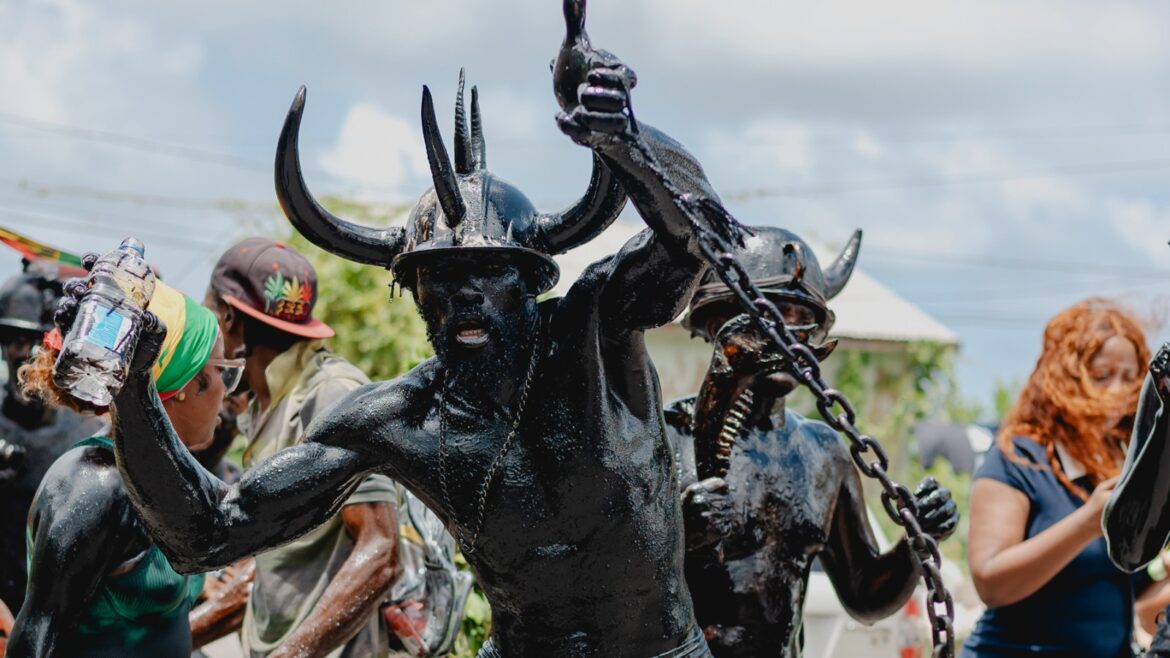
By 3:30 AM J’ouvert morning – a time named for the French colonizers’ term for dawn – I was up, slipping on some basketball shorts and a sports bra that I knew could be tossed out. I wrapped my shower-capped hair in a long black scarf that could go too. For J’ouvert, Grenadians “play”  – in the customary nomenclature – Jab Jab, a centuries old tradition of blackening their skin with molasses and tar (or, more recently, motor oil or sustainable charcoal oil), donning horned helmets, and parading to their distinct sub-genre of soca music. Post-emancipation, it became a satirical take on the way white masters saw Black folks – as subhuman and grotesque – and reflect the horrors of slavery back to them. The term Jab Jab itself comes from the French term for devil. Though Grenada’s Jab Jab is distinct, it’s a ritual that spans the West Indies, where Caribbeans marched to say, “You think I’m a Black demon? I’ll show you a Black demon.” 

When my travel group of journalists and influencers – sponsored by the Grenada Tourism Authority and its media partners – made it to the busy downtown streets just before sunrise, the roads were flush with youth throwing flames into the air with lighters and cans of bug spray and dragging chains like the ones that tethered their ancestors to ships across the Middle Passage. They jumped and moshed to dark, intense soca from the local stars of the season, especially the riotous “Bury All” by Lil Kerry. Some toted hyperrealistic props of bloody octopus tentacles in their mouths. There were a few Scream masks. As night grew to day, I saw the age range widen – elders danced joyfully in their black paint, a father doused his school-aged sons in oil as they splashed and played. I let random men pour their tubs of motor oil on me. I danced and marched for miles. I had never felt so free, so powerful, or so connected in a sea of strangers.  So, that night, after bathing in the crystal blue ocean with sand and dish soap alongside hundreds of others (and two more showers), I wept in the bed of my Sandals suite.

Editor’s picks

Some tears were of pain. About 11 percent of Africans brought to Grenada as slaves between 1669 and 1808 are believed to have been Sierra Leonean, like my parents, whose direct lineage avoided the ships by grace alone. Many Grenadians are believed to be descendants of our own Temne tribe. I cried for those stolen from Sierra Leone and for the colonial shambles the country is still in. I cried for everything my family has continued to endure there. There were also tears of pride for all the resilience around me – my immigrant mother’s resolution to thrive, my dead grandmothers’ resolution to love, and the Grenadian resolution to carry Jab Jab traditions from African coasts to Caribbean plantations to the very city streets I walked so brazenly that day. I cried because with every video I WhatsApped my mom of Grenada’s rolling hills, bright architecture, national dishes, skilled drummers, and limber dancers, she messaged back, “This might as well be Sierra Leone.” Grenada’s Spicemas felt more African than I could have ever imagined. As the world shrinks for Africans, with growing travel to places like Lagos, Accra, Johannesburg, and Cape Town, carnival in Grenada strikes me as a necessary diasporic destination, too. 

Related Content

“We want people to come to experience our culture and to do so respectfully,” says Fiona Compton, founder of Know Your Caribbean, an educational platform for West Indian culture and history with nearly half a million Instagram followers. Compton is the daughter of St. Lucia’s first Prime Minister, Sir John Compton. She began obsessively studying Caribbean archives after seeing reductive representation of her people as a college student in London. “Take the initiative to come and to learn why it is we do what we do, so that way the culture will not become a parody of ourselves,” Compton warns potential visitors. “People realize you put on the horns to remind people of the evils of what we come from. We’re not here to just perform and just be some pretty characters,” she says, nodding to the popular Fancy Mas traditions of Carnival Tuesday, which can be an expensive outing of bejeweled body suits, elaborate feathered wings, professional make-up, and endless rum and food. It’s important as a deeply carnal celebration of freedom, and like J’ouvert, it too serves a real purpose. “We are here to go into something that’s deeply spiritual.”

You can hear the Grenadian reverence for their traditions in the very songs that soundtrack carnival, blasted from 16-wheeler sound systems. One of the tenants of Spicemas is Soca Monarch, a competition at the national stadium where local artists perform songs made specifically for the season in massive productions. “Culturally, my island full of history,” sings L.E.D. on the song he competed with, “Viral Again.” “So happy to my neighbor/My neighbor happy to see me/Nobody here is strangers/One big family/We serving one creator/And we play mas tremendously.” It rides the same riddim, or beat, as Muddy’s “Payroll,” which earned him the Soca Monarch title. “Payroll” is absolutely electric, with a moving music video of he and a crew playing Jab Jab like an army. “When stars align/Greatness outshines all hatred in space and time,” Muddy chants in the song’s stirring first moments. “And still we rise/With grace and with faith in the morning, with chains and oil.”

While I spent Spicemas in the capital of Saint George’s, where there are the most populous gatherings, Jab Jab musician, historian, and preservationist Ian Charles tells me there’s a distinct authenticity to J’ouvert in the more rural parishes where massive plantations once dominated. “If you’re looking for hardcore, pristine cultural drums on the road, no big music trucks, you got to go up to Saint Andrew and Saint Patrick,” he says. While the jab music of Soca Monarch is digitized and modern, like Afrobeats, in its traditional form, Grenadian jab soca consists of a three-hand-drum system – one for bass, one for melody, and one called a “kupai,” akin to the French word for “to cut.” Jab Jab players use the goat-skin dùndún drum of Nigerian, Yoruba lineage and the Malian djembe drum. The drum patterns, says Charles, are not far off from that of genres like Fuji and Juju. On top of these rhythms, there’s call and response storytelling, and the blows of a conch shell. 

All these elements, Charles and Compton explain, were inherited from Africa. “The drum was used for lots of things,” says Compton. “It’s conjuring spirits, it’s sending secret messages, and it was inciting the spirit of rebellion. In my research, looking at many of the rebellions of enslaved people across the Caribbean, the drum was always used in a ceremony just before. Now, people hear the drum and we cannot help but start moving. It lights up something inside of us.” Because of the revolts, Compton says, drumming and African spiritual practices were eventually criminalized in the colonies. As Black instruments were confiscated and burned, the new Caribbeans would abandon their plantations to perform secret rites in the forests, or remake their tools entirely. “That’s how the invention of steel pan [drumming] happened,” Compton says as an aside. “Because all forms of African percussion were made illegal in Trinidad well into the 1930s, so Trinidadians decided to rebel against that. Trinidad has oil, so they had all of the surplus of oil drums. They were saying, ‘We’re not going to adhere to these laws; we’re going to create a whole new style of music.’”

One of the moments that moved me most was seeing a massive Ghanaian flag waving majestically in the Soca Monarch crowd as I watched from a suite high above the stadium at first. Throughout carnival, there are flags everywhere – people swing them above their heads, tie them to their waists, and hoist them high from poles. There are all kinds of flags too – mostly Caribbean, but I later met a queer Hondouran with their flag, and spotted a few Nigerians too. Yet, Soca Monarch was my first night of Spicemas, and I immediately felt at home. My family played so much soca at our parties that as a child, I assumed it was African music. Seeing a West African flag so prominently and so seamlessly signaled to me I was somewhere I belonged. I happened to run into the Ghanaian crew with the towering Black Star at Fancy Mas, and bolted to them. We embraced like old friends. One of them is a neurosurgeon where I live. Another told me they always travel the world as a group, and Spicemas felt like somewhere they belonged, too.

Querine Salandy for Chambers Media Solutions

Dr. Shantel George, an Afro-Caribbean history scholar at the University of Glasgow, found that  at the heights of the slave trade in Grenada, between 1669 and 1808, 33 percent of captives came from ports at the Bight of Biafra, representing tribes we now think of as Nigerian, like the Igbo. Another 21 percent came from the Gold Coast, likely people from present-day Ghana and Burkina Faso. Fourteen percent came from what was known as the Windward Coast; today, Ivory Coast and Liberia. Eleven percent came from West-Central Africa, incorporating folks from the Kongo kingdom and modern Gabon. Another five percent were likely of the Mandingo, Bambara, Malinke, Wolof, and Fulbe tribes of the Senegambia port, and the last portion were thought to be of the Bight of Benin, kidnapped from places in modern Benin and Lagos, Nigeria. 

Trending Stories

Once in Grenada as a hodgepodge of stolen people, they reformed themselves into new ethnic groups and developed a tradition called Nation Dance, weekly spectacles where these emerging families represented themselves. “Nation Dance exemplifies the ways in which peoples were able to resist racial slavery through the formation of new diasporic identities and relationships which drew on their African experiences,” George cites. They elected kings and queens in masquerades like the ones of Spicemas now. I say all this to say that while Spicemas is distinctly Grenadian, it is also very African, and proudly so. It’s worth seeing for yourself. 

Made in Africa is a monthly column by Rolling Stone staff writer Mankaprr Conteh that celebrates and interrogates the lives, concerns, and innovations of cultural workers of the African diaspora from their vantage point. Check out our Made in Africa playlist, updated with the hottest Jab Jab songs from Spicemas.

August 23, 2025 0 comments
0 FacebookTwitterPinterestEmail

Social Connect

Facebook Twitter Instagram Pinterest Youtube Snapchat

Recent Posts

  • 2009 feels like a whole other world away

  • Watch Ariana Grande and Jimmy Fallon Perform a History of Duets

  • Spotify’s Joe Hadley Talks ARIA Awards Partnership

  • Nick Offerman Announces 2026 “Big Woodchuck” Book Tour Dates

  • Snapped: Above & Beyond (A Photo Essay)

Newsletter

Subscribe my Newsletter for new blog posts, tips & new photos. Let's stay updated!

Categories

  • Bollywood (1,929)
  • Celebrity News (2,000)
  • Events (267)
  • Fashion (1,605)
  • Hollywood (1,020)
  • Lifestyle (890)
  • Music (2,002)
  • TV & Streaming (1,857)

Recent Posts

  • Shushu/Tong Shanghai Fall 2026 Collection

  • Here’s What Model Taylor Hill Is Buying Now

  • Julietta Is Hiring An Assistant Office Coordinator In Dumbo, Brooklyn, NY (In-Office)

Editors’ Picks

  • 2009 feels like a whole other world away

  • Watch Ariana Grande and Jimmy Fallon Perform a History of Duets

  • Spotify’s Joe Hadley Talks ARIA Awards Partnership

Latest Style

  • ‘Steal This Story, Please’ Review: Amy Goodman Documentary

  • Hulu Passes on La LA Anthony, Kim Kardashian Pilot ‘Group Chat’

  • Hannah Einbinder Slams AI Creators As “Losers”

  • Facebook
  • Twitter

@2020 - celebpeek. Designed and Developed by Pro


Back To Top
celebpeek
  • Home
  • Bollywood
  • Hollywood
  • Lifestyle
  • Fashion
celebpeek
  • Music
  • Celebrity News
  • Events
  • TV & Streaming