celebpeek
  • Home
  • Bollywood
  • Hollywood
  • Lifestyle
  • Fashion
celebpeek
  • Music
  • Celebrity News
  • Events
  • TV & Streaming
Home » Nobel
Tag:

Nobel

Was Donald Trump Nominated for the 2025 Nobel Peace Prize? – Hollywood Life
Celebrity News

Was Donald Trump Nominated for the 2025 Nobel Peace Prize? – Hollywood Life

by jummy84 October 11, 2025
written by jummy84

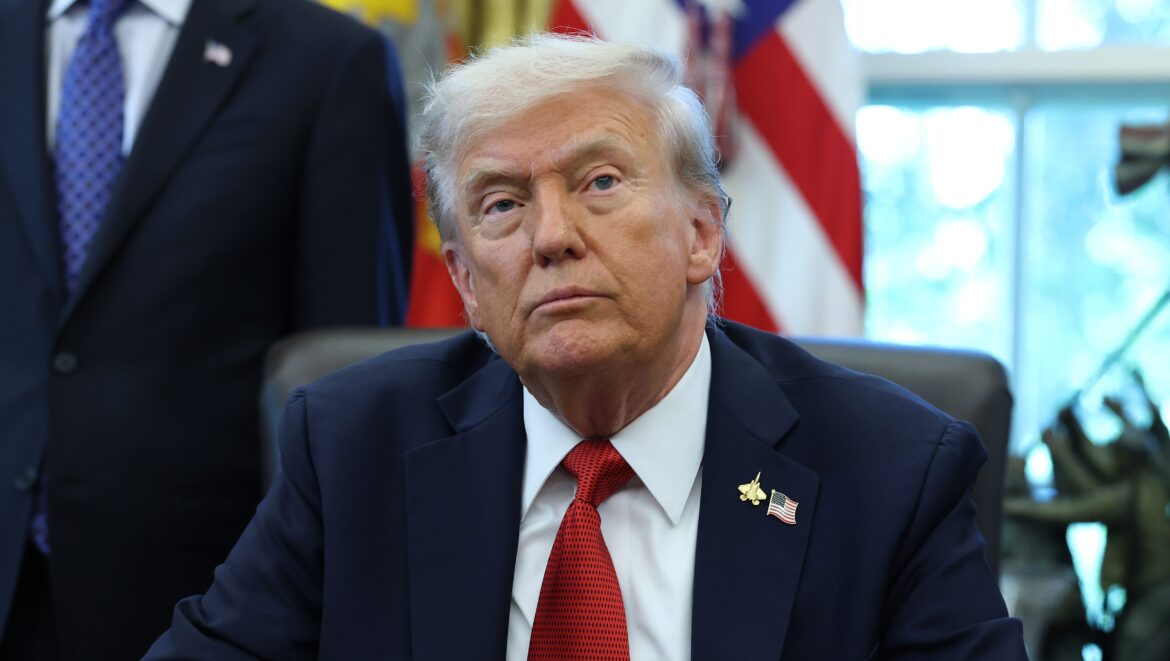
Image Credit: Getty Images

Donald Trump has made headlines over the years for his desire to take home the highly coveted Nobel Peace Prize, but he hasn’t been awarded it. The 2025 prize winner is Venezuelan politician and opposition leader María Corina Machado. Amid her win, some are wondering if Trump was even nominated for the Nobel Peace Prize this year.

Find out what we know about the selection process for the prize below.

Who Won the 2025 Nobel Peace Prize?

Venezuelan politician María Corina Machado won the 2025 Nobel Peace Prize for her “tireless work promoting democratic rights for the people of Venezuela and for her struggle to achieve a just and peaceful transition from dictatorship to democracy,” the Norwegian Nobel Committee said in its October 2025 announcement.

“Maria Corina Machado meets all three criteria stated in Alfred Nobel’s will for the selection of a Peace Prize laureate,” the committee continued “She has brought her country’s opposition together. She has never wavered in resisting the militarization of Venezuelan society. She has been steadfast in her support for a peaceful transition to democracy.”

BREAKING NEWS
The Norwegian Nobel Committee has decided to award the 2025 #NobelPeacePrize to Maria Corina Machado for her tireless work promoting democratic rights for the people of Venezuela and for her struggle to achieve a just and peaceful transition from dictatorship to… pic.twitter.com/Zgth8KNJk9

— The Nobel Prize (@NobelPrize) October 10, 2025

In response to Machado’s win, White House Communications Director Steven Cheung accused the Norwegian Nobel Committee of placing “politics over peace” in their decision.

“President Trump will continue making peace deals, ending wars, and saving lives,” Cheung tweeted. “He has the heart of a humanitarian, and there will never be anyone like him who can move mountains with the sheer force of his will. The Nobel Committee proved they place politics over peace.” 

President Trump will continue making peace deals, ending wars, and saving lives.

He has the heart of a humanitarian, and there will never be anyone like him who can move mountains with the sheer force of his will.

The Nobel Committee proved they place politics over peace. https://t.co/dwCEWjE0GE

— Steven Cheung (@StevenCheung47) October 10, 2025

How Does Anyone Win the Nobel Peace Prize?

The Norwegian Nobel Committee is responsible for voting. The nomination of a candidate is only acceptable when it’s submitted by a person that meets specific criteria. The necessary criteria includes members of national assemblies and governments, university professors, others who have been awarded with the prize and current and former members of the committee, according to the committee’s website.

Was Trump Nominated for the Nobel Peace Prize?

There is no way of knowing whether or not Trump was nominated for the 2025 Nobel Peace Prize because the Norwegian Nobel Committee “does not confirm the names of nominees, neither to the media nor to the candidates themselves.” The list of nominees is released 50 years after the prize is awarded.

The committee revealed that there were 338 nominees for the 2025 Nobel Peace Prize, of which were 244 individuals and 94 were organizations.

Trump’s rumored nomination has been a major topic over the years. His 2016 presidential opponent, Hillary Clinton, said she’d nominate the Republican for the Nobel Peace Prize if he could end the war in Ukraine without granting Russia any territory.

“If we could pull that off, if President Trump were the architect of that, I’d nominate him for a Nobel Peace Prize, because my goal here is to not allow capitulation to Putin, aided and abetted by the United States,” Clinton said on the “Raging Moderates” podcast in August 2025. “I’m dreaming that for whatever combination of reasons, including the elusive Nobel Peace Prize, President Trump may actually stand up to [Russian President Vladimir] Putin on behalf of not just Ukraine and its democracy and its very brave people, but frankly, on behalf of our own security and interests.’
October 11, 2025 0 comments
0 FacebookTwitterPinterestEmail
How Nobel laureates uncovered the body’s immune watchdogs
Lifestyle

How Nobel laureates uncovered the body’s immune watchdogs

by jummy84 October 7, 2025
written by jummy84

Our immune system is so powerful that it can sometimes attack parts of our body itself, leading to autoimmune disorders. Today, it is well known that the body has a regulatory mechanism, called peripheral immune tolerance, that prevents the immune system from going overboard, but it took a long journey spanning decades before scientists deciphered how that works.

PREMIUM
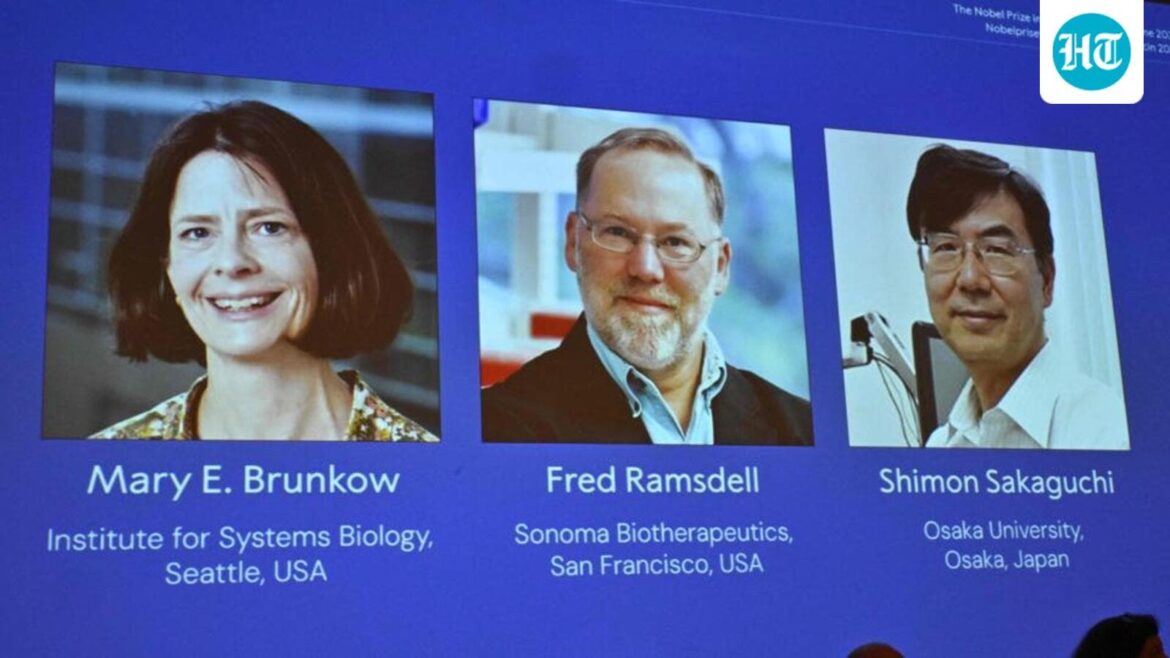
The portraits of Mary E Brunkow, Fred Ramsdell and Shimon Sakaguchi displayed during a press conference where the winners of the 2025 Nobel Prize in Physiology or Medicine were announced at the Karolinska Institute in Stockholm, Sweden. (AFP)

The Nobel Prize for Medicine, announced on Monday, honours three scientists who made pioneering discoveries along that journey. Shimon Shakaguchi, currently with Osaka University, discovered regulatory T cells, the watchdogs that help prevent the immune system from attacking the body. Independently, Mary E Brunkow (Institute for Systems Biology, Seattle) and Frederick J Ramsdell (Sonoma Biotherapeutics, San Francisco) identified a gene which, if mutated, could lead to autoimmune disease. Later, Shakaguchi completed the jigsaw by establishing that the same gene controls the development of regulatory T cells.

Cue from Oppenheimer

For the Nobel laureates, the journey began in the 1980s with Shakaguchi’s discovery, and was furthered in the 1990s-2000s by Brunkow and Ramsdell’s work. But the seeds were laid even farther back — in the 1940s, during the Manhattan Project led by Robert J Oppenheimer.

Researchers developing the atomic bomb were studying the consequences of radiation on mice. They found some male mice were born with scaly skin, an extremely enlarged spleen and lymph glands; these lived for just a few weeks.

Since only male mice are affected, it was obvious that the X chromosome must be diseased. A female has two X chromosomes, so if one is defective, the healthy one compensates for it, but she can pass on the mutation to males in future generations.

Five decades later, Brunkow and Ramsdell investigated this mouse strain, named “scurfy”. Then working at a Washington-based biotech company, Celltech Chiroscience, they guessed the scurfy mice could provide clues to pharmaceuticals for autoimmune diseases.

Investigations showed the mice’s organs were being attacked by T cells — something was causing the immune system to go rogue. Brunkow and Ramsdell searched for the mutant gene, a painstaking task in those days when whole genomes were not available. It took them years before they identified the faulty gene, which they named FOXP3.

This had implications for human health. A rare autoimmune disease that affects boys, called IPEX, is also linked to the X chromosome. By mapping gene samples, the researchers established that IPEX is the human equivalent of mice’s scurfy disease; mutations in the same FOXP3 gene cause both diseases.

All this implied that the FOXP3 gene could be important in the work of regulatory T cells, discovered by Sakaguchi earlier. Two years later, it was Sakaguchi again who established that this was indeed the case.

Finding the mechanism

Before the concept of regulatory T cells was established, scientists had proposed a population of cells named “suppressor” T cells, which they suggested prevented over-the-top immunity. But the idea changed over the last 30 years, said Srini V Kaveri, Director of Research (Emeritus) at Centre de Recherche des Cordeliers (CNRS), Paris.

“The precise mechanisms accounting for these suppressive effects were not clearly defined at the molecular and biochemical level. That was because the real cells which carried the suppressor function were not isolated with specific markers. Furthermore, as the findings could not be reproduced at cellular levels, the area began to fade, and the suppressor cells were discredited,” Kaveri told HT.

It was known, however, that the organ key to T cell development is the thymus (hence T) in the upper chest. This would imply that removing the thymus should inhibit T cell activity. In the 1980s, Sakaguchi’s colleagues found something quite contrary: when they removed the thymus from three-day-old mice, the immune system went into overdrive and the mice developed autoimmune disease.

Next, Sakaguchi isolated T cells from healthy mice and injected them into mice without a thymus. This time, there appeared to be T cells that could protect the mice from autoimmune diseases. It took him a decade of work before he identified the driver — regulatory T cells, characterised by the proteins CD4 and CD25.

Decades later, Sakaguchi added more insight to the work he had begun. After Brunkow and Ramsdell identified the FOXP3 gene, Sakaguchi and other researchers proved that this gene controls the development of regulatory T cells. These cells not only prevent other T cells from attacking the body, but also ensure that the immune system calms down after it has eliminated an invader.

Why it matters

Today, a lot is understood about how regulatory T cells (Tregs) work, spurring the development of newer treatments.

“Tregs inhibit the growth and multiplication of harmful cells and can also inhibit the deleterious cytokine production by pathogenic T cells. In addition to harmful T cells, Tregs can target several other cell types, including antigen presenting cells (APCs). Elucidating the effect of Tregs on APCs is of great importance for the understanding of the pathogenesis of autoimmune and inflammatory diseases. We in our lab in Paris, made one of the first and extremely important observations that Tregs can modulate the functions of APCs,” Kaveri said.

Sometimes, regulatory T cells can be a hindrance. Tumours can attract large numbers of regulatory T cells that shield them from the immune system. Researchers are trying to find ways to dismantle this wall so that the immune system can access the tumours.

In autoimmune diseases, on the other hand, researchers are trying to find ways to promote the formation of regulatory T cells. Researchers are also trying to isolate regulatory T cells from a patient, multiply them in a laboratory and return them to the patient, thus giving them more regulatory T cells.

“Dreadful autoimmune diseases cortisones can now be tackled in a specific manner. In our lab in Paris, we have described an approach by which we can expand the Tregs in patients with autoimmune and inflammatory diseases,” Kaveri said.

“Treatments of several diseases relying exclusively on transplantation which were major challenges are now within reach… All this has been possible thanks to a finer understanding of the mechanisms of peripheral tolerance. Although Tregs are not the only actors of peripheral tolerance, at this time, they somehow occupy centerstage,” he said.

October 7, 2025 0 comments
0 FacebookTwitterPinterestEmail

Social Connect

Facebook Twitter Instagram Pinterest Youtube Snapchat

Recent Posts

  • 2009 feels like a whole other world away

  • Watch Ariana Grande and Jimmy Fallon Perform a History of Duets

  • Spotify’s Joe Hadley Talks ARIA Awards Partnership

  • Nick Offerman Announces 2026 “Big Woodchuck” Book Tour Dates

  • Snapped: Above & Beyond (A Photo Essay)

Newsletter

Subscribe my Newsletter for new blog posts, tips & new photos. Let's stay updated!

Categories

  • Bollywood (1,929)
  • Celebrity News (2,000)
  • Events (267)
  • Fashion (1,605)
  • Hollywood (1,020)
  • Lifestyle (890)
  • Music (2,002)
  • TV & Streaming (1,857)

Recent Posts

  • Shushu/Tong Shanghai Fall 2026 Collection

  • Here’s What Model Taylor Hill Is Buying Now

  • Julietta Is Hiring An Assistant Office Coordinator In Dumbo, Brooklyn, NY (In-Office)

Editors’ Picks

  • 2009 feels like a whole other world away

  • Watch Ariana Grande and Jimmy Fallon Perform a History of Duets

  • Spotify’s Joe Hadley Talks ARIA Awards Partnership

Latest Style

  • ‘Steal This Story, Please’ Review: Amy Goodman Documentary

  • Hulu Passes on La LA Anthony, Kim Kardashian Pilot ‘Group Chat’

  • Hannah Einbinder Slams AI Creators As “Losers”

  • Facebook
  • Twitter

@2020 - celebpeek. Designed and Developed by Pro


Back To Top
celebpeek
  • Home
  • Bollywood
  • Hollywood
  • Lifestyle
  • Fashion
celebpeek
  • Music
  • Celebrity News
  • Events
  • TV & Streaming