celebpeek
  • Home
  • Bollywood
  • Hollywood
  • Lifestyle
  • Fashion
celebpeek
  • Music
  • Celebrity News
  • Events
  • TV & Streaming
Home » VistaVision
Tag:

VistaVision

Why Yorgos Lanthimos Shot VistaVision in Basement Set Film
TV & Streaming

Why Yorgos Lanthimos Shot VistaVision in Basement Set Film

by jummy84 November 1, 2025
written by jummy84

In “Bugonia,” after Teddy (Jesse Plemons) kidnaps Michelle (Emma Stone), a large percentage of the movie takes place inside the conspiracy-obsessed kidnapper’s house. Specifically, his basement, where he goes to extreme lengths to get what he wants from the powerful, cunning CEO he’s holding captive.

While a guest on this week’s episode of the Filmmaker Toolkit podcast, director Yorgos Lanthimos discussed why the limitations of the basement setting were cinematically necessary.

“Films build microcosms, and those can be of varying sizes, and this is one of the smaller ones. That creates a lot of tension and allows you to scrutinize the situation,” said Lanthimos. “It’s like looking through a microscope a little bit, if you limit things, if you go further and deeper and closer, [you ask as a viewer], ‘What is there?’ And especially if there’s an explosive dynamic, you’re so close, it’s amplified.”

'The Love That Remains' ('Ástin Sem Eftir Er')

Working within restricted space, Lanthimos felt the need to go big with the filmmaking, both with supervising sound editor/re-recording mixer Johnnie Burn’s sound design and composer Jerskin Fendrix’s music, which is by far the biggest score in the score-adverse director’s career.

“I just felt that the juxtaposition of a really big soundtrack would be interesting,” said Lanthimos. “There’s a lot of big themes and a lot of big feelings, so I wanted that to be represented in an extreme way in the soundtrack and music and sound design. It’s a similar reason that we ended up shooting the film on VistaVision.”

That’s right, “One Battle After Another” and “The Brutalist” aren’t the only two recent films that breathed life back into the once-dead large-format and barely functioning VistaVision cameras that had spent decades on the shelf. But unlike Lathimos, Paul Thomas Anderson and Brady Corbet reached for the VistaVision to lend a big-screen grandeur to what were the directors’ most expansive and epic films to date.

While on the podcast, Lanthimos recognized how counterintuitive it was shooting his smallest (spatial speaking) film on the largest possible negative, but said that after using VistaVision to shoot the reanimation scene in “Poor Things,” the director and his cinematographer Robbie Ryan knew the format would be perfect to frame his “Bugonia” characters. “It was all about these characters, it was all about this very intense environment, photographing them in a large format, making their portraits bigger than life in a way, just added this necessary layer to express all these big ideas and feelings.”

Aesthetically, Lanthimos preferred the VistaVision over the more well-established and less cumbersome 65mm film cameras — the images weren’t as wide (he wanted “boxier”), and the tonality, depth, and richness of the image appealed to his and Ryan’s sensibilities.

“After ‘Poor Things,’ we kept thinking about the images, and Robbie [kept] asking around about the VistaVision cameras,” said Lanthimos.

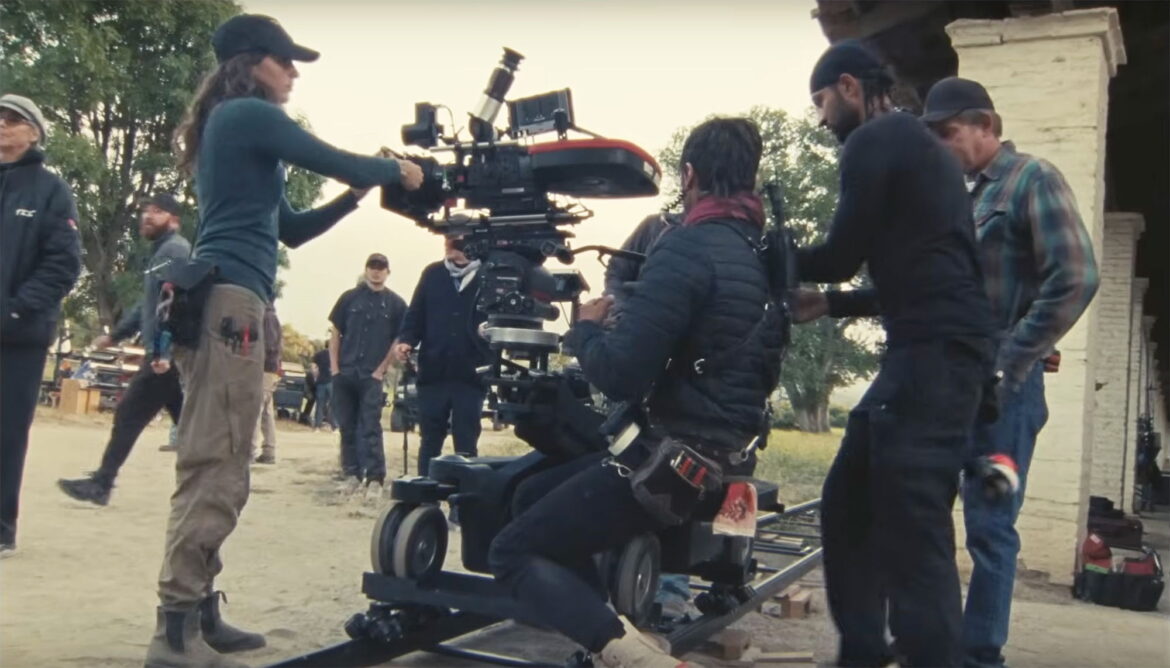
On “Poor Things,” they had only been able to use VistaVision on the non-dialogue reanimation scene because the old cameras were too loud to record sync sound. Afterwards, the persistent Ryan eventually tracked down a quieter Wilcam 11 VistaVision camera.

“We discovered this one camera that exists in the world, that’s functioning, which is quieter than those cameras, but it’s huge, and temperamental, and very difficult to load, and it takes a lot of time,” said Lanthimos.

BUGONIA, from left: director Yorgos Lanthimos, cinematographer Robbie Ryan, Emma Stone, on set, 2025. ph: Atsushi Nishijima / ©Focus Features / Courtesy Everett Collection
Yorgos Lanthimos, cinematographer Robbie Ryan, Emma Stone, and the Wilcam 11 on the ‘Bugonia’ set©Focus Features/Courtesy Everett Collection

The descriptor of the Wilcam 11 as “functioning” is up for debate, as it created constant problems on the “Bugonia” set. “One Battle After Another” cinematographer Michael Bauman told IndieWire the quieter WilCam 11 was so cumbersome and temperamental (completely failing during some camera tests according to camera operator Colin Anderson), PTA deemed it “unreliable” during the testing phase. On “One Battle” they went with the louder VistaVision camera, switching to Super 35mm for interior shots where the camera was in very close proximity to the actors delivering dialogue, and testing ways to eliminate “the extremely” loud camera noise in post-production when the camera was at a certain distance or outdoors.

Lanthimos expressed “surprise” that the dialogue-heavy “One Battle” got away with the noisier camera, before acknowledging how unique his film’s needs were. “I guess we had a lot of scenes in a basement, a very enclosed space — the sound of a camera that loud was really problematic for us. We couldn’t get the camera many feet away, in order to try and dump down the sound a little bit. And so for us, there wasn’t any other solution. And in the end, it kind of became an advantage. We embraced it, we went with it, and it just became a restriction in a way that makes you more creative.”

To hear Yorgos Lanthimos’s full interview, subscribe to the Filmmaker Toolkit podcast on Apple, Spotify, or your favorite podcast platform.
November 1, 2025 0 comments
0 FacebookTwitterPinterestEmail
How to Watch 'One Battle After Another' in VistaVision
TV & Streaming

How to Watch ‘One Battle After Another’ in VistaVision

by jummy84 September 18, 2025
written by jummy84

When the rise of television threatened movie attendance in the 1950s, Hollywood responded by introducing several new exhibition formats designed to bring people back to theaters with the promise of widescreen images and stereophonic sound. CinemaScope, Cinerama, and VistaVision were just a few of these processes, which dazzled audiences and yielded films like “The Robe,” “The Bridge on the River Kwai,” and “Around the World in 80 Days,” attracting customers in droves.

Now, as exhibitors struggle with the rise of streaming and declining theater attendance, one of America’s greatest living filmmakers has revived one of the greatest of all widescreen formats, giving today’s audiences the same reason to get off their couches that Alfred Hitchcock, Michael Curtiz, and other premier directors of their era gave in the 1950s. The glorious return of VistaVision began last year when Brady Corbet shot “The Brutalist” in the format and exhibited the film in several venues in 70mm, a gauge that approximates VistaVision’s high resolution — but that was only the beginning.

'Arco'

Now, director Paul Thomas Anderson has not only filmed but is releasing “One Battle After Another” in VistaVision, with a handful of venues projecting the movie in a format that hasn’t been seen by audiences of a new release film since Marlon Brando’s “One-Eyed Jacks” in 1961. (Lucky viewers at this year’s TCM Film Festival did get to see revivals of “We’re No Angels” and “Gunfight at the O.K. Corral” in true VistaVision.)

Why is that important? And what does it mean for audiences, filmmakers, and projectionists? Let’s break it down.

What made VistaVision special compared to rival formats like CinemaScope was its larger negative — around twice the size of a typical 35mm film frame, as the film was run through the camera horizontally rather than vertically. As Margaret Bodde, who works with Martin Scorsese’s Film Foundation, told IndieWire, “With CinemaScope, you have a four-perf negative. VistaVision is eight-perf, so you’re doubling the size of the image. It just has a superior image quality.”

In spite of that superior quality, VistaVision ultimately became more or less obsolete for feature film production, though it continued to be used extensively for special effects work on blockbusters like the original “Star Wars,” “Back to the Future,” and “Jurassic Park.” “One Battle After Another” was shot using a combination of VistaVision and Super 35, and will be released in no fewer than seven formats. This has led to intense excitement among cinephiles — and no small amount of misinformation.

In one example, a fan-created graphic recently took off on social media and led to widespread confusion over aspect ratios of the various exhibition formats. (Among other things, it incorrectly stated that the movie would be released in a 2.20:1 aspect ratio in 70mm.) To clarify what formats “One Battle After Another” will be presented in, their technical specs, and where to see them, IndieWire reached out to the source: Paul Thomas Anderson.

Anderson referred us to three members of his post-production team: editor Andy Jurgensen, post-production supervisor Erica Frauman, and associate editor Jay Trautman, all of whom dealt with the complexities of VistaVision and the movie’s varied release prints throughout the post-production process. Together, they addressed several important questions related to the different ways you can watch “One Battle After Another” when it opens in theaters on September 26.

The below interview condenses and combines responses from Jurgensen, Frauman, and Trautman on the specifics of formats for seeing “One Battle After Another.”

What Are the Release Formats for “One Battle After Another,” Their Aspect Ratios, and Sound Specs?

Screenshot

What Aspect Ratio Was the Movie Originally Shot in?

The film was shot using a combination of VistaVision (8-perf) and Super 35 (4-perf) formats. (“Perf” referring to the perforations that run alongside or — depending on the format — above and below the image so that the celluloid can be pulled through the projector.) Both offer a tall enough negative to accommodate the full IMAX 1.43:1 aspect ratio, though the image can be cropped top and bottom to fit the 1.90:1 IMAX or standard 1.85:1 aspect ratios. Camera operator Colin Anderson used ground glass marked with framelines for both 1.85:1 and 1.43:1 compositions to ensure flexibility in framing.

When the opportunity for special VistaVision screenings arose, Paul Thomas Anderson chose to present the film in the full 1.50:1 VistaVision frame, an aspect ratio very close to IMAX’s 1.43:1. The 5-perf 70mm version is presented in 1.85:1, pillarboxed within a 2.20:1 frame, while standard DCPs are also formatted in 1.85:1.

How Do the Different Release Formats Complicate the Post Process?

We often say that each release format offers its own unique experience of the film. In the photochemical world, it’s impossible to make all formats look exactly the same!

Because the film was shot with both VistaVision and Super 35mm cameras, we had to navigate not only multiple release formats but also multiple capture formats. If we were using the digital intermediate process that nearly every modern film uses, we would just scan all of the negative and resize it in a computer. However, we cut and splice the camera negative and print photochemically. This means that we had to figure out how to create the VistaVision negative from our Super 35mm shots and our digital visual effects. We started testing these processes over two years ago. In the end, FotoKem configured both an optical printer and a digital film recorder specifically for VistaVision, allowing us to create all the necessary elements to assemble a complete VistaVision negative and produce a VistaVision release print.

Does Paul Thomas Anderson Have a Preferred Format?

Paul has noted that the VistaVision presentation is the closest to the film’s intended look, as it’s struck directly from the VistaVision cut negative. There are only four of these special screening venues currently scheduled — in Los Angeles, New York, Boston, and London.

That said, we always knew there would be an IMAX release, so from the beginning, the 1.43:1 and 1.90:1 IMAX presentations (both film and digital) were intended to be the most immersive. This is the first narrative feature film to be presented entirely in IMAX’s 1.43:1 aspect ratio (with no jumping between aspect ratios). The 70mm (5-perf) version is an optical blow-up from the VistaVision-cut negative. It has slightly more grain and contrast, and its 1.85:1 aspect ratio matches the non-IMAX DCP presentations.

What Does It Really Mean to Capture and Project in True VistaVision?

Unlike traditional 35mm film, which runs vertically through the camera gate, VistaVision uses a horizontal feed. This allows the image to be recorded on a frame that is twice the size of a standard 4-perf 35mm frame, resulting in a finer-grained negative with improved image quality.

Just like the cameras, VistaVision projectors must also run the film horizontally. Very few of these projectors still exist today. According to VistaVision expert Charlotte Barker, “It’s been exactly 70 years since VistaVision projectors were first installed for commercial use, debuting with Paramount’s ‘Strategic Air Command’ in 1955. Back then, seven U.S. theaters were outfitted with VistaVision projectors, custom 2-foot-deep curvilinear screens, and special aperture plates. ‘One Battle After Another’ will echo this historic rollout next week at The Vista in Los Angeles, Regal Union Square 17 in New York, Coolidge Corner Theater in Boston, and Odeon Leicester Square in London.”

Warner Bros. refurbished two Ballantyne VistaVision projectors for use in Los Angeles and New York; Barry Wright (Bell Theatre Services) refreshed their VistaVision projector in London. Boston Light & Sound had previously refurbished two projectors supplied by the George Eastman Museum for the TCM Festival in April of 2025; these will be used in Boston. Each Ballantyne projector is equipped with DTS readers to synchronize audio and fitted with custom-built platters capable of running the entire two-hour, 40-minute film on a single reel. The Boston location will utilize two projectors and play reel-to-reel. Projectionists at each location are receiving specialized training to operate the equipment.

Projecting in VistaVision allows prints made directly from the original cut negative to be shown to an audience. This hasn’t been possible for over 60 years. Historically, footage shot on VistaVision had to be converted to another format for exhibition. As far as we know, this is the first new release feature film to be projected from true VistaVision prints since “One-Eyed Jacks” in 1961.

Where Can We See the Movie Projected on Film?

See the below listings across select cities when “One Battle After Another” opens starting September 26.

VISTAVISION ENGAGEMENTS

Los Angeles, CA, USA — Vista Theater
New York, NY, USA — Regal Union Square 17
Boston, MA, USA — Coolidge Corner Theater
London, England, UK — Odeon Leicester Square

IMAX 70MM (15-PERF) ENGAGEMENTS

Dallas, TX, USA — Webb Chapel IMAX
Fort Lauderdale, FL, USA — AutoNation IMAX
Indianapolis, IN, USA — Indiana State Museum
Irvine, CA, USA — Regal Edwards Irvine Spectrum 21
London, England, UK — BFI IMAX
New York, NY, USA — AMC Lincoln Square 13
San Francisco, CA, USA — AMC Metreon 16
Tempe, AZ, USA — Harkins Arizona Mills 18
Universal City, CA, USA — AMC Universal Citywalk 19
Woodbridge, Ontario, Canada — Cineplex Vaughan IMAX

70MM (5-PERF) ENGAGEMENTS

Atlanta, GA, USA — Plaza
Austin, TX, USA — Alamo Drafthouse South Lamar
Berlin, Germany — Delphi
Berlin, Germany — Zoo
Chicago, IL, USA — Music Box
Copenhagen, Denmark — Denmark Imperial
Dublin, Ireland — Irish Film Institute
Melbourne, Australia — Palace
Milwaukee, WI, USA — Oriental
New Orleans, LA, USA — Prytania
New York, NY, USA — Alamo Drafthouse Downtown Brooklyn
New York, NY, USA — Angelika Cinema 1, 2, 3
New York, NY, USA — Angelika Village East 7
Oakland, CA, USA — Grand Lake
Portland, OR, USA — Hollywood
San Francisco, CA, USA — Alamo Drafthouse New Mission
Silver Spring, MD, USA — AFI Silver
Somerville, MA, USA — Somerville
Sydney, Australia — Ritz
Vancouver, BC, Canada — Park

Paul Thomas Anderson’s “One Battle After Another” opens in theaters on September 26. Special thanks to Benjamin Tucker for his assistance with this article.

September 18, 2025 0 comments
0 FacebookTwitterPinterestEmail
New VistaVision Featurette for PTA's 'One Battle After Another' Movie
Hollywood

New VistaVision Featurette for PTA’s ‘One Battle After Another’ Movie

by jummy84 September 4, 2025
written by jummy84

New VistaVision Featurette for PTA’s ‘One Battle After Another’ Movie

by Alex Billington
September 3, 2025
Source: YouTube

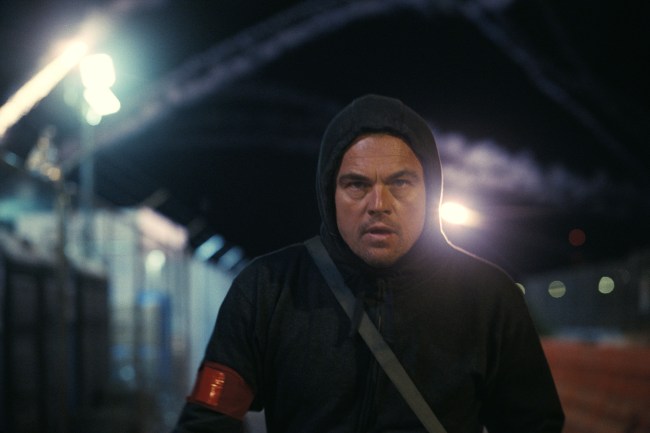
“You’re going to wonder ‘why does it look like that?’ And the answer is: because of this beautiful, beautiful format.” Warner Bros has debuted a new promo featurette for Paul Thomas Anderson’s One Battle After Another movie – his action thriller about revolutionaries. This is hitting theaters nationwide in September in only a few more weeks. This exciting new PTA movie is about a father trying to find his daughter who has been arrested (rewatch the first official trailer). When their evil nemesis resurfaces after 16 years, a band of ex-revolutionaries reunite again to rescue the daughter of one of their own. Starring Leonardo DiCaprio as Bob Ferguson, plus Regina Hall, Sean Penn, Alana Haim, Teyana Taylor, Wood Harris, Benicio del Toro as “Sensei”, Shayna McHayle, and Chase Infiniti as his daughter. This quick video focuses on the VistaVision format that they filmed this in – a special 35mm film format originally invented in the 1950s (more info here). The Brutalist was also shot on VistaVision, then upgraded for projection onto 70mm film last year. The same with this movie! PTA’s big new exiting One Battle After Another is landing in theaters soon with special screenings on film in select cities (tickets here). This should be a great time! Watch below.

Here’s the VistaVision featurette for Paul Thomas Anderson’s One Battle After Another, via YouTube:

One Battle After Another Featurette

One Battle After Another Tickets

You can rewatch the first teaser for PTA’s One Battle After Another right here and second full trailer here.

Inspired by Thomas Pynchon’s postmodern 1990 novel Vineland. When their evil enemy resurfaces after 16 years, a group of ex-revolutionaries reunites to rescue one of their own’s daughter. One Battle After Another, formerly known as The Battle of Baktan Cross or Desert Highway or BC Project, is written and directed by the acclaimed American filmmaker Paul Thomas Anderson, director of the films Hard Eight, Boogie Nights, Magnolia, Punch-Drunk Love, There Will Be Blood, The Master, Inherent Vice, Phantom Thread, and Licorice Pizza previously, as well as a few shorts, music videos, and other projects. Produced by Sara Murphy, Adam Somner, and Paul Thomas Anderson. This might premiere at a film festival coming up this summer, but nothing has been announced yet. Warner Bros will debut PTA’s One Battle After Another in theaters nationwide starting September 26th, 2025 coming up soon. Who’s down to watch this movie?

Share

Find more posts in: Featurette, Hype, To Watch, Trailer

September 4, 2025 0 comments
0 FacebookTwitterPinterestEmail

Social Connect

Facebook Twitter Instagram Pinterest Youtube Snapchat

Recent Posts

  • 2009 feels like a whole other world away

  • Watch Ariana Grande and Jimmy Fallon Perform a History of Duets

  • Spotify’s Joe Hadley Talks ARIA Awards Partnership

  • Nick Offerman Announces 2026 “Big Woodchuck” Book Tour Dates

  • Snapped: Above & Beyond (A Photo Essay)

Newsletter

Subscribe my Newsletter for new blog posts, tips & new photos. Let's stay updated!

Categories

  • Bollywood (1,929)
  • Celebrity News (2,000)
  • Events (267)
  • Fashion (1,605)
  • Hollywood (1,020)
  • Lifestyle (890)
  • Music (2,002)
  • TV & Streaming (1,857)

Recent Posts

  • Shushu/Tong Shanghai Fall 2026 Collection

  • Here’s What Model Taylor Hill Is Buying Now

  • Julietta Is Hiring An Assistant Office Coordinator In Dumbo, Brooklyn, NY (In-Office)

Editors’ Picks

  • 2009 feels like a whole other world away

  • Watch Ariana Grande and Jimmy Fallon Perform a History of Duets

  • Spotify’s Joe Hadley Talks ARIA Awards Partnership

Latest Style

  • ‘Steal This Story, Please’ Review: Amy Goodman Documentary

  • Hulu Passes on La LA Anthony, Kim Kardashian Pilot ‘Group Chat’

  • Hannah Einbinder Slams AI Creators As “Losers”

  • Facebook
  • Twitter

@2020 - celebpeek. Designed and Developed by Pro


Back To Top
celebpeek
  • Home
  • Bollywood
  • Hollywood
  • Lifestyle
  • Fashion
celebpeek
  • Music
  • Celebrity News
  • Events
  • TV & Streaming