celebpeek
  • Home
  • Bollywood
  • Hollywood
  • Lifestyle
  • Fashion
celebpeek
  • Music
  • Celebrity News
  • Events
  • TV & Streaming
Home » Toro
Tag:

Toro

Guillermo del Toro, Oscar Isaac Talk 'Frankenstein' with Patti Smith
TV & Streaming

Guillermo del Toro, Oscar Isaac Talk ‘Frankenstein’ with Patti Smith

by jummy84 December 13, 2025
written by jummy84

Guillermo del Toro has never met a Q&A he doesn’t like. More than most, he enjoys sharing his enthusiasm with moviegoers and smart interlocutors like poet-musician-author Patti Smith (her latest memoir, “Bread of Angels,” is in bookstores). Oscar Isaac joined them for a lively conversation about the awards contender “Frankenstein,” which is currently streaming on Netflix. Watch the video exclusively above.

Here’s the December 2 New York Q&A, edited for brevity and clarity.

Patti Smith: In the early 50s, when I was a child, I saw, as we all did, James Whale’s “Frankenstein” and “The Bride of Frankenstein” and was greatly beguiled and saddened. But when I read, as you did, “The Modern Prometheus” by Mary Shelley, I saw that there was a whole world of imagination and thought processes and the evolution of the creature. And [I] wish that James Whale was still alive and would do another one. But we didn’t need him, because you came along and you gave us really something so much more akin that merged your sensibilities with Mary Shelley’s. Give us a little bit of you as a child. What world of books? I know how it happened to me. I want to hear about you.

Models show walk up stairs at the 2007 Oscar Fashion Preview at the Academy of Motion Pictures Arts and Sciences on January 30, 2007 in Los Angeles, California.

Guillermo del Toro: I was weird. I was extremely thin. I’m not joking. I used to button my shirt all the way up, and had a bowl haircut. I was like a Rutger Hauer son. almost albino, very pale. And in 1969, my father won the National Lottery, and he became a millionaire, and he bought a house, and somebody told him that he needed a library, because he was now a cultured gentleman. So he bought a huge library, which he never visited, and I read everything in there.

I read an encyclopedia of art that made me know as much about painting or sculpture as I would have a comic book artist: Jack Kirby or Monet or Manet or Renoir, they were all mixing in my imagination. I read an encyclopedia of health that made me the youngest hypochondriac in history. I stayed and read. And that was part of the disappointment. “This child is not well.” They sent me to a psychologist, and he gave me clay and said, “Could you do something with this?” And I did a skeleton. It didn’t go well.

Patti Smith: I’ve seen this movie now three times, on a little screen, on the airplane, on a bigger screen… One thing that always intrigues me is Victor Frankenstein’s body language. It’s almost like an artless choreography that becomes art. You’re always in motion. You make everything seem almost like a dance. It gives the film almost an operatic sensibility. I wanted to ask you about your body language, if that was a choice.

Oscar Isaac: It was very much in the conversation with Guillermo. The camera never stops moving. It’s always moving, and so often I’m moving in counterpoint to the camera. It always felt very musical. The whole thing, that first scene, when he’s in the medical conference, it feels very much like an aria. There were times when I was filming it where I was expecting people to start singing; the sets were so operatic as well. And a lot of the movement came from Kate Hawley’s incredible costumes.

Patti Smith: You can see the fabric, like in your shirts, and the threads.

FRANKENSTEIN, Jacob Elordi as The Monster, 2025. ph: Ken Woroner / © Netflix / courtesy Everett Collection
‘Frankenstein’©Netflix/Courtesy Everett Collection

Oscar Isaac: There was a lot of pleasure in wearing those little black high-heeled boots and running up and down the stairs in those plaid pants and the things that she would put me in, that crazy robe. It also came a lot from Guillermo. He’s a fucking superhero of pain (laughs) and darkness and hilarity and absurdity. And so, we became completely linked and synchronized, for better or worse.

Guillermo del Toro: We’re still trying to shake it off.

Oscar Isaac: The movement was like a symbiosis that happens.

Patti Smith: The creature, like you and Jacob — that’s like ballet movement. Then, when you’re giving the exhibition to the courtroom, it’s a different sweeping, and then you take Elizabeth in your arms and a different kind of sweeping, the whole thing, your body language is fantastic.

Guillermo del Toro: We actually designed the wardrobe to look like ’60s London, like he would be coming out with The Rolling Stones or Jimi Hendrix. We wanted him to feel like a rock star.

Oscar Isaac: Yeah, you talked about, especially that scene, that you wanted that swagger, to command that, the flowing shirts. But even using that cape is almost like a matador, yeah, it’s expressive, heightened.

Guillermo del Toro: And a lot of hips.

FRANKENSTEIN. (L to R) Mia Goth as Elizabeth and Oscar Isaac as Victor Frankenstein in Frankenstein. Cr. Ken Woroner/Netflix © 2025.
‘Frankenstein’Ken Woroner/Netflix

Patti Smith: You’re right about the sets. They’re so majestic. You should do [the opera] “Parsifal,” the holy fool. Just throw out Wagner’s “Parsifal,” do some of it!

Guillermo del Toro: Like a Mexican “Parsifal.” Well, we tried to design as if it was an opera, the big Medusa, the minimal elements that are around everything. I always say there’s no eye candy in my movies. There’s high protein, because we’re telling the story. I can take you through the shapes and the colors, precisely why we designed them like that, but we wanted to make it as a novel, as epistolary. And one of the things that Gothic romance does is have a story within a story within a story. So I wanted to have self-contained color and camera language and shape language in each of the points of view, and if I made the fabric of the main characters, we wove. We didn’t buy it. We made it. We hand-embroidered it, we printed it, we dyed it, everything. We created rolls of fabric because all the language and the clothes is from nature, like Elizabeth has natural patterns from minerals, from butterfly wings. Her shawls are X-rays. Victor has the embroidered circulatory system. The vest had that. And we wanted to create this world of natural anatomical fields, and we repeat the patterns of the sets on the clothes, etc.

It’s impossibly rich, all those things. And even with the movement, again, to talk about it, starting in this vital place, alive with movement. And slowly calcifying as he gets more angry and more regret[ful]. And then he becomes more creature-like, even with those costumes and the prosthetic leg, as the creature becomes more human. So even those two are rising in opposite ways.

Patti Smith: I was so in love with that ship. I love all the Antarctic explorers and Shackleton.

Oscar Isaac: Imagine rolling up to the Netflix studio, and there’s a fully-sized ship, like the huge, actual-size ship, on gimbals in the parking lot. That was one of the first things that I saw when I arrived.

Patti Smith: It looks like these glass pictures, found in Antarctica. It almost made me feel nauseous, in a good way.

Guillermo del Toro: My producing partner felt nauseous when I said, “We’re building it for real,” but I was making a point that it should be a handcrafted movie by humans, for humans. There’s something that happens when 90 percent of what you’re seeing has a physical component. Yes, we built a ship. When he moves the ship, it’s on motors, and he’s moving the ship with all the sailors on top. When you see the ship, every shot you see is a real ship. We covered the parking lot with ice. We came up with a method to sandwich translucent solids on the icebergs. And we were inspired mainly by Caspar David Frederick, the glass plates from Shackleton, whatever has been found undocumented. We went to the places in Scotland, the UK. We shot in real locations. And we built full-size sets.

Patti Smith: How you worked is the same process as Victor, because when he’s making the sinews of [the creature’s] fingers and all the details of how he’s putting them together and stripping the other bodies, it’s all by hand. It’s a metaphor for your work.

Oscar Isaac: What’s beautiful is that, as opposed to it being this horror scene, it’s lit so beautifully. There’s this beautiful waltz playing, it’s him at his most calm and peaceful.

Guillermo del Toro: He’s happy.

Oscar Isaac: Yeah, that’s what he knows how to do, make his creature…It’s fast, it’s passion, it’s heightened. This isn’t naturalism. We watched movies, different films, to find the tone of it. Oliver Reed was somebody that we watched; what a complicated, huge, magnetic, and scary person. And Pedro Infante, we watched these 1930s Mexican films. We spoke a lot in the words of telenovelas. [Guillermo] would say, “I need you to give me the Maria Cristina. Come on.” We spoke in Spanish the entire time to each other. For me, it is the mother tongue. My mother spoke to me only in Spanish, even though I grew up here since I was a year old. But there was something about speaking that way, that unlocked a mode of unconscious expression, and giving over to that kind of unbridled expression.

Patti Smith: Of the female characters, like Ofelia [“Pan’s Labyrinth”], who I love so much, and Elisa [“The Shape of Water”], and now Elizabeth, and they all give themselves. They all feel empathy with something that everyone else would be frightened of or repelled by, they’re all drawn. And I wrote my notes, “Who are you in all these films?” I think you’re the little girls. You have that eternal young girl longing for a pure love, and they all find it even in death.

FRANKENSTEIN, from left: Mia Goth, Oscar Isaac as Victor Frankenstein, 2025. ph: Ken Woroner / © Netflix /Courtesy Everett Collection
‘Frankenstein’©Netflix/Courtesy Everett Collection

Guillermo del Toro: The Catholic part is to suffer. But there is a pristine way of looking at life in all its ups and downs. And if you don’t look for perfection, if you look for imperfection, but necessarily, you can either accept or let go. That’s about it. And both are in the lexicon of existing. Elizabeth is the only modern character [in “Frankenstein”] and the only character that is not alone. It’s about loneliness so much, and then for a moment, a brief moment, [she and the creature] are together. The creature and Victor are always in the mirror together because they’re part of one single soul, which is what fatherhood and being a child is. You don’t realize it’s a soul that has been split in two, but Elizabeth and the creature are an emptiness split in two, and they attract each other because they feel that they both were broken in the same way. The tone visually has to be of a piece with the tone of the actors. When you think of Jimmy Cagney or Oliver Reed, they’re not naturalistic, but they’re real.

I like the heightened sensation that you’re in a movie, you’re not in the real world. But all that goes to hell if Elizabeth looks at the creature and she sees makeup. She has to see it like a real soul. So, every time they were together, I would shoot them at 36 frames. So I would be able to slow down when she enters with the dress, it floats, and when she’s looking at him, I speed it up to 18 frames so her face is vibrating. And when she’s looking at him, all these little things that you learn through 30 years of craft are invisible, but her performance being real is the key, the performance of Victor and the creature has to be real. Their arc starts in opposites. Victor finishes his life’s work the night the creature starts his life. And also, he’s so heartbreaking; they’re never going to see eye to eye. He basically becomes a mother in the first four weeks of postpartum. Those three characters form a single soul, Elizabeth, Victor, and the creature for me.

Patti Smith: He starts his sorrow the minute he achieves his goal, when he sits on those steps and thinks that there’s no more, forget what he says about the horizon, it’s done. He’s finished his course, and now the debris of all his work is going to haunt him. But as a girl, I was attracted to the creature. Frankenstein, the monster as James Whale gave us, I was never attracted to him. I felt empathy for him always, even when he accidentally killed the little child; you still have pain for him, but the way that I felt about your creature was completely different. He gave me hope, the idea that he would achieve another level of intelligence or answers to immortality. How did you decide how his countenance would look?

Guillermo del Toro: The two main inspirations were a statue of Saint Bartholomew in Rome, which is made of alabaster, and the lines are anatomically incorrect, but they’re beautiful. They’re almost Art Deco, and the head was designed after the patterns of phrenology that were created as a pseudoscience in the 1800s. There are so many echoes of Christ in the movie with the creature, and we can go through them and raising him, the crown of thorns, the red mantle on his shoulders, the wound on the side when he resurrects after three days, but it’s also Adam expelled, and finding a tree with red fruit, and getting to know pain through that. So all the biblical beauty, for me, tells you this is not a repair job, it’s a newly minted soul. Therefore, the ruining of it is more painful. They’re not ruining something they patched up. They’re ruining something that he minted.

And the pursuit has to be the red of the mother. The color red of the mother pursues Victor through the film and comes back with Elizabeth, the scarf, the gloves, the batteries, the angel, blah, blah, blah. He says he’s interested in life. He’s interested in vanquishing death. The way he treats life is completely cavalier. So the creature needs to be on the same color palette as Elizabeth, and they achieve this sort of translucent alabaster, nicotine oyster grace. And they come together at the end on their wedding night, which I wanted to make the one moment they have together. And the creature becomes, first, a baby, and the reactions are completely clean. And it’s very hard for an actor to do nothing, but he achieves it. Jacob, and then I give him three words: Victor, Elizabeth, friend, and the more he accumulates words, the more he knows pain. And with pain comes questions, and with questions comes the need for answers, and he finally achieves Grace at the end of the film.

He’s brutal with those that are brutal with him, he’s loving with those that are loving, and at the end, he is loving with those that were brutal with him, and accepts the grace of the son. So his performance tracking from Jacob was far from Victor’s part from Oscar, because they have such a beautiful arc together. For that, forgiveness seemed to work. I was betting on one gesture, and that’s the hand grabbing the hand. Oscar found it on the day. The first scene we shot together with the two guys was that scene.

Oscar helped me so beautifully. I wrote it for him, so I would send him pages before anyone, and we found the pentameter, so to speak, the rhythms of the language, so that 90 percent of the dialogue in the movie is completely new. It doesn’t come from the book, but he needed to have the same poetic breath of the book, and we found that.

FRANKENSTEIN, Oscar Isaac as Victor Frankenstein, 2025.  © Netflix / courtesy Everett Collection
‘Frankenstein’©Netflix/Courtesy Everett Collection

Patti Smith: When [Elizabeth] said, “Who hurt you?” I felt like that phrase hovered over the entire film. I felt like it was echoing over and over, even when the brother died, when the brother says, “You are the monster who hurt him.” He has this realization of how no one really hates the other, it’s just human nature or animal nature…The world consciousness, everything.

Guillermo del Toro: Pain is basically inevitable, and because we are mammalian hunter-gatherers, we’re going to necessarily get in the way, because your hope and my hope are never going to fully coincide all the time. And that’s why I wanted to paraphrase the book in giving the creature its own voice and [making] it a fairy tale. And he learns from the animals, the ravens give birth to him. The deer teach him violence. Then the mice adopt him, and then the wolves are the world. The wolves don’t care, but they’re going to hurt you, and that’s a fact. My father was kidnapped in 1998, kept for 72 days. And we had to go through it, and continue functioning, because you cannot stop functioning. You have to stay yourself. And the final image comes from that. When my father was kidnapped in the middle of the kidnapping, I resented the sun. I said, “Why does the sun rise, when I’m in pain?” And then the question became, “Why am I in pain when the sun rises?” You have to give yourself to that grace of a metronome that is much larger than your woes. And if you give in to that metronome, then you find release. So brutality is part of the language that structures reality. I don’t say I’m in favor of it existing. I was so familiar with loss when I was a kid. The familiarity that I have with Mary Shelley, my mother had many miscarriages. I had two siblings younger than me, and whenever she went to the hospital, I thought s”he’s gone, she’s not coming back.” “Who hurt you?” comes from a fairy tale, Oscar Wilde’s “The Selfish Giant.” When he raises the baby Jesus and he says, “Who hurt you?” I love that.

Horror, parable, and fairy tale are closely related. Horror articulates trauma in a way that no other genre does, except fairy tale and parable. And that’s why we are so moved by things that are intangible. Hans Christian Andersen and Oscar Wilde are the masters of pain and beauty. Those are two guys that are as much in touch with the brutality as they are in touch with the beauty. Every other tale can be sadistic or not, and in a more Jungian way. But those two, they are turning to aesthetics, pain, horror, and beauty.

Patti Smith: Well, thank you for being the eternal child. Thank you, Oscar. You’re both awesome.

“Frankenstein” is now streaming on Netflix.

December 13, 2025 0 comments
0 FacebookTwitterPinterestEmail
Benicio del Toro And Cameron Diaz To Star In 'Reenactment'
TV & Streaming

Benicio del Toro And Cameron Diaz To Star In ‘Reenactment’

by jummy84 October 31, 2025
written by jummy84

EXCLUSIVE: Fresh off his critically acclaimed performance in One Battle After Another, Benicio Del Toro has found his follow-up project as he is set to star in Reenactment with Cameron Diaz in talks to co-star. Grant Singer wrote the original screenplay and will direct.

Production is set to begin soon in Los Angeles and plot details are being kept under wraps. Molly Smith, Trent Luckinbill and Thad Luckinbill of Black Label will produce along with Patrick Wachsberger of 193, a Legendary company. Black Label’s Rachel Smith will executive produce along with Ashley Stern of 193 and LBI’s Rick Yorn and Scott Greenberg.

Patrick Wachsberger’s 193 will also handle international sales. This project reunites Grant Singer with Black Label Media and Benicio Del Toro following Singer’s 2023 directorial debut Reptile. Following its world premiere at the 2023 Toronto International Film Festival, the film was released by Netflix where it topped streaming charts.

Del Toro can most recently be seen in Paul Thomas Anderson’s One Battle After Another. He is repped by LBI Entertainment, Range Media Partners and Hansen, Jacobson, Teller.

Diaz can most recently be seen in the 2025 Netflix action comedy Back in Action opposite Jamie Foxx. Netflix recently reported the feature was the most watched film of 2025 so far. She is repped by LBI Entertainment and Jackoway Austen Tyerman.

Black Label is also in development on The White Van, with Singer attached to direct. He is repped by CAA, LBI Entertainment and attorney Steve Burkow.

Black Label Media is behind the highly anticipated Lynne Ramsay film Die, My Love starring Jennifer Lawrence and Robert Pattinson. The film, which they also financed, premiered at Cannes, where it was acquired by Mubi in a bidding war for $24 million. It will be released in theaters on November 7. Next up, Black Label will reteam with director JD Dillard for The Strange, for which casting is underway.

193 is a stand-alone joint venture with Legendary and has support from Legendary’s resources and divisions. At its inaugural Cannes Film Festival in 2025, 193 secured international sales for four marquee films, reflecting the quality of its burgeoning slate. These included the biggest sale of the festival for psychological thriller Die My Love, from four-time Cannes prize winner Ramsey.

193’s other 2025 Cannes sales were: drama biopic Scandalous!, the directorial debut of two-time Academy Award nominee Colman Domingo, starring Sydney Sweeney and David Jonsson; action franchise-starter The Surgeon, starring Academy Award winner Michelle Yeoh, from physician and acclaimed filmmaker Roshan Sethi, reuniting Wachsberger with his John Wick collaborator Basil Iwanyk; and The Toxic Avenger, a darkly comedic reimagining of the 1984 cult classic. Sundance Grand Jury Prize winner Macon Blair wrote and directed the film, which stars four-time Emmy winner Peter Dinklage alongside Kevin Bacon, Elijah Wood, and Jacob Tremblay.

October 31, 2025 0 comments
0 FacebookTwitterPinterestEmail
Jacob Elordi Wows in del Toro Monster Movie
TV & Streaming

Jacob Elordi Wows in del Toro Monster Movie

by jummy84 October 13, 2025
written by jummy84

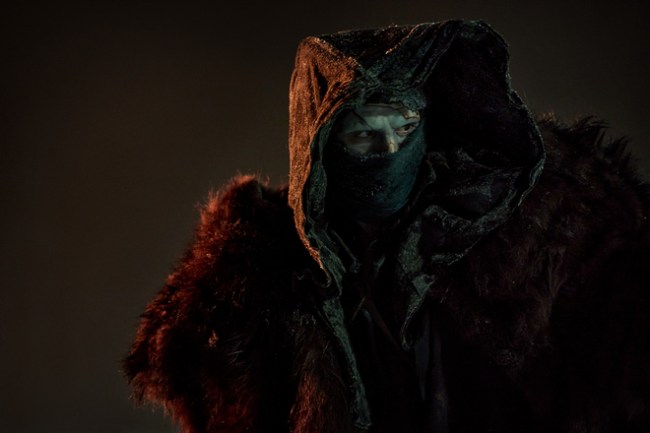
Del Toro’s second Netflix movie is bolted to the Earth by hands-on production design and crafty period detail. While it may be too reverently faithful to Mary Shelley’s source material to end up as a GDT all-timer, Jacob Elordi gives poignant life to the most emotionally complex Frankenstein monster since Boris Karloff.

October 13, 2025 0 comments
0 FacebookTwitterPinterestEmail
Benicio Del Toro Makes Surprise Cameo In 'SNL' Skit About Spanish
TV & Streaming

Benicio Del Toro Makes Surprise Cameo In ‘SNL’ Skit About Spanish

by jummy84 October 5, 2025
written by jummy84

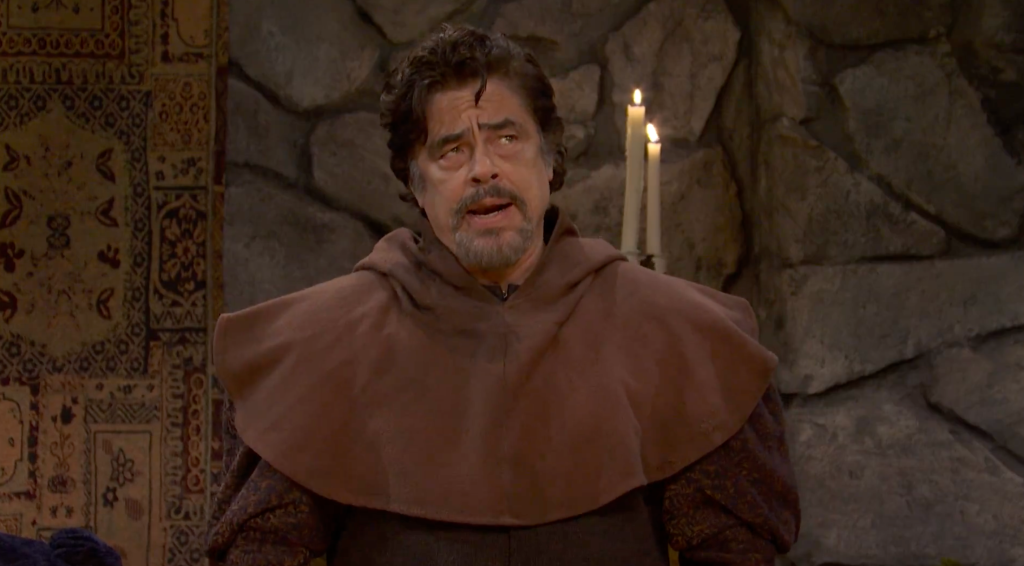
Benicio Del Toro made a surprise cameo appearance on Saturday Night Live tonight, joining host Bad Bunny and frequent collaborator Marcello Hernandez in a sketch spoofing the idiosyncrasies of the Spanish language.

Set in a medieval Spain, Bad Bunny and Hernandez were seen explaining to a cohort of scholars the reasoning behind why certain nouns were masculine or feminine.

“Yes, the ocean is a boy because it is fun, but sometimes, for no reason, it kill you,” Hernandez said.

Kenan Thompson then made the conclusion that a “girl word is a girl thing.” For example, dress would be feminine. “No, dress [vestido] is a boy,” Bad Bunny clarified.

Meanwhile, the word Bible is feminine “because it’s beautiful,” Bad Bunny said, and “also because, the Bible, everything you wanna do, it say no,” Hernandez added.

The Barcelona delegate, as portrayed by an overly ceceando Mikey Day, suggested skipping the tiresome lecture, only to be taken off camera to be beheaded.

At this point, Hernandez introduced his cousin to list “a few more rules that you’ll only need to remember for school but will be totally useless in real life.”

Enter stage left: Del Toro, fresh off his press tour for Paul Thomas Anderson’s One Battle After Another.

“Listen carefully. We will do also formal and informal, like you or You,” he began, drawing the difference between the informal tú and formal usted, both Spanish pronouns for second-person singular.

He continued, “What if the letter ‘r’ lasted a really long time? Like errrrre,” joking about the Spanish rolled R, or trill as it’s known in English, and vibrante múltiple, as it’s known in Spanish.

Watch the sketch above.

October 5, 2025 0 comments
0 FacebookTwitterPinterestEmail
Guillermo del Toro and Yeon Sang-ho Talk Creative Process at Busan
TV & Streaming

Guillermo del Toro and Yeon Sang-ho Talk Creative Process at Busan

by jummy84 September 20, 2025
written by jummy84

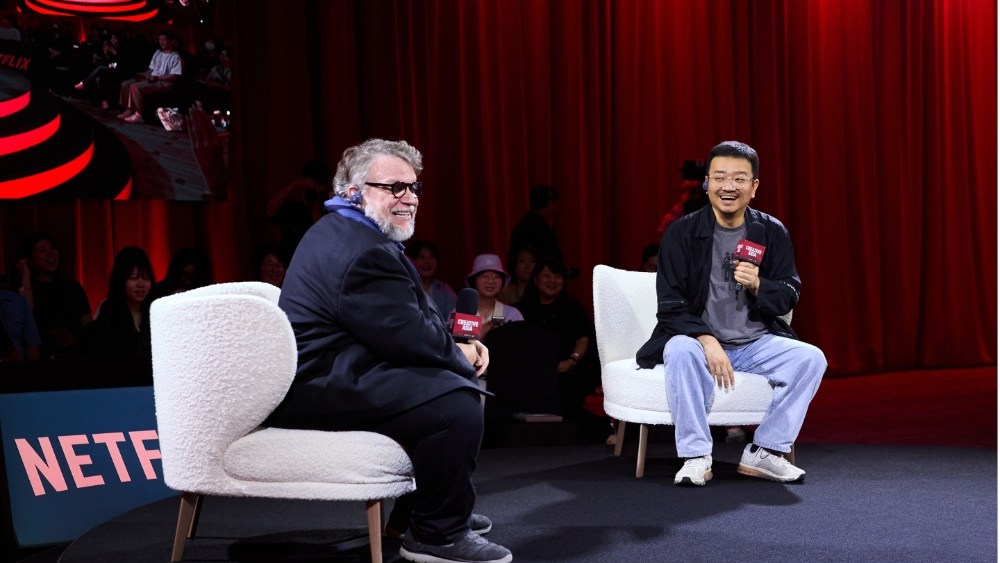
Two of cinema’s most imaginative voices came together at the Busan International Film Festival for an intimate conversation about their creative processes, revealing surprising connections between their work despite being separated by continents and cultures.

Guillermo del Toro and Yeon Sang-ho, both masters of blending the fantastical with deeply human stories, participated in a session at Netflix‘s Creative Asia conference. The conversation offered insights into how both directors approach their craft.

Both filmmakers traced their creative origins to childhood encounters with monsters and Japanese animation. Speaking about his formative years, del Toro said: “I’m not a good outdoorsy guy. I’m an indoor observer, reader, consumer of audiovisual media, storyteller. You know, if there was no movies, they would throw me out of a cliff to die.”

The Mexican filmmaker revealed how Japanese tokusatsu shaped his worldview: “So we watched all the series, not only Osamu Tezuka, but we watched all the Tsuburaya series, Ultraman, Ultraseven, Ultra Q. So I grew up like a Japanese kid.”

Yeon shared similar influences, explaining: “Actually, I think it’s right to say that I get inspiration from everything in life. But when I was young, at that time in Korea, Japanese animation was on TV, and I’m not a good sportsman.”

The conversation turned to their approaches to adapting existing material. On his adaptation of Mary Shelley’s “Frankenstein,” playing at Busan, del Toro detailed his decades-long relationship with the source material: “I saw the movie when I was seven, I read the book when I was 11, and since that time until now, I have made it a point to study… the lives of the Romantics. Percy B. Shelley, Mary Shelley, Lord Byron.”

His philosophy on adaptation is deeply personal: “You study all of that through decades and decades and decades and it becomes part of you. And then what you do is like you sing the same song with your own voice with different arrangements and it feels new because it matters to you.”

Yeon, who is adapting the Japanese manga “The Human Vapor,” expressed surprise at del Toro’s deep knowledge of obscure Japanese works, including the 1960 film “The Human Vapor,” demonstrating the cross-cultural pollination of genre filmmaking.

Praising Yeon’s transition from animation to live-action, del Toro called it “very rare that an animation director transitions so beautifully to live action.” He emphasized animation as “a pure form of art,” particularly stop-motion, which he continues to pursue alongside his live-action work.

Yeon reflected on the different strengths of each medium: “Animation and live-action have somewhat different appeals. In animation, almost all drawing styles exist. You can convey something just through the shape of appearance, which is a really big appeal, and depending on how you make it move, the way emotions are expressed changes a lot, so it has a broader range for conveying emotions. Live-action films definitely have authenticity that comes from the talents that actors possess, so there’s definitely a different kind of delivery power from that.”

He continued: “Since I’m doing a lot of live-action film series now, I have a desire in one corner of my heart to someday make some legendary animation like Osamu Tezuka or works like those I loved so much when I was young. When I work on projects with creatures, there’s somewhat the joy I had when doing animation.”

Both directors shared stories about embracing unexpected moments during production. Recalling the “Train to Busan” production, Yeon shared a specific example: “Originally, since I did animation, I try not to draw as much as possible. But when some explanation is needed, I do draw. The most representative case was when filming ‘Train to Busan’ – there was a scene where zombies were being dragged away in the ending, but that scene didn’t exist originally. We said we should add such a scene, but the staff couldn’t accurately understand what kind of scene it was, so I spent about a day drawing that scene. Amazingly, it’s almost identical to the image that appears in the movie now.”

He also shared another production story: “We had a past scene, so we worked quite hard to do the set dressing. We came after setting it up, but the night before, there was an incredibly heavy rain. It rained and all the mud was washed away, and the floor we had set up became completely muddy. At first, we thought we were unlucky and tried to clean it up, but as we tried to clean it, the look itself matched so well with the past. When such accidents happen, the accident isn’t really an accident but makes the film really special.”

Expanding on this philosophy, del Toro said: “As you age, you learn to, when you’re a young director, you talk a lot. When you are older, you listen a lot. And you know who’s talking all the time? The movie… And if you learn to listen, you make a better movie by realizing that accident is telling you this is what the movie wants to be.”

When asked about maintaining human elements within spectacular set pieces, del Toro emphasized that “everything is drama” regardless of scale. He described filmmaking as “poetry with hardware,” explaining how technical elements like camera movement and editing create emotional impact.

“Film is poetry with hardware,” he said. “You have a dolly track, you have a lens, you have a camera… you’re using hard things to produce symphonic movement.”

Both directors stressed the collaborative nature of their work. Noting that all visual elements work together, del Toro said: “Wardrobe is set design. Set design is cinematography. Cinematography is wardrobe. There’s no difference. You’re creating a single image.”

He shared advice from makeup effects master Dick Smith, quoting Laurence Olivier: “When you’re an actor in a rain scene, let the rain do some of the acting for you.” This philosophy extends to every element of production, where “everything is acting.”

The conversation touched on handling negative criticism. Yeon offered his perspective: “Actually… I feel what kind of thoughts critics have about certain works. I feel it, and sometimes there might be a gap between that person and me. When there’s a gap, I try to respect and understand it enough, but it doesn’t have a big influence on my work.”

Meanwhile, del Toro revealed he no longer reads reviews, positive or negative: “If you believe the good ones, you have to believe the bad ones. And I don’t want to.”

He emphasized depth of connection over breadth of audience, sharing how Terry Gilliam’s “Brazil” transformed him despite playing to an empty theater: “It doesn’t matter how many people liked it or not. It changed my life.”

Addressing the current industry landscape, Yeon drew historical parallels: “I think this way. Since I did animation, those who really like animation will know, but there used to be something called videodeck. When videodeck first started to emerge, a genre called OVA (Original Video Animation) began to appear in Japan.” He noted that while streaming offers global simultaneous release, theatrical films have different timing across countries and provide different depths and delivery methods, making them “completely different” experiences.

Focusing on the “size of ideas” rather than screen size, del Toro noted that content must work effectively in both home and theater environments.

The session concluded with advice for first-time directors. Offering a marriage metaphor, del Toro said: “Making a movie is not a date, it’s a marriage. So don’t marry that easy. Marry people you really give a fuck about.”

September 20, 2025 0 comments
0 FacebookTwitterPinterestEmail
Idris Elba, Del Toro & Nina Hoss Urge Empathy
TV & Streaming

Idris Elba, Del Toro & Nina Hoss Urge Empathy

by jummy84 September 8, 2025
written by jummy84

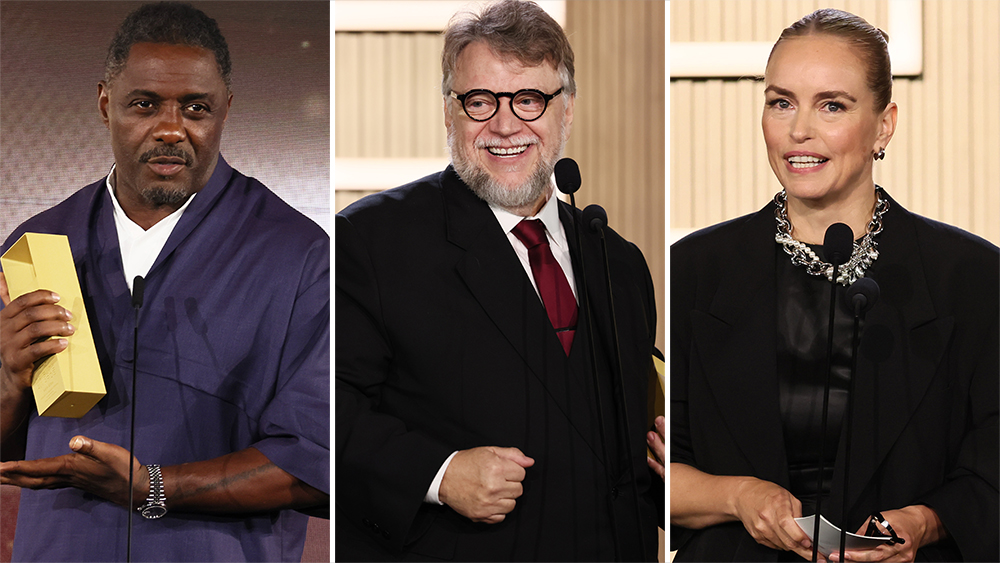
At tonight’s Toronto International Film Festival Tribute Awards, honorees like Idris Elba, Guillermo del Toro and Nina Hoss urged empathy, invoking the state of the world as in desperate need of human compassion.

The gala, which is an annual fundraiser supporting TIFF‘s core mission of cinema’s transformative power in real life, honored the outstanding impact of leading industry members. This year’s awardees also included Jodie Foster, Hikari, Lee Byung Hun, Kazu Hiro, Channing Tatum, Jafar Panahi, Zacharias Kunuk and Catherine O’Hara.

This year’s event also celebrated TIFF’s 50th Edition.

Though the artists’ statements remained vague in their gesticulations toward various sociopolitical crises currently sending shockwaves through the earth, it’s not difficult to infer veiled references to rising authoritarianism or the wars in Sudan and Gaza, which have led to catastrophic threats of famine.

Hoss, who featured in Hedda and received one of the Performer Awards, said, “We can’t forget what’s going on around us in the world … but I believe in the power of cinema, I truly do. I believe that when we sit in this room together, coming from all kinds of backgrounds — if young or old, it doesn’t matter what education we have — film brings us together because we can dive into, for a little moment in a very intimate way, into another person’s world, another person’s life, and we get challenged, we laugh with the person, we cry and experience his world and in the best way, hopefully we feel empathy. And from empathy, comes kindness, and we need that in this world right now.”

Nina Hoss, recipient of the Performer Award at the TIFF Tribute Awards, speaks to the current state of the world and how more kindness and empathy is needed pic.twitter.com/4YwRveg8C1

— Deadline (@DEADLINE) September 8, 2025

Meanwhile, Frankenstein filmmaker del Toro noted lightheartedly: “Canadians are modest and shy except on traffic and hockey; they go really crazy, yeah? Really violent,” he joked, eliciting audience laughs. “But in the meantime, they don’t like to talk about their achievements, so it takes a Mexican to tell you that Canada is a bastion of hope in the world right now.”

Elba, who received the TIFF Tribute Award in Impact Media, stated: “Even though we don’t really want to talk about it at a celebration of our industry, it is important to acknowledge the pain the world is feeling altogether, and that pain is something that — no matter what you do, whether we make films or you sponsor events like this — you close your eyes at night, you feel that pain because we’re human beings; we’re empaths.”

The multi-hyphenate added that the award is a symbol encouraging people to “make an impact with your lives, make an impact with our world by feeling something, all right? Feel it. No matter where you stand on whatever conflict is going on in the world, feel something, please. Our children, our children’s children — they need to know that we felt something during this time.”

Idris Elba, recipient of the Award in Impact Media at the TIFF Tribute Awards, speaks to the bittersweet moment of accepting this award amidst the current state but encourages people to make an impact in our world pic.twitter.com/C7cvxgjytI

— Deadline (@DEADLINE) September 8, 2025

September 8, 2025 0 comments
0 FacebookTwitterPinterestEmail
Guillermo del Toro insists his version of Frankenstein is not a warning about AI
Celebrity News

Guillermo del Toro insists his version of Frankenstein is not a warning about AI

by jummy84 August 31, 2025
written by jummy84

31 August 2025

Guillermo del Toro insists his forthcoming film Frankenstein is not a warning about artificial intelligence.

Guillermo del Toro insists his forthcoming film Frankenstein is not a warning about artificial intelligence

The 60-year-old director – whose earlier work The Shape of Water won the Golden Lion at Venice in 2017 – addressed questions about AI at the film’s official press conference on Saturday (30.08.25) afternoon ahead of its world premiere, when his $120 million monster movie, starring Jacob Elordi and Oscar Isaac will debut in competition for the festival’s top prize.

Revealing his new adaptation of Mary Shelley’s novel is about humanity, imperfection and power rather than technology, Guillermo said: “It’s not intended as a metaphor for that (the dangers of AI.)

“We live in a time of terror and intimidation, certainly.

“And there’s no more urgent task than to remain, in a time where everything is pushing towards a bipolar understanding of our humanity.

“The movie tries to show imperfect characters and the right we have to remain imperfect, and the right we have to understand each other under the most oppressive circumstances.”

He added with a smile: “I’m not afraid of artificial intelligence. I’m afraid of natural stupidity.”

In the new version of Frankenstein, Jacob plays the creature locked in conflict with his creator Victor Frankenstein, played by Oscar.

Guillermo added he imagined the film not as a conventional horror story but as a layered family drama. He said: “I’ve been following the creature since I was a kid.

“I waited for the movie to be done in the right conditions, both creatively in terms of achieving the scope to make it different, and to make it at a scale that you could reconstruct the whole world. I’m in postpartum depression now that it’s finished.”

Jacob was asked at the same event who in society he views as monstrous.

He answered: “Men in suits.”

Guillermo interjected: “Very well tailored (suits.)”

Oscar was also at the event and recalled his first conversations with Guillermo about taking the role of Victor.

He said: “I can’t believe that I’m here right now. I can’t believe we got to this place from two years ago, sitting at (Guillermo’s) table eating Cuban pork and talking about our fathers and our lives, to him saying, ‘I want you to be Victor,’ then not really being sure if it was true or if I was just dreaming. It just seemed like such a pinnacle.”


August 31, 2025 0 comments
0 FacebookTwitterPinterestEmail
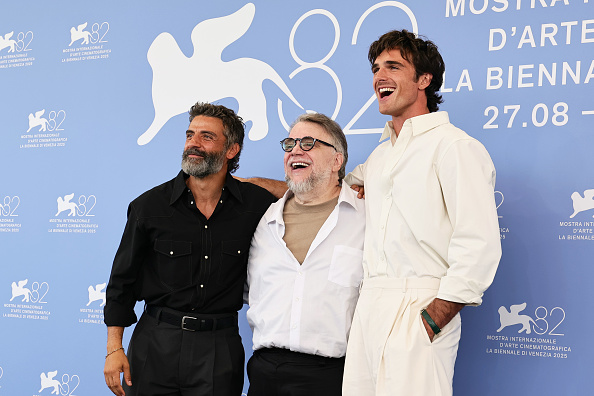
Oscar Isaac, Guillermo del Toro and Jacob Elordi
TV & Streaming

Guillermo Del Toro On ‘Frankenstein’, Netflix, Theatrical And AI

by jummy84 August 30, 2025
written by jummy84

Guillermo del Toro‘s adaptation of Mary Shelley’s Frankenstein launches at the Venice Film Festival today and the filmmaker, cast and backers Netflix were at the film’s Lido press conference.

Oscar Isaac stars as Dr. Victor Frankenstein, the brilliant but egotistical scientist who brings a creature (Jacob Elordi) to life in a monstrous experiment that ultimately leads to the undoing of both the creator and his tragic creation.

Oscar winner Del Toro was asked by a journalist — sitting a row back from Netflix co-CEO Ted Sarandos — whether he would have liked more than a three-week theatrical run for his big-budget spectacle?

Del Toro quipped initially: “Yeah. I mean, look, look at my size. I always want more of everything,” before adding of the $120M movie: “To me, the battle we are going to fight in telling stories is on two fronts, obviously the size of the screen, but the size of the ideas is very important. The size of the ambition. Can we reclaim scale, and reclaim scale of ideas. It’s a dialogue, and it’s a very fluid dialogue. I’m very happy. You never know what’s going to happen….To reach more than 300 million viewers, you take the opportunity and the challenge to make a movie that can transform itself and that evokes cinema.”

Del Toro said of his inspiration for making the movie: “It was a religion for me. Since I was a kid — I was raised very Catholic — I never quite understood the saints. And then when I saw Boris Karloff on the screen, I understood what a saint or a messiah looked like. So I’ve been following the creature since I was a kid, and I always waited for the movie to be done in the right conditions, both creatively in terms of achieving the scope that it needed for me to make it different, to make it at a scale that you could reconstruct the whole world.”

Del Toro was asked about the danger AI and technology poses to humanity: “We live in a time of terror and intimidation, certainly. And the answer, which art is part of, is love. For me, forgiveness is part of love and so many other things. And the central question in the novel from the beginning is, what is it to be human? What makes us human? And there’s no more urgent task than to remain human in a time where everything is pushing towards bipolar understanding of our humanity…I think that the movie tries to show imperfect characters and the right we have to remain imperfect, and the right we have to understand each other under the most oppressive of circumstances. It is very biographical to me, but it is, I think, biographical for anyone that tries to preserve their soul in the times we’re living in. And to me, artificial intelligence I’m not afraid of; I’m afraid of natural stupidity, which is much more abundant.”

Oscar Isaac described the journey he had been on since meeting Del Toro about the part two years prior: “I can’t believe that I’m here right now. I can’t believe we got to this place from two years ago, sitting at your table [looking at Del Toro] eating Cuban pork; just talking about our fathers and our life too…It was like a fusion. I just hooked myself into Guillermo, and we flung ourselves down the well.”

Elordi said he poured his whole being into the role of the monster: “It was a vessel that I could put every part of myself into. From the moment that I was born to being here with you today, all of it is, is in that character. And in so many ways, the the creature that’s on screen in this movie is the sort of purest form of myself. He’s more me than than I am.”

At Netflix’s Tudum event earlier this year, Del Toro called the film “the culmination of a journey that has occupied most of my life,” adding, “Monsters have become my personal belief system. There are strands of Frankenstein through my films.”

Coming off his third Oscar win for Guillermo del Toro’s Pinocchio, another literary adaptation for Netflix, Del Toro’s Frankenstein also stars Mia Goth (X), Felix Kammerer (All Quiet on the Western Front), Lars Mikkelsen (The Witcher), David Bradley (Guillermo del Toro’s Pinocchio), Christian Convery (Sweet Tooth), Charles Dance (Game of Thrones) and Christoph Waltz (Inglourious Basterds).

Del Toro directed from his own script and produced alongside J. Miles Dale and Scott Stuber.

August 30, 2025 0 comments
0 FacebookTwitterPinterestEmail

Social Connect

Facebook Twitter Instagram Pinterest Youtube Snapchat

Recent Posts

  • 2009 feels like a whole other world away

  • Watch Ariana Grande and Jimmy Fallon Perform a History of Duets

  • Spotify’s Joe Hadley Talks ARIA Awards Partnership

  • Nick Offerman Announces 2026 “Big Woodchuck” Book Tour Dates

  • Snapped: Above & Beyond (A Photo Essay)

Newsletter

Subscribe my Newsletter for new blog posts, tips & new photos. Let's stay updated!

Categories

  • Bollywood (1,929)
  • Celebrity News (2,000)
  • Events (267)
  • Fashion (1,605)
  • Hollywood (1,020)
  • Lifestyle (890)
  • Music (2,002)
  • TV & Streaming (1,857)

Recent Posts

  • Shushu/Tong Shanghai Fall 2026 Collection

  • Here’s What Model Taylor Hill Is Buying Now

  • Julietta Is Hiring An Assistant Office Coordinator In Dumbo, Brooklyn, NY (In-Office)

Editors’ Picks

  • 2009 feels like a whole other world away

  • Watch Ariana Grande and Jimmy Fallon Perform a History of Duets

  • Spotify’s Joe Hadley Talks ARIA Awards Partnership

Latest Style

  • ‘Steal This Story, Please’ Review: Amy Goodman Documentary

  • Hulu Passes on La LA Anthony, Kim Kardashian Pilot ‘Group Chat’

  • Hannah Einbinder Slams AI Creators As “Losers”

  • Facebook
  • Twitter

@2020 - celebpeek. Designed and Developed by Pro


Back To Top
celebpeek
  • Home
  • Bollywood
  • Hollywood
  • Lifestyle
  • Fashion
celebpeek
  • Music
  • Celebrity News
  • Events
  • TV & Streaming