I have fond memories of sitting in the back row of the tiny Holiday Cinema 3 at the Sundance Film Festival with indie executive Bingham Ray, in acquisition mode, checking out a new movie that only the programmers had ever seen.
Back in the ’90s through the aughts, the excitement of discovering the next “In the Bedroom,” “sex, lies, and videotape,” or Jennifer Lawrence was palpable, when buyers for American narratives were plentiful and the indie market was on the rise. It wasn’t all about celebrity suites and swag giveaways back then. The burgeoning Main Street parties were always musts to avoid, except for one: It was always tough to get into Cinetic’s Monday night party, but you learned everything you needed to know in that upstairs room at Zoom.

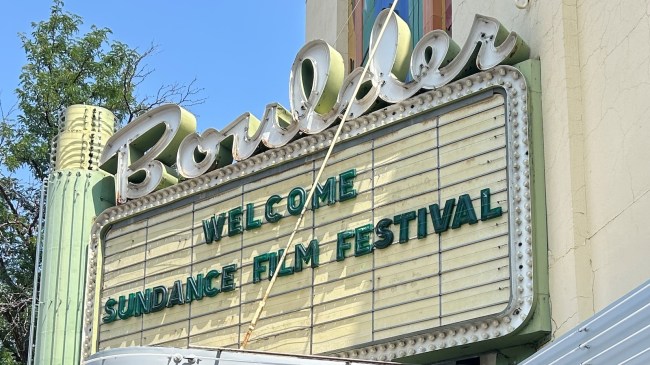
Those days, and Zoom — and its one-time owner and Sundance founder Robert Redford — are gone. But as Sundance preps for its January 2026 Park City finale, the industry is wondering what the first Sundance Boulder edition in 2027 will look like. Many hope the festival will contract in scale.
My first visit to the 13th Middleburg Film Festival, set at billionaire founder Sheila Johnson’s posh Salamander resort in the rolling hills of Virginia outside of Washington, D.C., reminded me of the pleasures of a small film festival. If just 45 new features are on view, every attendee gets into the venues. If the press and talent guests are a select few, there’s more access to the folks roaming the halls.
I dropped into a late-night library circle as Oscar-winner Chloé Zhao (whose “Hamnet” shared the audience prize with “Rental Family”) confessed she’d like to open a funeral home. I ate lunch with Rose Byrne and Mary Bronstein (“If I Had Legs I’d Kick You”), Nina Hoss (“Hedda”), and Zoey Deutch (“Nouvelle Vague”). I ate dinner with Middleburgh producer-advisors Ron Yerxa and Albert Berger (“Little Miss Sunshine”) and “Train Dreams” auteur Clint Bentley (“Sing Sing”) and his star Joel Edgerton. And at the annual barbecue, I hung out with songwriter Diane Warren, who still hopes to win a real Oscar after 16 nominations, as opposed to settling for an honorary one. (For the 2023 Oscar show, she practiced her song “Applause” on a dummy piano, she confessed, which turned out to be live accompaniment for singer Sofia Carson on the broadcast. That’s grace under fire!)
Good stuff, right? Over the years, I’ve gotten to know industry people at small festivals around the country, from California’s Mill Valley, Santa Barbara, Palm Springs, and Sonoma to Florida’s Sarasota, Miami, and Fort Lauderdale, Washington’s Orcas Island, Oregon’s Ashland, and New York‘s Hamptons. I bonded with friends and expanded my ever-growing film community.

The question for any small festival is how to control growth and expansion. Do you have to keep growing? Middleburg director Susan Koch is weighing these questions now, as demand for attendance grows. She doesn’t want her local audience to not get into her screenings, as happens to regular passholders at Telluride ($780), who often wait in line for popular titles only to see most seats taken by priority passholders ($4900).
Telluride director Julie Huntsinger, who has her 20th festival coming up, keeps the program to about 60 titles. She is not able to control the rising costs and price-gouging in the wealthy Colorado mountain town. “It’s a box canyon,” she said on the phone. “Prices are going to be whatever they’re going to be. But in terms of growing, we’re small, we’ll keep to the same amount of passes.” At Telluride, in effect, the patrons pay for the cheaper passes, which have not gone up in price for 16 years.
The danger of a festival getting too large — Toronto plays more than 200 features — is that it overwhelms its attendees with too much choice. “People want that curation,” said one festival leader, who criticizes festivals like Toronto for programming too many movies that are not “a bold new voice taking a chance. I hope Sundance becomes a little more concise. Bigger is not better.”

Another festival executive added, “Sundance and Toronto are selling titles in the independent acquisitions market. You never know what is the center of attention there.”
The Toronto International Film Festival has scaled back, actually. Since 2015, the feature films in the official selection steadily declined from 287 to 210 in 2025. “We put ourselves on a diet in the mid-2010s,” said TIFF CEO Cameron Bailey. “People were just scrambling, trying to see everything, and buyers were trying to see all the sales titles. They felt there was too much on offer. It was hard to tell what they should focus on most. They wanted a tighter selection.”
Bailey has also made an effort to make the festival more walkable, eliminating theaters that required transportation. Now, every screening venue is within a 10-minute pedestrian distance.
Bailey sees festivals as “living things, and they have to evolve,” he said. “Typically, festivals, once they catch on with the industry and public, will increase in size or at least in ambition. Sundance has an opportunity to completely reset.”

On a much smaller scale than Toronto, even though it’s in a bigger city, Film at Lincoln Center’s New York Film Festival main selection has stayed about the same size for years: this year’s slate was 29 films, with additional sidebars tallying a total 75 features. The festival books two films a night in its main venue, Alice Tully Hall. “It’s the best experience for the audience,” said Film at Lincoln Center president Daniel Battsek.
As the indie market contracts, what should Sundance’s primary role be in 2027 and beyond? “Sundance has a long-held and well-deserved reputation for nurturing and anointing new talent; this process and the festival play a critical role in the independent film ecosystem,” said Battsek, who points to a movie like Jordan Peele’s Sundance breakout “Get Out” in 2017. “The audience reaction created a bit of a wave that continued right through to all sorts of success.”
As for Sundance, as festival director Eugene Hernandez often points out, the first half has long been noisier and more crowded, while the vibe changes as the second half returns to the quieter movie-focused Sundance of yore. Sundance has also created a smaller sidebar festival every year, first in London, then, in recent years, Mexico City.
Separated from its ritzy ski resort setting, will Sundance Boulder return the festival to its indie roots and resist the pressure to permit Main Street’s corporate swag suites and raucous parties? Hernandez is still focused on Sundance 2026, and his team has yet to make many key decisions about Sundance 2027, from screening venues and hotels to festival hubs. They have been mounting screenings with the local film community, which includes enthusiastic cinephile college students.
Sundance Boulder promises many changes from icy Park City, which had become daunting to navigate. It could be tempting for the festival to expand into a more spacious town. Already, Sundance has announced plans to center its activities in the walkable downtown area, including the pedestrian mall Pearl Street, wrote IndieWire’s Kate Erbland, “with access to restaurants, cafes, vintage theaters, performance arts spaces, a multiplex, university facilities, and other auditoriums.”
As Sundance makes its transition to Boulder, we can hope that its leadership not only builds a more sustainable film festival but resists the temptation to expand into the Boulder playground.