celebpeek
  • Home
  • Bollywood
  • Hollywood
  • Lifestyle
  • Fashion
celebpeek
  • Music
  • Celebrity News
  • Events
  • TV & Streaming
Home » Review » Page 12
Tag:

Review

Film Club review: Dramedy has potential but it's yet to be unlocked
TV & Streaming

Film Club review: Dramedy has potential but it’s yet to be unlocked

by jummy84 October 3, 2025
written by jummy84

For one thing, Wood has already proven herself to be a delightful and engaging screen presence, so getting to hear her own screenwriting voice was a fascinating prospect.

For another, it’s always a thrill to see new British comedy series come to air, at a time when there are so many unique, funny and vibrant comedies out there (despite what some many would have you believe).

Then there’s the show’s charming concept, it’s quirky visual aesthetic, a central turn for Nabhaan Rizwan, I could go on – the point is, there were a lot of selling points.

It’s therefore a strange feeling to come out of watching all six episodes of Film Club and feel that it hasn’t quite made its mark yet, or fulfilled that desire I had. That’s not to say it wasn’t an enjoyable watch, or that it couldn’t achieve that potential in future – just that, right now, there are a few bumps in the road.

Nabhaan Rizwan as Noa and Aimee Lou Wood as Evie in Film Club. BBC/Gaumont/Ben Blackall

Film Club stars Wood as Evie, a young woman who hasn’t left the house in six months after suffering from a mental health episode, described as a ‘wobble’.

Every Friday, as a weekly escape, she and her friends, including best friend Noa (Rizwan), meet up in her mum’s garage and celebrate film. There’s a different film chosen for each week, decorations are put up to recognise that, costumes are required, phones are banned and a movie-related quiz takes place. It’s delightful. There’s just one snag.

That is that Evie and Noa are quite clearly in love with each other, despite never having expressed their feelings to one another. Oh, and Evie has a boyfriend, Josh. Oh, and Noa is moving to Bristol for his dream job, meaning film club won’t be continuing.

It’s all rather a lot for Evie to deal with, and over the subsequent weeks she goes on a journey of discovery, to reflect on her feelings for Noa, as well as to learn more about herself.

Aimee Lou Wood as Evie in Film Club, wearing a space suit.

Aimee Lou Wood as Evie in Film Club. BBC/Gaumont/Ben Blackall

First things first, there are a lot of things about this set up that are really winning. The idea of the actual film club itself is so charming as to be almost ridiculous.

It’s crucial to note here, that this is not some hang-out for real, hardcore cinephiles. The films they watch each week are the most classic of classics that everyone will have heard of, and the vast majority of viewers will have seen – think Alien and The Wizard of Oz.

This gives the whole thing are a far more wholesome vibe, and the sense that this really is an excuse for socialising first and foremost. The characters have a passion for film (well, most of them do), but it’s their friendship that binds them, and this is just a fun way to express it.

It’s telling that this was conceived of during the Covid pandemic, at a time when physical meet-ups were impossible, yet it also feels deeply resonant today.

Even without restrictions, society has still become so much more virtual and isolated. A series preaching about the joys of social interaction, and showing characters simply enjoying each other’s presence by being a bit silly, with no fear of judgement, is not only endearing, but also kind of critical.

Nabhaan Rizwan as Noa, Aimee Lou Wood as Evie and Adam Long as Josh in Film Club.

Nabhaan Rizwan as Noa, Aimee Lou Wood as Evie and Adam Long as Josh in Film Club. BBC/Gaumont/Ben Blackall

The characters here are also a complete joy to have on our screens, and Wood and her co-creator Ralph Davis have assembled a brilliant cast to bring them to life.

Wood herself is magnificent as Evie, whose positivity and passion are infectious and whose mannerisms are so fantastically specific and clear. Rizwan’s Noa is more straight-laced and, as is commented on at numerous times, formal, but has a habit of breaking out into incredibly bold accents and performances.

As a duo fronting the show, they’re both fantastic, with superb chemistry which feels like a real, long-lasting friendship.

Meanwhile, there are excellent supporting turns throughout, including from Liv Hill as Evie’s sister Izzie, with that sibling relationship between really well-drawn and observed.

Two real MVPs are Suranne Jones as Evie’s mum Suz, a genuinely distinct, brilliant character and such a departure from the typical ‘on-screen mum’ figure, and Adam Long as Josh, who may not be right for Evie, but has an endearing turn of phrase and a excitable energy.

Set up, all great, characters, delightful, intentions, utterly good-natured. So, what are these issues? Well, these come, instead, in the detail of the narrative and in the tone. On the latter, it’s key to note that reviewing comedy is hard – it’s so subjective and every individual will find different things funny.

Liv Hall as Izzie and Suranne Jones as Suz in Film Club. They are both holding champagne flutes.

Liv Hall as Izzie and Suranne Jones as Suz in Film Club. BBC/Gaumont/Ben Blackall

Unfortunately, I personally just didn’t find Film Club all that funny. It’s operating on a grounded, low level of humorous interactions, and sure, there are some funny character beats throughout and some sequences that evoke a chuckle, but for the most part it’s just not something that provided me with any real, deep laughs.

Part of the reason for this is that, despite being billed as a comedy-drama, the synonym dramedy might work better, simply because the drama is really the first port of call.

That brings me neatly to the plot, and in particular, the central romantic tension between Evie and Noa – these two are perhaps just too meant for each other.

Of course, that concept has a long history in romantic comedies, both in film and on TV, but here it’s kind of absurd. Evie doesn’t seem to have any particular chemistry with Josh, she and Noa are practically an old married couple from the word go, and even his moving away doesn’t feel like enough of an impediment to giving it a go.

There’s barely even the standard question of both parties being worried to ruin the friendship if they were to be rejected – their chemistry is so utterly blatant that even they so don’t seem entirely oblivious to how one another feels.

Every time there’s a roadblock in their journey, it just feels like a slightly forced and mechanical way to drag out the will-they-won’t-they storyline.

Nabhaan Rizwan as Noa in Film Club, wearing a silver costume and bicycle helmet, and riding a bike.

Nabhaan Rizwan as Noa in Film Club. BBC/Gaumont/Ben Blackall

However, if you’re not vibing with the central romantic story, there are still plenty of other subplots to go down. In fact, there are slightly too many, with this scattershot approach leaving some of the most crucial ones feeling under-developed.

For instance, Evie’s mental health storyline is drawn in the broadest brush strokes, and never really honed in on in any substantial or meaningful way.

The lack of specificity may be universalising, and therefore a comfort to some, but it means that when Evie does start to get better it’s slightly harder to feel her catharsis, simply because we’ve never been entirely sure what she was struggling with to begin with.

Again, this could be an intentional statement on the ways in which we relate to others in times of crisis, and everyone’s experiences surrounding the topic will be different.

Purely from a dramatic standpoint, it can be somewhat frustrating, as though the show is keeping us at arm’s length. However, on a real-terms level, if this series helps some people who are struggling feel more seen, then that is wonderful, and a real, tangible good.

Kai Assi as Ziggy and Owen Cooper as Callum in Film Club.

Kai Assi as Ziggy and Owen Cooper as Callum in Film Club. BBC/Gaumont/Ben Blackall

The way this storyline is dealt with just does seem to be part of a piece with a number of the other decisions made across the board. For instance, the film club conceit should be grounds to commit to a real episodic structure, wherein the films chosen are used as themes for the instalments, expressing what they’re trying to explore and doing so with aesthetic links.

At times, it feels this is the route the show is going down, and those are arguably some of the best moments of all. One dreamlike sequence involving a spacesuit, inspired by Alien, is fantastic.

However, as in a number of other areas, it fails to commit to this as a long-running structure, or indeed any structure or unifying concept. This keeps you on your toes, for sure, but sometimes a defined framework for episodes is good, helping to act as the glue holding everything else together.

Instead, we get what feels like many different versions of this show, with a number of different branches and characters being underserved – Adolescence breakout Owen Cooper in particular is largely wasted as local kid Callum.

As already expressed, none of this is to write Film Club off. If you’re looking for a really easy, cosy watch of an evening, something fairly light where you can spend time with likeable characters and superb performers, then this could very well fit the bill.

It’s also not to say that a second season couldn’t completely win me round on some of these quibbles. There’s so much potential here that I’d love to see a second iteration of this, one where some of the screws are tightened and a really clear theme, story and structure are honed in on.

But for now, Film Club isn’t quite the knockout personal favourite I wanted it to be – even if it’s still delightful to have a series which firmly celebrates friendship and film.

Film Club begins on Tuesday 7th October at 10pm on BBC Three and iPlayer.

Add Film Club to your watchlist on the Radio Times: What to Watch app – download now for daily TV recommendations, features and more.

Check out more of our Drama coverage or visit our TV Guide and Streaming Guide to find out what’s on. For more TV recommendations and reviews, listen to The Radio Times Podcast.


October 3, 2025 0 comments
0 FacebookTwitterPinterestEmail
Olivia Dean: The Art of Loving Album Review
Music

Olivia Dean: The Art of Loving Album Review

by jummy84 October 2, 2025
written by jummy84

“I’ve done all the classic stuff,” Olivia Dean sings on “Nice to Each Other,” the lead single from her second album, The Art of Loving. And it certainly does seem that way—the rising British neo-soul star studied songwriting at London’s prestigious BRIT School, got her first gig as a backing vocalist for the chart-topping dance-pop group Rudimental, and, throughout the 2020s, has worked her way up the United Kingdom’s traditional ladder to stardom: BBC Introducing Artist of the Year, Glastonbury, Jools Holland. She cites Amy Winehouse and Carole King in interviews and has covered the Supremes and Nat King Cole. So I’ll respectfully disagree with Dean’s follow-up claim, that “all the classic stuff… it never works.” Arriving at the peak of her fame to date, The Art of Loving is a genuinely lovely collection of would-be classic pop songs, all variations on the titular theme. It moves with the timeless grace of some bygone, indeterminate era in music and celebrity, one that maybe never existed to begin with.

Prior to recording The Art of Loving, Dean had immersed herself—as many of her generation have and many more surely will—in bell hooks’ All About Love. “‘Gotta throw some paint,’ that’s what bell would say,” she sings on the album’s brief prelude. More precisely, Dean drew inspiration from an exhibition of the same name by the artist Mickalene Thomas, itself a response to hooks’ influential work of theory. Whereas Thomas’ paintings are elaborate and rhinestone-encrusted, The Art of Loving is filled with little marvels of economy. Dean and executive producer Zach Nahome borrow a spare set of bongos from a Laurel Canyon open mic, a buttery Brill Building Rhodes organ, and some well-placed bah-bah-bahs courtesy of Motown girl-groups. In their fastidious arrangements, little details that might otherwise go unnoticed—a five-note, hyaline piano motif on “Nice to Each Other” or the passage of double-time horns that follow the first chorus of “Let Alone the One You Love”—instead become focal points.

October 2, 2025 0 comments
0 FacebookTwitterPinterestEmail
Kantara Chapter 1 review: Folk goes mass as Rishab Shetty, Rukmini Vasanth excel in uneven but visually splendid prequel
Bollywood

Kantara Chapter 1 review: Folk goes mass as Rishab Shetty, Rukmini Vasanth excel in uneven but visually splendid prequel

by jummy84 October 2, 2025
written by jummy84

Kantara Chapter 1 review

Cast: Rishab Shetty, Rukmini Vasanth, Jayaram, Gulshan Devaiah

Director: Rishab Shetty

Rating: ★★★

Halfway into Kantara: Chapter 1, I could not help but feel that the film, like the original Kantara, was an elaborate setup for a visually splendid payoff. The film tests your patience, exhausts you, and frustrates you before eventually rewarding you with what is one of the most visually stunning climaxes in recent times. Yet, while the original Kantara held it all together, Chapter 1 seems to be nudging the viewer to just wait for that payoff and ignore the bumpy ride along the way. Does it take the sheen away a bit? Certainly. Is Kantara Chapter 1 still a watchable film? Immensely so! Despite the unevenness and drab moments, Rishab Shetty yet again scripts a theatrical spectacle that can only be experienced, not explained.

Kantara Chapter 1 review: Rishab Shetty takes on the daunting task of following up to Kantara.

What is it about

Kantara: Chapter 1 is an origin story that explains the backstory of the daivas and the guliga we saw in Kantara. Rishab plays Berme, a warrior from Kantara, a hamlet that is at odds with the neighbouring Kadamba kingdom. The ruler Vijayendra (Jayaram) has enforced an uneasy truce with Kantara, but his ambitious and wayward son, Kulasekhara (Gulshan Devaiah), wants to annex Kantara and capture the resources in the forest. Even as the princess Kanakvathi (Rukmini Vasanth) tries to find a middle ground, blood spills, and Kulasekhara and Berme come face to face.

What works and what doesn’t

While the 2022 film Kantara was a rooted film about traditions and folk tales of coastal Karnataka, Kantara: Chapter 1 is an ambitious, large-scale story of greed, war, and destiny. It is magnified several-fold as compared to the first part. The prequel is more mass than folk, giving both the heroes and the villains enough time to saunter on the screen and indulge in some elevation. If Kantara had some nuance, Chapter 1 has the subtlety of a sledgehammer. It is loud, bold, and in-your-face, perhaps a little too much at times.

What makes Kantara Chapter 1 a little intolerable at times is how uneven and scattered the narrative gets, particularly in the first half. It moves at a leisurely pace, flitting between the two settings and often indulging a bit too much in the characters’ frivolities. The humour seems forced, and the romance a little rushed. Yet, the moment the action kicks in, the film gets back on track.

Movie Review

Kantara: Chapter 1

Kantara: Chapter 1

Rating Star 3/5

Tracing the origins of the daivas and guliga in Kantara, the Rishab Shetty film focusses on the standoff between the village and a neighbouring kingdom centuries ago.

Cast

Rishab Shetty, Rukmini Vasanth, Jayaram, Gulshan Devaiah

Verdict

Kantara Chapter 1 relies upon its visuals, cinematography, and splendid scale to patch over the roughness in the narrative. Rishab Shetty and Rukmini Vasanth’s performances help too.

Rishab Shetty balances the folk traditions that have inspired the film with modern sensibilities better this time around. Chapter 1 gives its women more agency than the first film ever did. But even this one can’t resist the knight-in-shining-armour trope. However strong the woman is, a man must rescue her in the end. Rishab Shetty’s writing seems to allow women to have power and independence only when they rebel or antagonise. Otherwise, it is reduced to tokenism. However, still props to the writer-director for giving a female character more prominence this time around, and even giving her some of the most powerful moments in the film.

But the real clincher for the film is the visuals. The VFX work is quite splendid for a film of this budget. The CGI tiger and monkeys, in particular, have been rendered beautifully. But it’s the film’s play with fire and the depiction of the guliga and daivas that steal the show. The powerful climax is elevated by Rishab Shetty’s performance, but the VFX plays an important role there. What is also noteworthy is the cinematography. Much of the film is shot at night, but Kantara: Chapter 1 thankfully discards the newfound penchant for too much darkness on screen.

The performances

I expected Rishab to shine again on screen, and he does. In scenes where he transforms into the guliga, he is a man possessed and delivers a breathtaking, captivating performance yet again. But for me, the other star was Rukmini Vasanth. The second half of the film allows her to take on a central role in the narrative, showing shades that films in this genre seldom allow female stars to. And the actor excels. Gulshan Devaiah has been wasted in the first half, but he briefly gets to show his true mettle after the interval.

Rukmini Vasanth in a still from Kantara: Chapter 1.

Chapter 1 a critique of consumerism as it is a commentary on greed and maintaining the ecological balance, all themes that were present in the first Kantara too. Here, they have been presented with a medieval lens, though. And Rishab Shetty does well as these are the only moments in the film that have some nuance and subtlety. But the visuals and performances, coupled with the splendid presentation of folkore, is enough to patch the holes left by the roughness in the narrative. This makes Kantara: Chapter 1 one of the most visually stunning and watchable Indian films in recent times.

October 2, 2025 0 comments
0 FacebookTwitterPinterestEmail
Pawan OG review
Bollywood

Sunny Sanskari Ki Tulsi Kumari Review: A feel-good comedy

by jummy84 October 2, 2025
written by jummy84

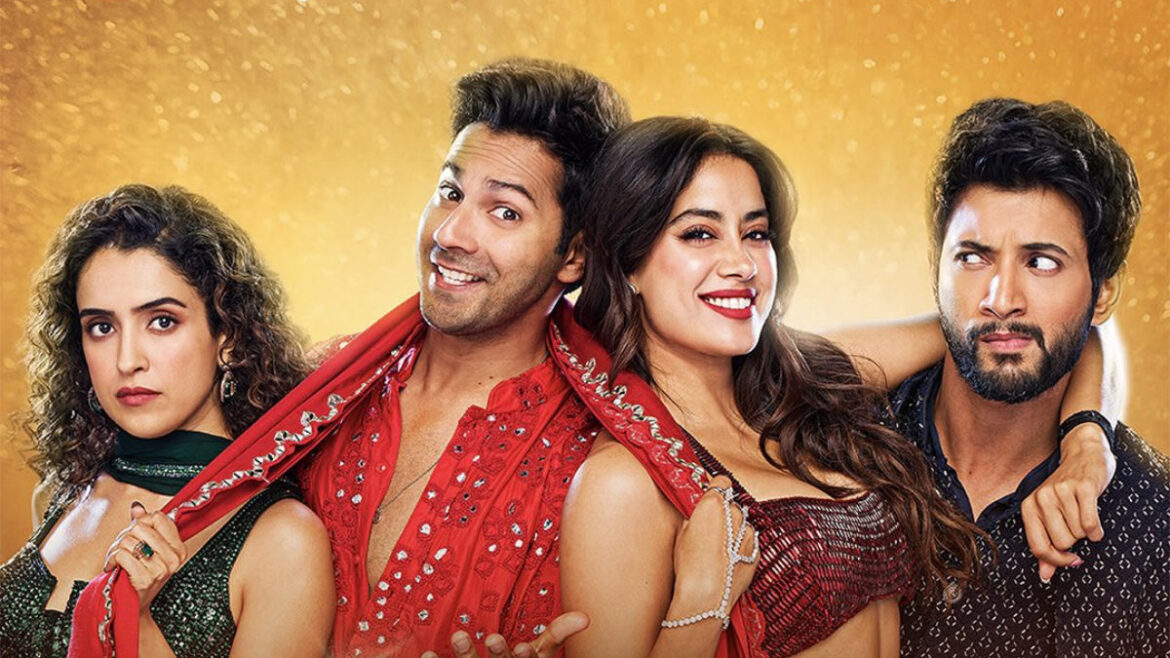
Sunny Sanskari Ki Tulsi Kumari is a rom-com sprinkled with emotional beats, something of a cross between My Best Friend’s Wedding (1997) and I Want You Back (2022). What stands out is that no one plays the villain here. All four central characters are simply muddled in matters of the heart, and it takes a string of misadventures to set them straight.

Sunny Sanskari (Varun Dhawan), the only son of a jeweller, is hopelessly in love with Ananya (Sanya Malhotra). But to her, theirs is merely a ‘situationship’, leaving him heartbroken. His misery deepens when he discovers she is engaged to Vikram (Rohit Saraf), a billionaire. Determined to win her back, Sunny vows to sabotage the wedding. Soon, he learns that Vikram too has a past. He has ditched his long-term girlfriend, Tulsi Kumari (Janhvi Kapoor), a schoolteacher, in order to get married to Ananya. Spotting common ground, Sunny proposes a pact with Tulsi: they will crash the wedding together and reclaim their exes. With Sunny’s best friend Bantu (Abhinav Sharma) in tow, they masquerade as a couple and land up at the lavish Rajasthan venue where Ananya and Vikram’s nuptials are set to unfold.

But their plans don’t quite play out as expected. In trying to wreck the wedding, Sunny finds himself warming to Vikram, and the two strike an unlikely friendship. Meanwhile, Tulsi and Ananya avoid the predictable trope of women at war; instead, they recognise that they are merely two women caught in circumstances beyond their control.

The narrative ambles through varying definitions of love, allowing the leads to gradually make sense of it all. Along the way, it slyly touches upon the unspoken truths of arranged marriage and the pressure of ‘adjustment’ still expected of women. Women’s empowerment isn’t the core theme, yet the film nudges in that direction.

The writing hits its stride in the comic set-pieces. There’s a hilarious mirror duel where Janhvi and Sanya attempt to appear slimmer by holding in their breath, and a riotous bhaang-fuelled sequence in which all four characters crawl across a lawn, spilling secrets. Sunny’s penchant for atrocious poetry, and Maniesh Paul as the eccentric wedding planner, add further levity. Even the jealousy games between the two pseudo-couples manage to charm. Yet, the comedy doesn’t undercut the emotional heft. A moving moment where Janhvi breaks down and Varun consoles her lingers long after. Similarly, the confrontation between Sanya and Varun is as raw as it is well-acted.

The film, however, stumbles on pacing. The editing is loose, with a couple of abrupt scenes that jar, and lip-sync issues in certain songs are distracting. The soundtrack is overstuffed too, with numbers that serve their purpose onscreen but lack recall value afterwards. The standout is the recreated Sonu Nigam classic Bijuria (1998), spruced up by Tanishk Bagchi and given a dazzling choreography. Another shortfall is the absence of seasoned supporting actors. Veterans like Pankaj Tripathi, Manoj Pahwa, Kumud Mishra or Sheeba Chaddha could have brought gravitas; instead, the parental roles are essayed by largely unknown faces.

Director Shashank Khaitan has made sure everyone gets their moment in the sun. Rohit Saraf gets plenty to do. His scene with Sanya towards the end shows both his vulnerability and strength. His bromance with Varun is another highlight of the film. Janhvi Kapoor gets to showcase her dance skills and her comic timing. Be it with Varun or with Sanya, it’s down pat. And she’s good in emotional scenes as well. Overall, a well-rounded performance from the actor. Sanya Malhotra is expressive as hell and uses her eyes and face effectively to convey her inner conflict. It’s the little things which count and Sanya makes sure that less is effectively more. Varun Dhawan is in his element here. He’s in fine form giving his own take on Govinda and Shah Rukh Khan, his chemistry with the two leading ladies is on point and he knows how to walk the thin line between comedy and drama.

The final product feels equal parts Karan Johar (who pops in with a delightful cameo) and Sooraj Barjatya. It’s designed for the family audience rather than the youth alone, and it offers a bit of everything, comedy, drama, songs, emotion, and a message tucked in lightly.

All in all, Sunny Sanskari Ki Tulsi Kumari is a good-hearted rom-com that never turns cynical, delivering mischief, warmth and relationship chaos in equal measure.

Also Read: Varun Dhawan and Janhvi Kapoor’s Sunny Sanskari Ki Tulsi Kumari Cleared By CBFC

October 2, 2025 0 comments
0 FacebookTwitterPinterestEmail
Rochelle Jordan: Through the Wall Album Review
Music

Rochelle Jordan: Through the Wall Album Review

by jummy84 October 2, 2025
written by jummy84

Jordan is a master of restraint and subtle expression. She doesn’t belt; she breathes, trusting her phrasing to carry the heat. On the sugary highlight “Sweet Sensation,” she slips out of Brandy-esque melisma to assert that smolder can stand alone. On “Crave,” a love song produced by Chicago house legend Terry Hunter, Jordan struts exquisitely; club music was always about feeling as much as stimulation, and Jordan is tapped into the heart of its lineage. Songs like “Crave,” “TTW,” and “Sum” keep steady four-to-the-floor rhythms that invite slink, not sprint.

The record’s polish comes from curation as much as performance. Jordan doesn’t just hire producers; she maps a dance diaspora of contemporary pop, Chicago and Detroit house, and UK garage, and threads herself through it. Standout favorite “Bite the Bait” gets a chrome‑sleek electro sheen from Jimmy Edgar that lets her cool vocal glide like lip gloss; “Around” draws on producer Hamdi’s UK bass sensibility, and Jordan rides the low end, sounding featherweight and self-assured. “I’m Your Muse” sharpens her chanteuse era into a point. Over KLSH and Machinedrum’s lithe kick, she purrs instructions, blurring ad‑lib and hook until the whole thing feels like an invitation and a boundary at once: “Just say you love me/Say you use me/Say you’re feening.” Elsewhere, KLSH keeps the pulse clean (“Ladida,” “Never Enough”), and the snap of Machinedrum and WaveIQ’s beat for “On 2 Something” gives her space to flirt in the margins. Jordan’s scene knowledge reads lived-in, not borrowed, and her voice remains the constant center of gravity.

If you come craving rupture or the feral edge of club experimentalism, you might want to look elsewhere. There are moments—especially for fans of her more edgy cuts—where you expect the veneer to crack. But the choice here is deliberate: restraint as seduction, control as heat source. Through the Wall makes its case without grandstanding, proof that command can be quiet. Jordan has always balanced sultry R&B with a steady impulse steeped in UK dance; the difference now is how serene she sounds in these choppy waters. Through the Wall isn’t the loudest record in the room, but it’s among the most replayable at 2 a.m.—and by that time, it’s only true party people in the house.

All products featured on Pitchfork are independently selected by our editors. However, when you buy something through our retail links, we may earn an affiliate commission.

Rochelle Jordan: Through the Wall

October 2, 2025 0 comments
0 FacebookTwitterPinterestEmail
Movie Review Sunny Sanskari Ki Tulsi Kumari | A Frothy Romcom That Finds Its Charm In Familiarity | Glamsham.com
Lifestyle

Movie Review Sunny Sanskari Ki Tulsi Kumari | A Frothy Romcom That Finds Its Charm In Familiarity | Glamsham.com

by jummy84 October 1, 2025
written by jummy84

Shashank Khaitan’s Sunny Sanskari Ki Tulsi Kumari arrives with a title that immediately reminds one of Sonu Ke Titu Ki Sweety—playful, tongue-twisting, and promising frothy entertainer. Much like Luv Ranjan’s 2018 romcom, Khaitan’s film also thrives on the chaos of relationships set against the backdrop of family, weddings, and music-filled festivities. Yet at its heart, the narrative owes more to Hollywood’s I Want You Back (2022), where jilted lovers team up to sabotage the impending union of their former partners, only to rediscover their own spark.

The story unfolds around Sunny (Varun Dhawan) and Tulsi (Janhvi Kapoor), two lovers whose paths cross when they discover that their respective former partners are about to marry each other. Driven by a mix of nostalgia and wounded pride, they embark on a scheme to derail the wedding and win back what they believe they’ve lost. It’s a premise that’s ripe for both situational comedy and emotional tension, and Khaitan keeps the tone largely light, rarely letting the narrative slip into melodrama.

What works best here are the dialogues. The film is peppered with lines that are unabashedly funny, occasionally even surprisingly sensible, and often sharp enough to catch the audience off guard. Several sequences are staged for outright laughter, and more often than not, they succeed. Maniesh Paul emerges as the surprise package of the film, with a comic timing that elevates predictable stretches into genuinely hilarious moments. Adding to the mix is Bollywood’s trademark wedding spectacle—songs staged amidst rituals and ceremonies—that provides the film with its festive flavour and commercial pull.

That said, the story never quite escapes predictability. From the moment the central plot is set in motion, it becomes fairly easy to guess where Sunny and Tulsi’s journey will end. Khaitan doesn’t attempt to subvert expectations, instead relying on charm, chemistry, and comedy to carry the film through. For some viewers, this may feel like a missed opportunity to dig deeper; for others, it will be precisely the breezy, uncomplicated ride they came looking for.

In the end, Sunny Sanskari Ki Tulsi Kumari doesn’t reinvent the romcom wheel, but it doesn’t pretend to either. Think of it as a Bollywood cocktail that borrows the festive chaos of Sonu Ke Titu Ki Sweety and the narrative hook of, I Want You Back, shaken up with Khaitan’s flair for witty writing and colourful staging. The result is a film that may be familiar, even formulaic, but remains undeniably entertaining.

Movie: Sunny Sanskari Ki Tulsi Kumari
Director: Shashank Khaitan
Cast: Varun Dhawan, Janhvi Kapoor, Sanya Malhotra, Rohit Saraf, Maniesh Paul, Akshay Oberoi, Abhinav Sharma
Theatrical Release Date: 2 October 2025
Run time: 2hrs 15mins
OTT Streaming Platform: Netflix

Rating: 3.5/5

October 1, 2025 0 comments
0 FacebookTwitterPinterestEmail
Doja Cat: Vie Album Review
Music

Doja Cat: Vie Album Review

by jummy84 October 1, 2025
written by jummy84

Doja, born in 1995 and influenced by 2000s radio, doesn’t have a deep attachment to the era. There are no explicit tributes to ’80s idols, although she has cited Nina Hagen as an inspiration. (Hagen is “a hot girl who isn’t trying to just be a hot girl,” Doja told The New York Times. “She has layers to her.” Preach.) The rapper’s main idea about the decade is essentially that it was a time when girls just wanted to have fun—a message very compatible with the Doja Cat experience. Swinging synth-funk cut “Take Me Dancing,” another team-up with SZA, presents clubgoing as the perfect post-coital digestif. “You’re so raw, boy, and you’re so romantic/When you fuck me right, and then you take me dancing,” Doja sings on the hook, skipping across the roller-rink-ready beat in her airy upper register. She’s just as loose and fun-forward on the slow jam “All Mine,” cooing and harmonizing with herself over gleaming synths and keys. For Doja, the ’80s is a whole vibe.

That fuzzy connection to the decade mostly makes for a breezy listen, but Doja runs into trouble when the pastiche boxes her in. Her singing and rapping are uncharacteristically binary on most songs, notably “Jealous Type” and R&B track “Acts of Service,” where the cool melodies mostly keep time until Doja spits. This has never been a problem in her music before, but here when she switches from rapping to singing, it can feel as if she’s featuring herself rather than changing direction. All her expression and color seems to get reserved for the rhymes.

That’s the case on the groovy “Couples Therapy,” which features some of her deftest singing but really erupts with personality once she starts rapping. “Cussing you out, you the one I resent/Cussing you out, I delete and re-send/Sorry, I got three selves, one’s 12/Sorry, you gave me hell once felt/Sorry, honeymoon phase over now,” Doja raps, her repeated pauses and phrases mirroring a back-and-forth with a partner. She’s worked to close the distance between her rapping and singing, but Vie’s retro framework sharpens the disparity; the emphasis on homage seems to discourage Doja from filling these songs with the constant transitions that propel older tracks like “Need to Know” and “Talk Dirty.” Where on previous Doja Cat records every little melody and tic and punchline felt memorable, here it’s always the rap that stands out.

The exception is highlight “Make It Up,” which notably departs from the album’s retro aesthetic. Gliding across keys and bass kicks, Doja swings between melodic rapping and crooning while ad-libbing in both modes, the constant motion culminating in a quiet countermelody that accents the final hook and becomes the outro. It’s not an accident that it’s one of the stickiest songs. Although Doja clearly envisions Vie as her poppiest album, with ’80s pop as her aesthetic of choice, the record is most interesting when she’s ignoring such distinctions rather than embracing them. Pop rap has never been the oxymoron the heads want it to be; it’s just one of the genre’s infinite permutations. Doja could use the reminder.

October 1, 2025 0 comments
0 FacebookTwitterPinterestEmail
Leset Pants Try-On and Review 2025
Fashion

Leset Pants Try-On and Review 2025

by jummy84 October 1, 2025
written by jummy84

We’re now 10 months into 2025, and if we take a moment to reflect on the shifting style landscape, one thing is clear: Jeans have taken a back seat, and trousers are having a major moment. This year, fashion people are swapping denim for fluid silhouettes, and much of that momentum can be credited to Leset.

Fashion editors and content creators, from Paris and London to NYC and L.A., are relying on Leset for its effortlessly chic pants. The brand has carved out a unique space between casual loungewear and refined ready-to-wear, proving that comfort and sophistication aren’t mutually exclusive. Even celebrities like Jennifer Lawrence, Hailey Bieber, Kaia Gerber, and Dakota Johnson—i.e., every A-lister you’d probably want to dress like—are fans of the Los Angeles–based brand. Whether heading to a meeting, the airport, or their local farmers market, these insiders reach for the pants, pairing them with everything from a sweater and flats to a tee and sneakers.

One of the main reasons Leset has built such a loyal following is the impressive versatility of its pants. With a range of silhouettes and fabrics—from sleek pull-on satin pants that can be dressed up to structured cotton poplin pants for a more tailored look to stretch-knit styles that move from the couch to the street with ease—there’s truly something for every wardrobe and lifestyle.

Since Leset launched in 2019, I’ve been closely following its rise and the now-iconic pant styles, especially the brand’s best-selling core silhouettes: Barb, Kyoto, Lauren, Margo, and Yoshi. I’ve read countless reviews, watched try-ons, and saved more Instagram posts and TikTok videos than I can count. But somehow, I’d never gotten the chance to try them myself—mostly because they tend to sell out within minutes of restocking. I decided to use my work perks to reach out to the brand and request the five favorites. Keep reading to hear my thoughts about these pants and learn why the desire to own a pair increases each season. The best part? They’ve all just been restocked, so if you’re eyeing a pair, I suggest you grab it fast.

Leset Lauren Pants

My review: I would say the Lauren is Leset’s most popular pant style. Why? Over the years, the brand has designed new iterations while maintaining the name and DNA of the original pants. For example, there are the Lauren Wide-Leg Pants, Lauren Crop Drawstring Pants, Lauren Crop Pleated Pocket Pants, and regular Lauren Pocket Pants, which I have tested. These pants are crafted from a soft, crêpe-like fabric that flows gracefully with every movement, lending an upscale appeal. The design is both practical and comfortable, featuring a gentle pull-on style adorned with sleek side slit pockets and a delicate elastic waistband that hugs without constricting. Although the brand recommends sizing up, I’d suggest sizing down, as they tend to run large.

Size range: XS–XL

Colorways: Three

Materials: 47% polyester, 47% rayon, 6% spandex

Sizing tip: Size down

Lauren Pocket Pant

Leset Margo Pants

Nikki Chwatt is wearing Leset pants for a try-on and review.

My review: As I sit on my 15-hour flight to Hong Kong writing this story, I am actually wearing Leset’s Margo Pants. Since I have a lot of time to spare, let me tell you all about them. One way to describe them is essential. If you, like me, have been searching for elevated sweatpants like Rag & Bone’s Miramar pants that don’t look anything like sweatpants, then these are your answer.

The silhouette is described as a straight-leg style, but it’s slightly more relaxed with a subtle shape that resembles a barrel-leg tapering at the ankle. The waist features a comfortable, medium-elastic band, and there are pockets located on the front and back because Leset knows fashion people love practical details. The fabric is a cozy cotton blend that feels high-quality yet keeps me warm, even with the plane’s AC on full blast. While I styled them with a crewneck shrunken sweater and ALO Sunset Sneakers for my flight, I’d also pair them with a more polished look, like a white tee, a leather jacket, and pointed-toe flats to dress them up.

Size range: XS–XL

Colorways: One

Material: 100% cotton

Sizing tip: Size down

Margo Cotton Tapered Pocket Pants

Leset

Margo Cotton Tapered Pocket Pants

Leset Barb Pants

Nikki Chwatt is wearing Leset pants for a try-on and review.

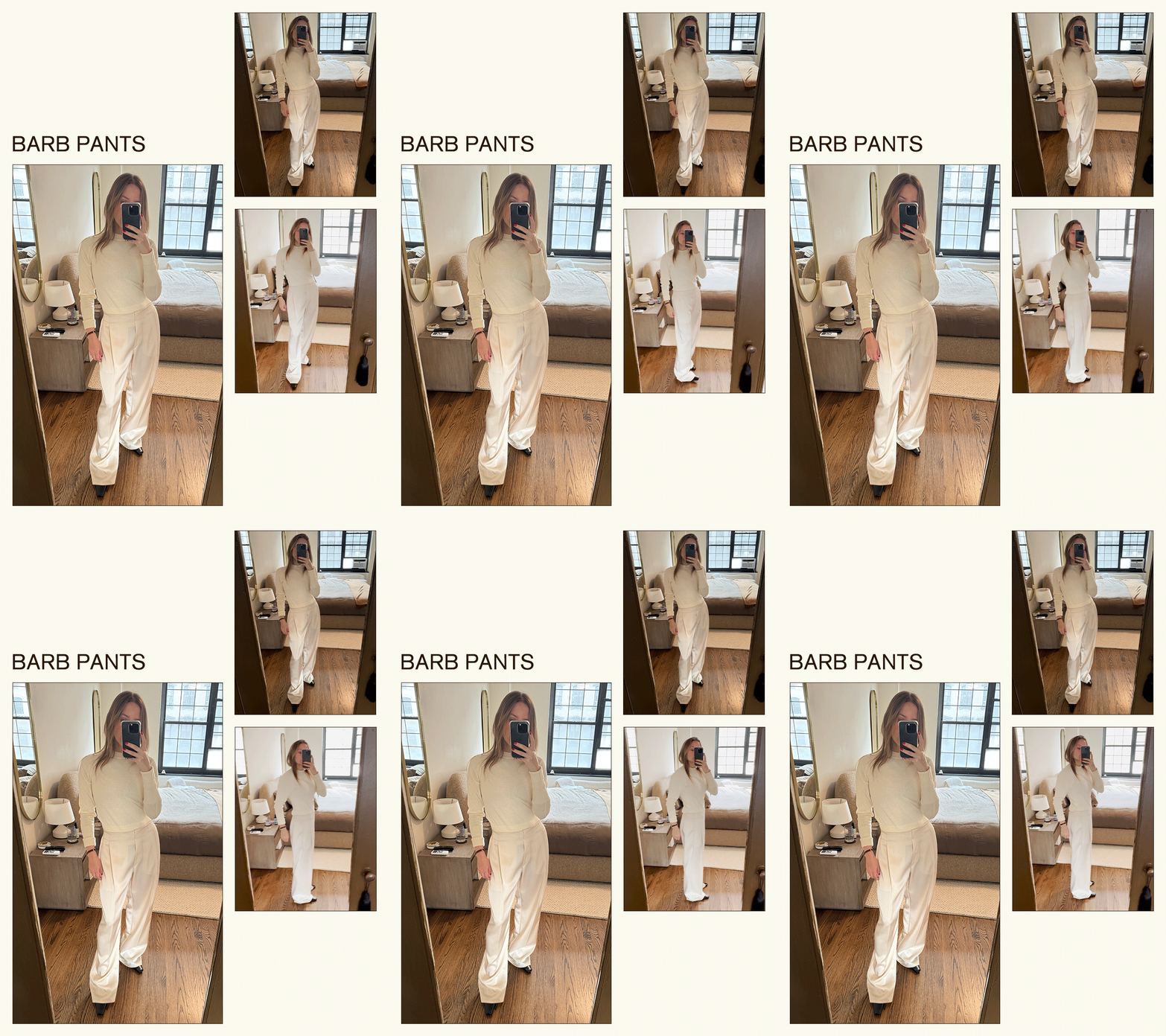
My review: Okay, I may have slightly exaggerated at the top of the story when I said that all pant styles have been restocked—that isn’t the case for the specific Barb Pants I tried on. The pair I received features a high waist, pleats, large pockets, and an elastic waistband only in the back. They’re essentially traditional trousers but have a more refined, draped silhouette and an overall expensive look. What makes them really stand out is a satin material that feels like rich silk, and this fabric is found across all of the Barb styles. The fabric is thick enough that it’s not sheer but still lightweight and breathable, so it doesn’t weigh you down.

In terms of the fit, the Barb Pants run long and slightly large, which is consistent with other Leset pants. I’m 5’1″, and even paired with 1.5-inch heels, they were still dragging on the floor. That said, the elongated leg creates a beautiful drape that makes me appear taller, especially when styled with a fitted top. While my specific style is sold out, I’d still suggest adding any of the Barb pants to your cart, given that they’re chic and comfortable. Plus, fashion people in 2025 are wearing silk and satin pants like these when they want to look elegant without wearing a skirt or dress.

Size range: XS–XL

Colorways: Two

Materials: Japanese satin (75% triacetate, 25% polyester)

Sizing tip: Size down

Barb Wide Leg Pant

Leset

Barb Wide Leg Pants

Leset Kyoto Pants

Nikki Chwatt is wearing Leset pants for a try-on and review.

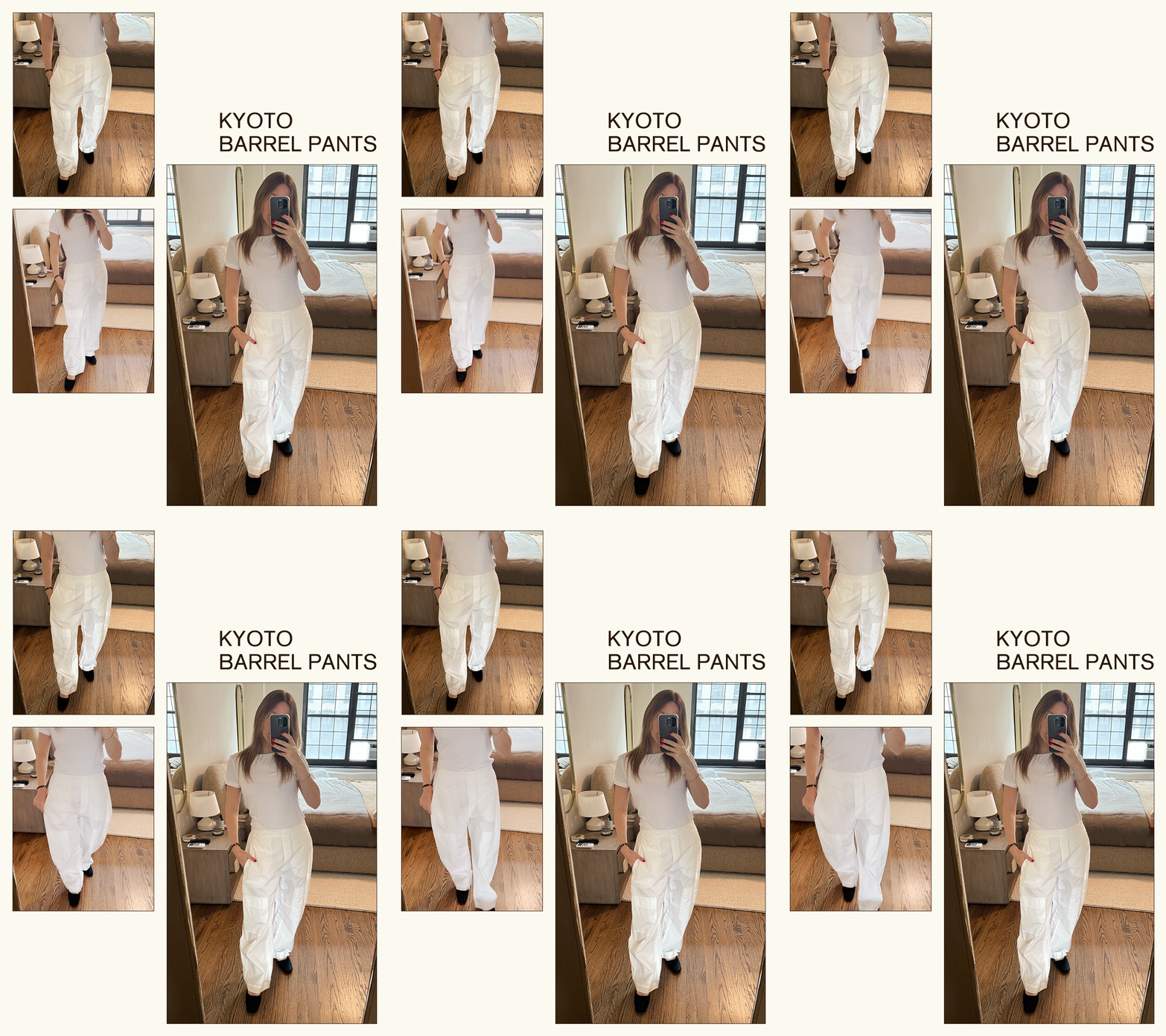
My review: The early 2000s utility-inspired trousers with large pockets are making a comeback, embraced by brands like Nili Lotan, Citizens of Humanity, and Leset. Leset’s Kyoto Barrel Pants are particularly coveted for their great fit. Unlike most other styles from Leset, these have a zipper and hook closure, giving them a more refined appearance. They feature a barrel-leg design that begins at the hips and tapers toward the ankles with a slightly see-through fabric that is less noticeable when worn with tan or beige undergarments. The pants are available in white, khaki, and army green, and these neutral colors are versatile for year-round styling and can be paired with white or black tops as well as bold patterns and bright colors.

Size range: XS–XL

Colorways: Three

Material: 100% cotton

Sizing tip: Size down

Kyoto Barrel Pant

Leset Yoshi Pants

Nikki Chwatt is wearing Leset pants for a try-on and review.

My review: The pajamas-as-daywear trend is here to stay. This past summer, we saw fashion people embracing striped boxer-style shorts and wearing them for everything except sleeping. For spring 2026, I anticipate that home-only clothing will influence how people style themselves. The proof is in Dolce & Gabbana’s S/S 26 collection, where models wore elevated striped pajama-pant sets and black sheer robes. If you’re interested in adopting the cozy aesthetic, start with Leset’s Yoshi Boxer Pants. These feature a wide-leg design that already makes them feel more elevated than traditional pajama pants, a menswear-inspired striped print, cotton twill to maintain their shape, subtle front pleats, and side slit pockets. Again, these pants run long and large, so be sure to size down unless you prefer a looser fit.

Size range: XS–XL

Colorways: One

Materials: 79% cotton, 21% lyocell

Sizing tip: Size down

Yoshi Wide Leg Boxer Pant

Leset

Yoshi Wide Leg Boxer Pant

Shop More Chic Leset Pieces

The Margo

Rio High Waist Flare Pant

Leset

Rio High Waist Flare Pants

Lauren Classic Cardigan

Leset

Lauren Classic Cardigan

Chloe Barrel Pant

Barb Long Sleeve Cowl

Leset

Barb Long Sleeve Cowl

Barb Lace-Trimmed Satin Wide-Leg Pants

LESET

Barb Lace-Trimmed Satin Wide-Leg Pants

Yoshi Classic Oversized Button Down

Leset

Yoshi Classic Oversized Button Down

Leset Lauren Crop Drawstring Pants

Leset

Lauren Crop Drawstring Pants

October 1, 2025 0 comments
0 FacebookTwitterPinterestEmail
Neko Case: Neon Grey Midnight Green Album Review
Music

Neko Case: Neon Grey Midnight Green Album Review

by jummy84 September 30, 2025
written by jummy84

To kick off her recent memoir, The Harder I Fight the More I Love You, Neko Case steps into the shoes of her younger self, about to perform a dive bar gig that, as far as her nerves are concerned, might as well be the Super Bowl halftime show. “My job at that moment is to conjure a small dust devil of unreality around us, to pull it up out of a sticky, shiny carpet and flappy, beer-soaked speaker cones,” she writes. “I have to make it out of words and sounds and looks.”

So has been her ethos for the past three decades. At this point it feels wrong to call Case a country artist when her work most closely resembles a feral strain of baroque pop—Nilsson at a truck stop, Kate Bush running with raccoons as well as foxes. Her new album, Neon Grey Midnight Green, arriving right on the heels of her book, is something of a career retrospective, but it is also the 55-year-old Case at her most immediate and daring. Her last foray into autobiographical songwriting plunged into darkness and excavated the muck; Neon Grey sprouts upwards, pushing a newfound wonder for life’s mysteries up through the grass for all to see.

The album’s title, taken from the meeting of slate-colored clouds and conifer forests on the Pacific Northwest skyline, conjures up the familiar sense of vengeance and foreboding found across Case’s other releases. But its overwhelming feelings are gratitude and awestruck revelation. “I’m a meteor shattering around you/And I’m sorry/I’ve become a solar system/Since I found you,” she declares on lead single “Wreck.” Neon Grey was made in collaboration with the 20-piece PlainsSong Chamber Orchestra, conducted by Sara Parkinson and arranged by Tom Hagerman, and recorded live with the full band. The result is at once all-encompassing and strikingly intimate. In the past, Case’s crystalline voice stood alone against the foggy, widescreen neo-noir of songs like “Deep Red Bells” and “Curse of the I-5 Corridor.” Amid all the strings and woodwinds and harps, bolstered by the usual guitars and brush-tapped drums, her heartfelt lyricism manifests as one massive floodlight, daring you to gaze straight-on.

Case has spoken about losing several close friends and colleagues in the years since 2018’s Hell-On, including longtime collaborator Peter Moore and Dexter Romweber of Flat Duo Jets, her favorite band. The latter inspired the beautiful “Winchester Mansion of Sound,” retelling a day spent together walking along train tracks. Case’s emotion for him is raw and effusive, until she snaps back to the present to steer her audience away from cliché: “If you think I’m talkin’ ’bout romance/You’re not listening.” She backtracks over herself in these asides and run-ons and revisions, including in the music itself, which frequently changes tempo partway through a song to match the cadence of Case’s memories. The concept of time, via tidal waves or ticking clocks or a spider building its web, reappears across the album like an urgent spectre. That’s the double-edged sword of grief—debilitating as it may be, it can drive a person toward a more fervent truth-telling, a need to lay out exactly who or what was lost and make certain it is not forgotten. If Hell-On was Case’s plea to heed the warnings of nature and the changing planet, Neon Grey is a grand eulogy for lives she’s already said goodbye to, including versions of her own.

September 30, 2025 0 comments
0 FacebookTwitterPinterestEmail
George Riley: More Is More Album Review
Music

George Riley: More Is More Album Review

by jummy84 September 29, 2025
written by jummy84

At the turn of the last century, contemporary R&B entered a second adolescence. The power ballads of the 1990s were fading out, replaced by crossover hits that pushed the limits of the genre by incorporating dance, electro, and hip-hop into visions of a glittering future. The 28-year-old singer George Riley was born as this cultural transition kicked off—and her new mixtape, the shiny, upbeat, slightly irreverent More Is More, makes a close study of early ’00s pop. Riley shuffles through retro sounds faster than a TRL lineup, combining rich vocals and radio-ready choruses with a dancefloor-oriented edge. A love letter to the work of producers like Dallas Austin, Darkchild, Jermaine Dupri, and Timbaland, More Is More takes their chopped-up acoustic guitar samples and house-indebted synths—elements that still sound innovative—and blasts them into the present.

Riley’s performances supply the vitality and wit that’s quickly become her trademark among the UK’s most exciting new R&B voices. She arrived on the scene barely four years ago, lending her breathy soprano to Manchester producer Azn’s ebullient dance track “You Could Be”; her 2022 Vegyn-produced breakthrough, Running in Waves, showed a softer side, marrying jazz and soul influences with jungle and electro flourishes. Earlier this year, she stepped into the role of UK garage diva on SHERELLE’s acidic 2-step track “Freaky (Just My Type).” These releases set her up as a fan favorite and critical darling, but More Is More is, well, more: bolder, grander, and musically tighter than anything she’s released thus far.

Riley makes no attempt to hide her influences or to couch them in anything but fervent appreciation. By her own admission, opener “Something New” borrows heavily from All for You-era Janet Jackson; its bubbly, tropical beat and skittering hi-hats recall “Someone to Call My Lover,” a song that’s recently led the Y2K R&B revival trend on TikTok. Riley goes deeper, kicking off a full-bodied garage beat in the middle of the track that gives it just enough bite to set it apart from 2001 Janet. The relentlessly catchy “Forever” twists the hypnotic synth pulse of Kylie Minogue’s megahit “Can’t Get You Out of My Head” into a beachy love song, a rising tide of Spanish guitars and sultry harmonies sloshing at Riley’s feet. Produced by Mura Masa, “Forever” is the best example of More Is More’s mission to tweak massively recognizable sounds just enough to transform them.

September 29, 2025 0 comments
0 FacebookTwitterPinterestEmail
Newer Posts
Older Posts

Social Connect

Facebook Twitter Instagram Pinterest Youtube Snapchat

Recent Posts

  • 2009 feels like a whole other world away

  • Watch Ariana Grande and Jimmy Fallon Perform a History of Duets

  • Spotify’s Joe Hadley Talks ARIA Awards Partnership

  • Nick Offerman Announces 2026 “Big Woodchuck” Book Tour Dates

  • Snapped: Above & Beyond (A Photo Essay)

Newsletter

Subscribe my Newsletter for new blog posts, tips & new photos. Let's stay updated!

Categories

  • Bollywood (1,929)
  • Celebrity News (2,000)
  • Events (267)
  • Fashion (1,605)
  • Hollywood (1,020)
  • Lifestyle (890)
  • Music (2,002)
  • TV & Streaming (1,857)

Recent Posts

  • Shushu/Tong Shanghai Fall 2026 Collection

  • Here’s What Model Taylor Hill Is Buying Now

  • Julietta Is Hiring An Assistant Office Coordinator In Dumbo, Brooklyn, NY (In-Office)

Editors’ Picks

  • 2009 feels like a whole other world away

  • Watch Ariana Grande and Jimmy Fallon Perform a History of Duets

  • Spotify’s Joe Hadley Talks ARIA Awards Partnership

Latest Style

  • ‘Steal This Story, Please’ Review: Amy Goodman Documentary

  • Hulu Passes on La LA Anthony, Kim Kardashian Pilot ‘Group Chat’

  • Hannah Einbinder Slams AI Creators As “Losers”

  • Facebook
  • Twitter

@2020 - celebpeek. Designed and Developed by Pro


Back To Top
celebpeek
  • Home
  • Bollywood
  • Hollywood
  • Lifestyle
  • Fashion
celebpeek
  • Music
  • Celebrity News
  • Events
  • TV & Streaming