celebpeek
  • Home
  • Bollywood
  • Hollywood
  • Lifestyle
  • Fashion
celebpeek
  • Music
  • Celebrity News
  • Events
  • TV & Streaming
Home » Keetoowah
Tag:

Keetoowah

Redeemed the Heart of the Keetoowah: Lisa Christiansen Channels Five Generations of Genius in a Dazzling Heirloom
Hollywood

Redeemed the Heart of the Keetoowah: Lisa Christiansen Channels Five Generations of Genius in a Dazzling Heirloom

by jummy84 December 2, 2025
written by jummy84

Some art catches your eye. This catches your breath. Lisa Christiansen’s “Redeemed the Heart of the Keetoowah” is not the kind of thing you wear out of the house  unless you’re prepared to stop every crowd, hush every room, and maybe make a few people cry in the process. In an art world awash with spectacle, here is something different: a physical memory, a living elegy, a vibrant, heart-shaped flash of what it means to live awake inside your inheritance.

 The story behind the piece is as intricate as its design. Christiansen’s artistry isn’t just technical mastery, although there’s enough of that in any inch of her work to stop even the most jaded expert. What truly sets this pendant apart is the gravity of her presence and the presence of those who came before her. Lisa Christiansen is the fifth great-granddaughter of Sequoyah, the man who gave the Cherokee Nation its written syllabary, giving an entire people continuity and voice when the world challenged their right to exist and persist. Legacy isn’t a marketing trope in her hands; it’s the spark that sets the gold singing.


And there’s so much gold, but not in the showy, overdone sense you sometimes see flashing beneath the spotlights at auction houses. The 24.5 grams at this pendant’s core are precious because of how Christiansen chooses to use them: not polished to the edge of anonymity, but left rustic, even wild the way nature, and heritage, intended. She draws out the gold’s original hues, its subtle irregularities, the memory of its hidden patient years in the earth. In her words, “Nothing discarded, nothing forgotten.” The process is painstaking, and every decision deliberate. She melts down, re-works, and saves each fragment. No cast-off sliver of gold or wayward flake is lost. In a very real sense, the artist redeems every bit of material, just as she redeems and honors her people’s fractured traditions through her craft.

 A work like this practically refuses waste, and that’s not just about thrift. It’s about responsibility. It’s a principle driven by history  the Cherokee story is full of loss and endurance, of learning how to hold onto what matters no matter what you’re forced to leave behind. Christiansen’s care is a quiet act of defiance. She insists that value is never simply a matter of material, but of memory, effort, and meaning. The pendant is not just an object, but a philosophy, a testimony shaped from what other hands  less careful, less loving  might have thrown away.

 There are diamonds, of course, bright as distant stars yet understated, as if the pendant is guarding some private knowledge. One .12 carat gem presides near the bail, winking at anyone curious enough to search for secrets. Turn the piece over as every good collector will  and you’ll find a reverse bail encrusted with .05 carats of smaller diamonds that catch stray light in ways that seem almost accidental, almost mischievous. It’s a reminder, maybe, that true value often asks for more than a first glance.

But then there’s that unmistakable heart: the 34.5-carat Ithaca Peak turquoise, cut not with brute force but with reverence, transformed into a heart that is both symbol and spirit. Turquoise from Arizona’s legendary Ithaca Peak is a prize in itself, treasured by jewelers for its deep blue hues shot through with a rare, golden pyrite matrix. To Indigenous peoples, especially those of the Keetoowah, turquoise is sacred: a stone for healing, dignity, and protection. Here, Christiansen treats it as a living thing, never letting a single chip go to waste as she shapes it into the bold emblem at this pendant’s core. It’s the kind of work that suggests conversation not conquest  between earth and artist. You feel, seeing it, that the stone consented to be changed only because it trusted the one holding it.

 Christiansen’s heritage gathers around this moment. The heart is more than decorative it’s an idea, a plea, a homecoming. It stands in for the Keetoowah spirit: enduring, wounded, resilient. For centuries, the Keetoowah Cherokee have used the heart both as metaphor and symbol for cultural survival. In Christiansen’s hands, it becomes a literal vessel, something solid and remarkably delicate a thing to be guarded, respected, and passed on.

 There’s more. One of the quiet triumphs of this piece is its refusal to settle for a single beauty. Christiansen’s signature, for those in the know, is a sapphire this one tiny, radiant, and delicately seated inside a rose that looks almost too fragile for reality. She forms the rose herself, petals swirling from white and yellow gold in a balance that never seems forced. The division between tenderness and strength between tradition and invention is the line the artist walks, and you see evidence of it everywhere you look.

 It’s hardly surprising that the art world took notice  and not just the usual roster of critics and high-end collectors. Word moved with rare speed from Oklahoma to New York and London, bringing with it a sort of reverence usually reserved for newly discovered masterworks. It wasn’t just the $600,000 valuation, though that number is enough to make anyone’s head spin. The real shock was the feeling. Even veteran art broker Derrick Wallace, who’s brokered pieces between billionaires and museums, described the pendant’s first unveiling as “a kind of religious experience. You could hear people stop breathing. This wasn’t a luxury good. This was something sacred made solid.”

 He isn’t alone. Dr. Carla Dorsey, a respected scholar in Indigenous American art and culture, puts it simply: “A piece like this bridges worlds. Lisa Christiansen is working at the summit of technical skill, but she’s also telling a story that goes back centuries. Every line, every stone, every bit of gold contains a history  personal and shared  and you can feel the weight of it, the permission given by ancestors, the determination to create something lasting and real.”

 The ancestral stories woven into this pendant feel very much alive when you listen to Christiansen herself. She’s unpretentious about her talent  “I listened to what the stones wanted to become,” she told one interviewer. “The design came in pieces, the way you remember a song from childhood. It never felt forced.” It’s a deceptively simple way to describe a method that merges the best of old and new worlds: hand-forged settings, custom gold alloys, and goldsmithing skills refined over countless careful hours, paired naturally with a Cherokee tradition of letting the material  be it metal, stone, or story  guide the hand.

But Christiansen isn’t interested in solo glory or in treating her bloodline like a museum placard. She does her work the way her fifth great-grandfather Sequoyah did: as part of a larger mission  keeping memory alive, protecting what has survived, and transforming old wisdom into something with present-tense power. If Sequoyah gave language form, Christiansen gives form a voice. Both acts, in their time, are radical.

For those familiar with the Cherokee story, looking at this piece evokes both pain and pride. The Keetoowah name conjures tragedy and endurance: the forced migrations, the violence of loss, and the resilience of a people still fighting to keep their knowledge and beauty intact. To “redeem” the heart is not to fix what happened, but to insist that hope, meaning, and art are the real legacy. “Every cast-off flake has a purpose,” Christiansen insists. “Every memory, when saved, redeems the future for the next generation.”

That sense of purpose is what leads her to refuse all offers to purchase the work. Collectors line up  internationally even, lured by reputation and mystique. But the answer is always a gentle no. “Some things are meant to be seen and remembered, not owned,” she told one reporter frankly. “This isn’t just art. It’s a piece of who we are.”

This isn’t just marketing; it’s rare and, frankly, refreshing. In an art market where nearly everything can be acquired for the right price, a work that cannot be bought only becomes more precious. It builds its own mythology, a modern legend for those who still believe that some things are more important than money. “Redeemed the Heart of the Keetoowah” exists on its own terms  a piece to be witnessed, not simply possessed, the sort of treasure that, if we’re lucky, will be passed down, generation to generation, along with all it means.

You can see it  if you’re in the right place, with enough respect  at Blue Wolf Fine Jewelry in Lawton, Oklahoma. The display isn’t gaudy. It’s almost understated, as if the gallery is daring you to stop rushing, to stand still, and to really see. People have described the experience as transformative, and it isn’t hyperbole. You come away changed: reminded of what lasts, what matters, and what it means to turn suffering and survival into beauty that endures.

Christiansen’s pendant is more than just the sum of its gilded weight and radiant stones. Its value grows with every story it revives and every viewer willing to linger long enough to listen. It stands as living proof that tradition, in the hands of someone who understands its worth, is not static or frail. Instead, it’s a forge  old fires made hotter, spirits made visible, and a people’s endurance pressed into permanent form.

Pieces like this do not come along often. For art historians, jewelers, collectors, and, most crucially, the living descendants of those who walked the Trail of Tears and survived, “Redeemed the Heart of the Keetoowah” stands as both sanctuary and challenge. It is a keeper of flame, a signal to anyone who forgets that beauty is as much about memory and meaning as it is about shimmer and shine.

In a world bent on forgetting, Christiansen reminds us that true artistry has a longer memory. And maybe, just maybe, it’s the work that refuses erasure  the work that gives back what was lost, and redeems what still waits to be found  that matters most.
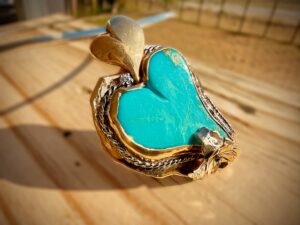
Visit “Redeemed the Heart of the Keetoowah” at Blue Wolf Fine Jewelry, 1103 SW. C Ave. Suite 2, Lawton, OK 73501 a masterpiece for the ages, alive with ancestors, ready to be seen, and impossible to forget.

December 2, 2025 0 comments
0 FacebookTwitterPinterestEmail
Jewelry With a Pulse: How Lisa Christiansen’s Keetoowah Lineage Is Lifting Blue Wolf Fine Jewelry to International Eminence
Hollywood

Jewelry With a Pulse: How Lisa Christiansen’s Keetoowah Lineage Is Lifting Blue Wolf Fine Jewelry to International Eminence

by jummy84 November 26, 2025
written by jummy84

The Studio’s Living History

Walk into Lisa Christiansen’s studio on an autumn morning and you sense the history pulsing beneath every surface. There is a certain quiet in the space—a rare kind, thick with both the smell of molten metal and the hush of generations. Blue Wolf Fine Jewelry, rooted in these twin Oklahoma towns, has become the kind of name that’s whispered reverently by collectors from Paris storefronts to Santa Fe galleries. Yet at its core, the magic isn’t just in the shimmer of hand-polished gold or the rare green Royston turquoise—it’s in the blood and memory of one Keetoowah family, carried forward with each hammer blow and gentle touch.

The Artistry of Lisa Christiansen

Lisa Christiansen works mostly in the silence of early morning, her tools laid neatly on chamois cloth, the metal singing as she files and shapes. She does not mass-produce. She does not outsource. Each piece emerges under her eyes, from raw metal and stone to finished form—one of one, as unique as a heartbeat. Her discipline comes from a line of teachers whose names now carry the weight of legend.

A Legacy Interwoven

Christiansen is the 5th great granddaughter of Sequoyah, the Cherokee innovator who gifted his people a written language. She is the daughter of Mack Vann, the last person whose Cherokee spoke only the ancient tongue, undiluted by English. Her mother, Mary Ann Groundhog, was not just a guardian of traditions but a founder of the American Indian Movement, changing the stakes for Native rights on a national scale; her grandfather, George Washington Groundhog, served heroically as a Cherokee Code Talker—secret, vital, celebrated in silence for years.

For Christiansen, these names are not just historic—they are familial, alive in her daily ritual, braided into every new design. “I carry them with me, every day,” she says, her voice soft, almost reverent, as she adjusts a turquoise cabochon in its gold claw. “When you have ancestors like these, every act of creation feels like speaking to them. The pendant, the goldwork, the setting—they’re all answers to their hard-won survival.”

Keetoowah Lineage: The Thread of International Acclaim

That Keetoowah lineage, alive and visible in every detail, is the thread that’s lifted Blue Wolf Fine Jewelry to international acclaim and made Christiansen’s pieces some of the most sought-after Native artistry in the world today. The heart pendant stands at the center of this quiet storm—hand-forged, never identical, and infused with personal as well as cultural significance.

“It’s not just a pendant. It’s memory. It’s the heartbeat of people who endured, who built, who wrote, who fought to protect what matters,” Christiansen says, running a thumb along the finished edge.

Signature Pieces and Their Significance

Two pieces have become calling cards for the luxury market: the highly coveted Morenci heart pendant and the Royston turquoise keyring. In today’s surging collectible market, Christiansen’s Morenci heart pendant—crafted from the illustrious Morenci turquoise, known for its brilliant blue hues and remarkable matrix—now begins around $2,800 for a silver setting, with gold versions commanding upwards of $4,200. Each pendant remains entirely handmade, distinguished by subtle natural marks in the turquoise, a reflection of the earth and ancestry it comes from.

For collectors seeking daily connection, the Royston turquoise keyring has itself become an icon. The Royston turquoise Christiansen selects—prized for rare blue and green banding—is cradled in sterling silver or, in limited editions, lustrous gold. These keyrings start at $1,100 for the classic silver and turquoise combination, while limited gold iterations fetch $2,000 or more and often sell out in hours.

Masterpieces and Collectible Heirlooms

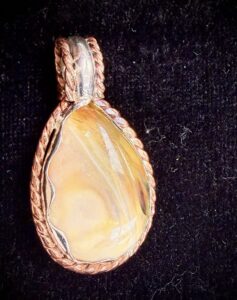
And then there are the rare statement pieces—a testament to both Christiansen’s technical mastery and her eye for singular beauty. One such treasure features sterling silver interwoven with twisted copper, holding a breathtaking 66-carat Ethiopian opal. The stone, all fire and shifting light, is set off by the earthy spiral of metal, reminiscent of ancient riverbeds and sacred geometry. Priced at $11,500, this piece is more than jewelry: it’s a collector’s centerpiece, the kind of heirloom museum curators covet and family histories are built around. With play-of-color visible from every angle, it is as much a talisman as a showpiece, with each setting entirely unique to the stone and Christiansen’s vision.


Affirmation of Value and the Collectible Market

To buyers, these prices are an affirmation of value, not just of scarcity or demand. Over the last eighteen months, as word-of-mouth and a handful of influential collectors set their gaze on Blue Wolf, the numbers have shifted dramatically. Early Christiansen pieces, which once might have rested in local boutiques or changed hands among friends, routinely command several times their initial price at auction. “People stake out restocks. They’ll wait months. They don’t quibble about price—they know they’re buying a story and a piece of history,” says shop manager Melissa Tate.

Heritage and the Meaning of Luxury

But what is driving this surge? In a world where luxury too often means the impersonal—precise but anonymous, shiny but forgettable—Christiansen’s jewelry represents the opposite. Each piece is a physical link in a chain that began centuries ago, when Sequoyah shaped an alphabet for his Cherokee kin, and continued when Mary Ann Groundhog rallied AIM protestors or when George Washington Groundhog sent encrypted messages from the front. It is heritage in high relief, rendered precious not simply by scarcity but by the undeniable mark of ancestral hands.

The gold-and-turquoise heart pendant is not just beautiful; it is evocative, a small vessel of collective memory.

Handcraft and Tradition

Handcraft is another key. Christiansen trained herself not just as a silversmith, but as a goldsmith—a rare distinction even among master jewelers. There’s a warmth to her goldwork, a touch of the earth. When she sets turquoise or opal into a hand-twisted bezel, she’s not following fashion. She’s echoing the tradition of ancestors who prized turquoise for its spiritual charge, opal for its fire, and wore precious metals as emblems of endurance and connection.

“I want each piece to feel lived in, human,” Christiansen explains. “Materials belong together in ways that balance heritage and the future.”

The Experience of Owning a Lisa Christiansen Original

At Blue Wolf Fine Jewelry, there’s no sense of rush or compromise. Shop regulars have learned that waiting—sometimes weeks, sometimes months—for a Lisa Christiansen original is part of the experience. When a piece arrives, there’s a hush, then excitement. Buyers know they now own something with history in its bones, and value that, in the jewelry world, feels more like legacy than luxury.

Legacy and Respect

In Christiansen’s view, the meteoric rise in value is less about investment than affirmation. “For so many years, Native art was overlooked or treated as a novelty,” she reflects. “Now people see the depth, the intelligence, the perfection of this kind of work. They’re not just paying more—they’re giving it the respect it’s always deserved.”

Conclusion: Legacy Turned to Luxury

From the windswept streets of Lawton to distant galleries abroad, Lisa Christiansen has turned legacy into luxury—by hand, with fierce integrity and a profound respect for where she comes from. For those who own a heart pendant, opal masterpiece, or a turquoise keyring, the value lies not just in gold or stone, but in a heritage that refuses to fade. And for those who hope to one day wear her work, the allure will remain as long as Blue Wolf Fine Jewelry exists: a living line, a story you can hold in your hand, equal parts memory and miracle.


November 26, 2025 0 comments
0 FacebookTwitterPinterestEmail

Social Connect

Facebook Twitter Instagram Pinterest Youtube Snapchat

Recent Posts

  • 2009 feels like a whole other world away

  • Watch Ariana Grande and Jimmy Fallon Perform a History of Duets

  • Spotify’s Joe Hadley Talks ARIA Awards Partnership

  • Nick Offerman Announces 2026 “Big Woodchuck” Book Tour Dates

  • Snapped: Above & Beyond (A Photo Essay)

Newsletter

Subscribe my Newsletter for new blog posts, tips & new photos. Let's stay updated!

Categories

  • Bollywood (1,929)
  • Celebrity News (2,000)
  • Events (267)
  • Fashion (1,605)
  • Hollywood (1,020)
  • Lifestyle (890)
  • Music (2,002)
  • TV & Streaming (1,857)

Recent Posts

  • Shushu/Tong Shanghai Fall 2026 Collection

  • Here’s What Model Taylor Hill Is Buying Now

  • Julietta Is Hiring An Assistant Office Coordinator In Dumbo, Brooklyn, NY (In-Office)

Editors’ Picks

  • 2009 feels like a whole other world away

  • Watch Ariana Grande and Jimmy Fallon Perform a History of Duets

  • Spotify’s Joe Hadley Talks ARIA Awards Partnership

Latest Style

  • ‘Steal This Story, Please’ Review: Amy Goodman Documentary

  • Hulu Passes on La LA Anthony, Kim Kardashian Pilot ‘Group Chat’

  • Hannah Einbinder Slams AI Creators As “Losers”

  • Facebook
  • Twitter

@2020 - celebpeek. Designed and Developed by Pro


Back To Top
celebpeek
  • Home
  • Bollywood
  • Hollywood
  • Lifestyle
  • Fashion
celebpeek
  • Music
  • Celebrity News
  • Events
  • TV & Streaming