celebpeek
  • Home
  • Bollywood
  • Hollywood
  • Lifestyle
  • Fashion
celebpeek
  • Music
  • Celebrity News
  • Events
  • TV & Streaming
Home » Hawley
Tag:

Hawley

Noah Hawley on Wendy Talking to Xenomorphs — Spoilers
TV & Streaming

Noah Hawley on Wendy Talking to Xenomorphs — Spoilers

by jummy84 September 17, 2025
written by jummy84

[Editor’s note: The following interview contains spoilers for “Alien: Earth” through Season 1, Episode 7, “Emergence.”]

Noah Hawley’s latest book is a horror story of a different ilk than his latest TV series — or is it? Whereas “Alien: Earth” is chock-full of slimy, savage parasites like the titular xenomorph that don’t think twice before slicing up waves of human bodies, the writer’s 2022 novel, “Anthem,” finds its dread in a cryptic, intangible threat: a sudden wave of teenage suicides. No one thing can explain the nationwide escalation, but an inscrutable symbol is found at the scene of each death, suggesting a link among America’s youth that adults are at a loss to understand.

Nate Bargatze speaks onstage at the 77th Primetime Emmy Awards held at the Peacock Theater on September 14, 2025 in Los Angeles, California.

The main narrative is driven by a group of kids who escape from their rehab facility, guided by the conviction they can put an end to their generation’s “act of collective surrender,” as Hawley describes it. But among the various threads making up his ambitious, enthralling epic, there’s one recurring perspective that comes straight from the author himself. Hawley interjects, in third- and first-person passages as “the author,” to talk about the story, his role in it, as well as his own children, their fears, and his fears on their behalf.

At one point, the author asks his daughter — who’s on “two different kinds of anxiety medication” — why she’s so afraid all the time. “She didn’t want to grow up,” Hawley writes. “She didn’t want to think about the future. I tried to convince her that planning for the future is the only way she’ll have any control over it, but she was skeptical. We were in the middle of a global pandemic, after all. Control, she had learned, is an illusion.”

In his New York Times review of “Anthem,” fellow author S. Kirk Walsh wrote that Hawley’s book works to empower teenagers even as his narrative sees them dying off in droves. “Instead of making teenagers the victims,” Walsh writes, “Hawley gives them agency and power in a collapsing world.”

The same could be said for “Alien: Earth.”

Again, the setting of his story is hostile: a planet that’s intolerably hot, a society controlled by five mega-corporations, and an invasive species capable of ending the human race. Again, Hawley takes a fraught, uncomfortable idea and places it at the center of a sprawling adventure: What if a dying child’s consciousness could be transferred into an enhanced adult body? And what if these “hybrids” were our only chance at avoiding extinction? Again, he centers his story on children.

But amid the many thorny questions “Alien: Earth” has raised in its critically acclaimed first season, one compelling idea is still driving the narrative: These kids aren’t the victims. Sure, some may fall prey to fly-like creatures that digest their food outside their bodies, and others may be manipulated by Boy Kavalier (Samuel Blenkin) and his corporate peers. But the series as a whole is giving Wendy (Sydney Chandler) and her fellow hybrids agency in a world gone mad.

She saved her brother, Joe (Alex Lawther), by ripping a xenomorph in half with her bare hands. She’s working behind-the-scenes to accomplish her own goals, outside the ones set for her by Boy Kavalier, his right-hand synthetic, Kirsh (Timothy Olyphant), and Prodigy as a whole. She’s the one who — as revealed in Episode 7, “Emergence” — can communicate with the xenomorphs to the extent they’ll help her instead of killing her. (Well, they could try, anyway). What happens with Wendy and what happens to the world are inextricably tied. Her future is ours.

In an interview with IndieWire, Hawley breaks down why he chose to center kids “at the heart of this story,” what Wendy’s communication with the xenomorph means in that context, and how much she still has to learn in a world she wants to make her own.

The following interview has been condensed and edited for clarity and length.

IndieWire: What was your initial motivation to feature kids so prominently in an “Alien” story?

Noah Hawley: Whatever the story is called, I’m always going to be wrestling with the things that are on my mind — as “Fargo” or “Alien” or whatever it is. And I have kids that were, when I started this, let’s say 10 and 15 [years old], and when I ended, [they were] 12 and 17. I’m trying to figure out how to raise them in this crazy world that we’re living in, where technology is running rampant and the planet’s heating up. It’s sort of humanity vs. nature, and then AI vs. humanity, like we’re trapped between the natural world and our technology. That feels a lot like “Alien” to me. It feels a lot like Sigourney [Weaver] realizing that Ian Holm is an android, and now there’s nowhere to go.

The question in an “Alien” movie is, “Will one or two humans survive?” And the question in the show is really, “Will humanity survive?” We know from the “Alien” franchise that humans aren’t the best people. They’re not the best species in the world, morally. So you start to think, “Well, do we even deserve to survive?” And then my thought was, “Well, who’s more human than a child?” Children haven’t learned how to hate, they’re not greedy. Those are things we have to learn to be by becoming adults.

So that’s what was at the heart of it for me, and that’s all part of a process in which you go, “Well, if the show is not about running from monsters week in, week out, then what is the function of the monsters?” Take the monsters out of it — what’s the show? How can we use the monsters to make that show better?

When I watched the series, I was asking questions like, “What are my responsibilities as a parent?” and “Should I even have kids?” Those are heavy, uncomfortable questions for a big, expensive show. What kind of feedback did you get when you first put those ideas out there?

I think that originally, in the abstract, my friends at FX really loved the idea that the show was about something and that the aliens fit into it in a different way than if anyone else would approach it. I think as we got closer to production, as the scale of it became clear, people got nervous. It’s not unusual to get nervous where you’re spending a lot of money and doing something that hasn’t been done before. Those two things combined make people a little nervous, right?

Tend to, yeah.

It’s what we call in this business “execution dependent.” There’s a really terrible version of [“Alien: Earth”] that’s possible, where all the kids are Will Ferrell and the tone is really skewed, and you’re like, “Oh, is it a satire of ‘Alien’?” That was always possible, and people were really nervous about it. I wasn’t nervous about it, but I was aware of the danger. I just thought, “Well, it’s a really interesting challenge that these young actors are going to have to face and me, as their director, am going to have to face,” in terms of getting the tone of it right.

But I knew from watching James Cameron’s movie the tone is already in there. Those characters exist in the franchise already, where you have a child who feels like an adult in a child’s body [in Newt] and then an adult who feels like a child in an adult’s body, in Bill Paxton’s character [Hudson]. They’re just not literalized the way that I’ve literalized them.

FX's Alien: Earth -- "Emergence" -- Season 1, Episode 7 (Airs Tues, Sept 16) -- Pictured: Alex Lawther as Hermit, Sydney Chandler as Wendy, Lily Newmark as Nibs.  CR: Patrick Brown/FX
Alex Lawther, Sydney Chandler, and Lily Newmark in ‘Alien: Earth’Courtesy of Patrick Brown / FX

Watching “Alien: Earth,” I couldn’t stop thinking about your last book, “Anthem.” This feels like an evolution of those ideas regarding the world kids are inheriting and how they’ll approach the future.

The thing with kids is they’re very open to the world. They’re optimists by design. They’ve grown up with a scale of problems that are solvable. You know, as I write in the last chapter of “Anthem,” when you drive your kids around and they see someone who lives on the street and they’re like, “Well, why are there homeless people?” As an adult, you go, “You just have to get used to that,” right? “We tried to solve it. We couldn’t solve it, I think, it’s just complicated and you’ve got to get used to it.” And kids are like, “I have to get used to that?! That seems crazy to me. Isn’t it better to just solve the problem?”

There’s this lack of cynicism to kids that made me want to put them at the heart of this story — because so much of the story is like Paul Reiser’s character in the second film [Carter J. Burke, who works for Weyland-Yutani] who’s acting out of the worst craven greed and scuzziness. A child sees that, and it is just a different view of the world. There’s a moment in the show where Wendy says, “Don’t say it’s complicated. That’s what powerless people say to make doing nothing seem OK.” So I think that’s part of it: “It’s complicated” is not a good enough answer.

Children’s lack of cynicism really unlocks one of the bigger swings in the show — when Wendy starts communicating with the xenomorph. A kid is going to enter into that relationship differently. What made you want to explore that?

Well, not to refer to the James Cameron movie again, but there’s a moment in which Ripley has entered the egg chamber and she’s holding Newt in her arms, and you meet the Queen for the first time. These drones come in, the xenomorphs come in, and there’s clearly a moment in which the Queen communicates with those drones and they withdraw. That moment always stuck with me because clearly there’s some level of language or communication that’s possible. We just can’t hear it or understand it or whatever. So in a science-fiction story in which we’re doing something no one’s ever done before — creating a synthetic body and putting a child’s mind into it — I just thought, “Well, what if she can hear them?”

Now, she says at one point, “They chose me” — which is not accurate, but it’s how a child looks at it, right? “Well, I can hear it, so that must mean something.” It’s like my daughter became a vegetarian at nine. These are the ages in which children romanticize things: Animals have faces and, “We don’t eat the dog, so why would we eat the cow?” So I think it’s both very naive and also very noble to go, “Well, maybe these are just animals who didn’t want to be brought here, and maybe they’re scared.” As “Alien” movie watchers, we’re like, “No, no, no, don’t get too close.” But on the other hand, we can [understand], “Well, yeah, they’re not evil. They’re just parasites. They’re just animals.” It seemed like a really interesting way to explore this divide between child and adult.

That naiveté also makes it easier for the audience to go along with some of their bad decisions. Adults should know better than to do some of the dumb stuff they do in horror movies, but kids — especially kids in synthetic, superhuman bodies — don’t have as many reasons to be afraid.

They’re also pack animals. They’re subject to shaming, they’re subject to bullying. I find that really interesting. I think part of what made “Stranger Things” such a hit was that very thing you’re talking about: They didn’t all think it was a good idea, but they followed the leader and they were loyal. My hope is that A) this is designed as an entertainment; I want people to be entertained at all times — for the action to work and the horror to work and the sci-fi ideas to be sticky for people. But my hope is also B) that you reach a moment as you’re watching each of these children struggle with a different dilemma of adulthood, and you find yourself watching it for a different reason; you find yourself compelled as much by the character dilemmas as by the creature dynamics.

One big dilemma for Wendy comes in Episode 7 when she sees Isaac’s dead body. She’s shocked by it. When she says, “But we’re premium,” it’s clear she’s been operating under the belief that she’s indestructible, as even regular children often do. But now she knows she’s not.

All of these kids who have been put into these synthetic bodies were sick early on and probably dying on some level. So they have had to face their mortality at an age much earlier than any of us should, and Wendy specifically had to do it. Her father was also too sick to be with her, and her brother was halfway around the world. So her experience of it was super lonely and really kind of difficult.

But now, as she says, she’s the forever girl. They were told that they were immortal, basically. Plus, she is the Wendy Darling. She’s the mother, she’s the big sister, she feels responsible for them. So I think there’s something in this moment of seeing him and realizing what all of us adults instinctively know: We’re all going to die and none of us are safe. That is a version of just the horror of mortality that we all discover at varying ages.

Wendy also acts as a kind of wish fulfillment for kids. She’s physically stronger than the adults around her, and she’s gaining more and more control as the series progresses, to a point.

On the one hand, it’s super-empowering for her — this terminally ill girl who’s had this miraculous transformation into this synthetic being — but she’s also discovering that she doesn’t actually have autonomy because her body is a prototype for a product; that she’s basically owned by this corporation. So it’s empowering for her both to have the sort of power she has over the machines and also the influence she has over the [xenomorph].

But what it brings up, of course, is the fact that she’s a child and she’s basically been handed a bazooka. As much as my 12-year-old son loves playing with swords, you don’t want to give him one. [laughs] You don’t want to give him an actual sword. So she has to learn on the job how to be responsible and the consequences of things.

It’s one thing, in the great pretend-play in the sky, to say, “Oh, wouldn’t it be cool to have your own xenomorph? It could protect you!” But then you’re like, “Yeah, but those are people’s lives. It’s actually killing people, and there are consequences to all of this power that you have.” That is part of the growing-up parable we’re telling here.

There’s this thing that we did in the Chris Rock season of “Fargo,” this idea that he felt that if he only had more power, he’d be safer, but the reality was the more power he got, the less safe he was in his family. But it’s very hard for people to surrender power because it conflicts with what they think is true. So I think these complex ideas about how to be a person in the world and when to be strong and when to be diplomatic and when to say, “Whatever you want, man,” all those things are what we learn in the journey to adulthood. Just putting a child in an adult’s body doesn’t make them an adult.

“Alien: Earth” is available on FX and Hulu. The Season 1 finale premieres Tuesday, September 23 at 8 p.m. ET.
September 17, 2025 0 comments
0 FacebookTwitterPinterestEmail
Richa Moorjani in
TV & Streaming

Noah Hawley Breaks Down Morrow’s Mission, ‘Alien’ Parallels, and More (Exclusive)

by jummy84 September 3, 2025
written by jummy84

[Warning: The below contains MAJOR spoilers for Alien: Earth, Season 1 Episode 5, “In Space, No One…”]

Alien: Earth took us back in time (and into space) mere days before the USCSS Maginot’s intended arrival date on the planet in the show’s riveting fifth installment, “In Space, No One…” which pays homage, not just in title, to Ridley Scott‘s 1979 film that started it all.

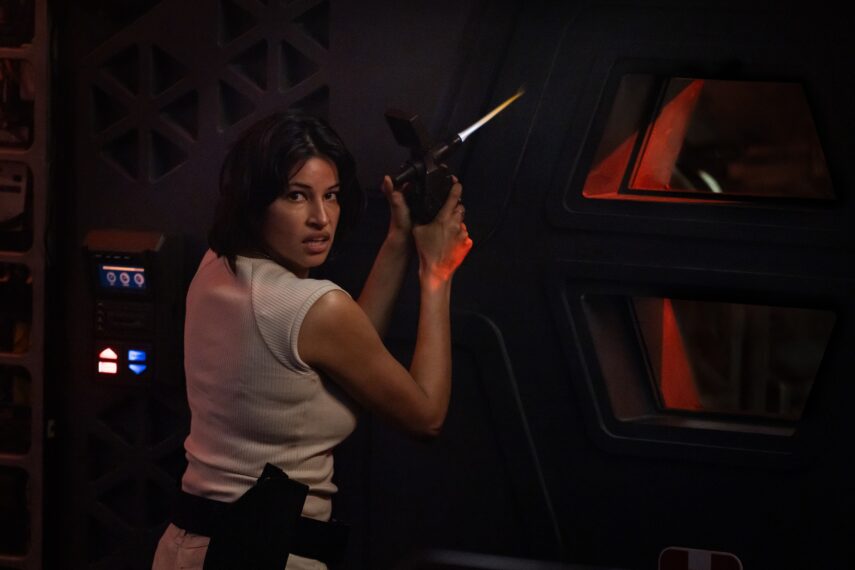
Written and directed by series creator Noah Hawley, Alien: Earth‘s latest episode tracks the events that led to the crash-landing of the USCSS Magino, as seen in the premiere episode, through Morrow’s (Babou Ceesay) eyes. As a security officer, the cyborg is alerted to a death aboard the ship caused by a breach in the containment of the species they’re transporting.

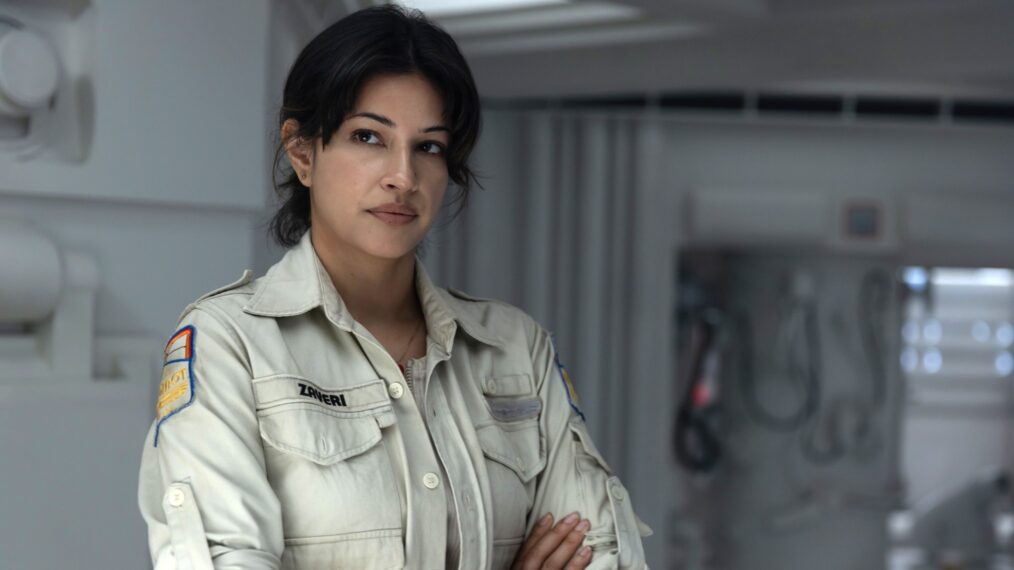
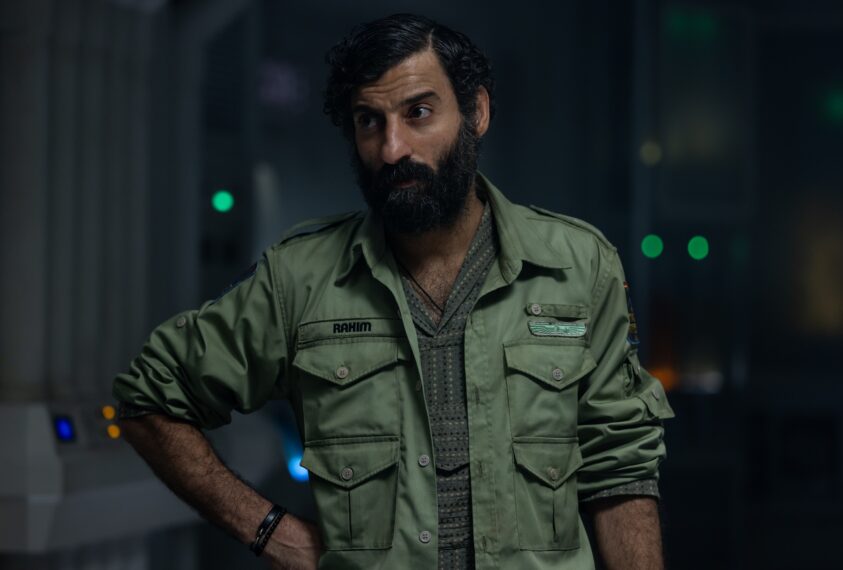
But as the events play out, Morrow realizes that sabotage is at play, and he begins to look at everyone suspiciously, including interim captain Zaveri (Richa Moorjani), who steps up after the ship’s captain dies. Still, the cyborg maintains his control and calm, even eliciting a curious comment from crewmate Rahim (Amir Boutros), who wonders how the cyborg doesn’t break a sweat despite the stress.

Realizing that navigation has also been lost, meaning the only potential outcome is a crash-landing, Morrow seeks answers and discovers a crew member has been tasked by Prodigy, Boy Kavalier’s (Samuel Blenkin) corp, to commandeer the ship and cargo. In other words, the seemingly random crash-landing had been orchestrated all along by the barefoot billionaire.

Patrick Brown / FX

And as Morrow roots out the sabatour, the creatures aboard are running amok, reducing the crew count drastically. When Morrow devises a plan to meet at the bridge, he decides that to preserve the cargo and deliver it to Weyland-Yutani, only he is needed to survive, and so he welds the door shut, leaving Zaveri to be massacred by the Xenomorph.

As he works to square away his tasks before closing himself in the emergency landing space, the calm and cool Morrow finally breaks a sweat. Is it due to the pressure of a 65-year-long mission during which he tragically lost his daughter? Hawley answers that question and many more, including which new species should scare viewers the most, in the Q&A below.

This episode pays homage to the story told in 1979’s Alien, but this time around, Morrow is at the center of it all. What made you want to reimagine this story, and what is driving Morrow to complete this mission?

Noah Hawley: I love the reversals for an audience in whom you’re rooting for, and who you’re rooting against. And I think those are some of the most meaningful moments as a viewer because it really is an active process that you go through. I remember in Season 2 of Fargo, Jesse Plemons and Kirsten Dunst, and they’re up against this Gerhardt family, and you think, “Well, I don’t care who they send, I’m rooting for Jesse and Kirsten.” And then they send the kid with cerebral palsy who wants to prove he’s a man. And the audience goes, “Well, hold on. I don’t want anything bad to happen to him.”

I think we’re trained to root for violence as a solution to a problem, and I always want the audience to have to wrestle with it a little bit and to look and to go, well, look at Morrow’s side of it. I mean, he has this mission he’s been tasked with, and he lost his ship. It was boarded, and they’ve stolen from him, and he’s the protagonist in his story, and his ethics are not our ethics, necessarily, but he’s not wrong on some level. When he says to Slightly, “If you took something from me, how is it wrong for me to take it back?”

Amir Boutrous in 'Alien: Earth'

Patrick Brown / FX

The biggest reveal in this episode is that Prodigy had infiltrated Weyland-Yutani’s USCSS Maginot with the intent to sabotage their mission. Does Morrow’s drive to go after Prodigy and Kavalier stem from wanting to give purpose to the time he lost with his daughter?

No, I think he articulates it in the third hour when he says, “I’ve been gone 65 years, this is my life’s work, and if I’ve lost this, then what was the point of those last 65 years?” And clearly, he made some choices. He sealed the door so that [Zaveri] couldn’t get in. I mean, he made these choices that are meaningful if you actually get the ends that justify the means. But if you don’t, then you just have the stuff that you did, and you have nothing to show for it.

This mostly contained episode builds up to an outcome we already knew. How did you approach that as a director and writer of the installment?

Well, you have to invest in all those people and think about how hard that is, to introduce this crew in 51 minutes, distinct and specific individuals whom you have feelings about. And then we’re also introducing and solving a sabotage mystery, and we’re playing out all these creature stories. So, on some level, why I wanted to do it was my mission overall was to try to turn Alien into something new. But if someone was going to get to also do classic Alien, I wanted that to be me. Right? I wanted to go, “I see what you did, Sir Ridley, and I see what you did, Mr. Cameron and Mr. Fincher, and here I am. Here’s my best effort at it.”

What’s interesting is that Morrow is technically in Ripley’s (Sigourney Weaver) shoes in this scenario, but he keeps his cool to the point that the crew questions why he isn’t sweating… until he is.

Then there’s that moment when Clem (Tom Moya) runs up and says something big, and you see for the first time Morrow doesn’t know what to do, everything is out of control. And that moment is everything to me. And Babou played it so brilliantly, but then he takes charge. There’s a moment she obviously can’t recover from that moment for herself, but he does, and that’s why he survives.

Richa Moorjani in 'Alien: Earth'

Patrick Brown / FX

In that final sequence aboard the USCSS Maginot, Morrow does begin to sweat. Is that a result of several different factors or merely the encroaching Xenomorph?

It’s a level of complexity. We all face it, right? You’re trying to get dinner on the table, there’s a flood in the bathroom, the cat’s throwing up in the other room. There’s a certain moment where you’re just like, I literally don’t know what to do right now. I don’t know which fire to put out. I don’t know what to do. Obviously, the stakes here are a lot higher, but I do think we all reach a moment where it’s just one thing too many, and he’s literally been carrying this crew; their priorities are weird, he’s got a drug addict for a doctor, it’s the island of misfit toys that’s on this ship. He’s been like, I’m going to get us through, and then at a certain point, he realizes I can get me through, I can’t get anybody else through, especially if they’re not going to help.

Babou Ceesay’s real-life daughter plays Morrow’s daughter in this episode’s flashback, and your son appeared alongside you earlier this season. What was it like incorporating real family members into the series, and how did that lend itself to more authentic moments onscreen? 

It’s only fair for him to get his kid onscreen, too. This is how I make things. I make things by hand and to the point of yeah, I record music for the show and my son asked if there was something for him, and I thought, well yeah, I can put him in, but he’s not one of the lost boys, so he could be the young Hermit, but I’m not going to write scenes for it. I was planning to shoot this flashback piece, and so I’d need a father and a mother, and I thought, there’s just going to be day players, and the best way to get any kind of performance out of him is to just get down on the floor and do it with him. And it was really meaningful for me personally, because, of course, that was two years ago. The difference between a 10-year-old and a 12-year-old is… he’s a different kid now, right?

And so for Babou, in that moment, I thought, we’ve all come all this way. He’s moved his family across the earth. Why wouldn’t I give him that lifelong memory and connection with his own child? That’s immortalized on film. I think that too often we look at these shows as some calculated act written by a cash register or something, but this is five years of my life. This is a very personal document for me,

We’ve known the Xenomorph for years, but you’ve introduced several new species into the Alien world with this series. Is there one we should be most terrified of?

Well, I think people are rightly focusing on the eye simply because it clearly has a larger agenda. And as you see, as the season goes on, this may not just be a parasite or a predator. This may be a rival. And I think that’s really interesting.

Alien: Earth, Tuesdays, 8/7c, FX and Hulu

September 3, 2025 0 comments
0 FacebookTwitterPinterestEmail
FX's Alien: Earth; Sheep.
TV & Streaming

Earth’ Boss Noah Hawley on That Creepy Eye-Sheep Alien

by jummy84 August 27, 2025
written by jummy84

It’s not easy to create an alien that can compete for your interest with a Xenomorph — which is arguably the greatest cinematic monster of all time.

But Alien: Earth writer-director-producer Noah Hawley hit a home run with at least one of his four original alien creations for his FX series with The Eye — an highly intelligent ever-starring eyeball with sucker-tipped tentacles that burrow’s into a victim’s head and then uses its body like a puppet.

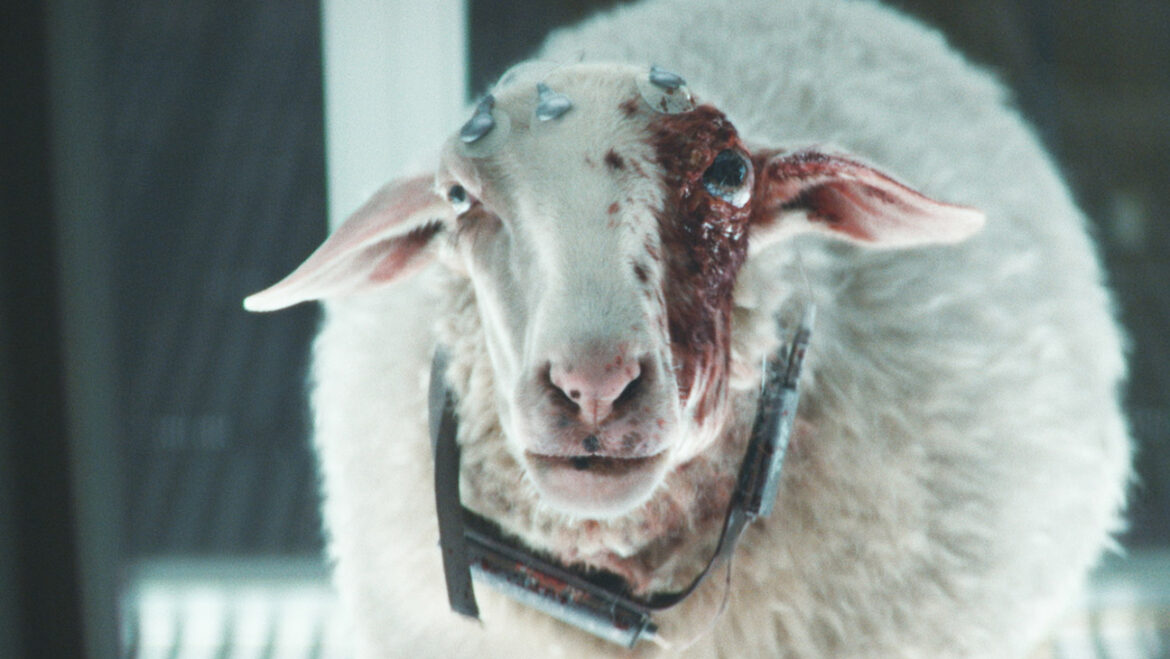
And in the fourth episode of the show’s first season, “Observation,” Hawley managed to make the creature even more unsettling by having a scene where Boy Kavalier (Samuel Blenkin) and Kirsh (Timothy Olyphant) conduct an experiment by letting The Eye infect a sheep — which now has a highly creepy all-knowing stare.

The sheep, by the way, was partly played by an actual sheep (which, of course, was not harmed).

We asked Hawley about his inspiration for the creature and the sequence.

“It’s one of the more disturbing things you’ll watch all year, I think,” he says of the sheep attack. “Every 5 percent improvement in visual effects made that sequence a 100 percent ‘worse’ in terms of its effectiveness — and by ‘worse,’ I mean better. I told director Ugla Hauksdóttir in London, ‘For me, the fact that you got the live sheep to back away from the camera [in seeming fear of The Eye], that made the whole sequence right. Because if that had been a CG sheep, there’s something about sheep — being like — us going ‘uh-huh!’ and backing away from camera really sold the gag.”

As for the creature’s design, The Eye was originally just the eye with little legs, until a visual effects supervisor suggested adding these suckers that it could shoot out and pull itself across a room.

“To me, there’s a relentlessness to this that is similar to the face hugger,” he says. “Certainly in James Cameron’s movie [Aliens] where Ripley [Sigourney Weaver] and Newt [Rebecca Jorden] are trying to get away from these things, and they just keep coming, and they’re fast, and they’re scrambling, and they’re spider like a crab. [The suckers] was a really great upgrade for the original conceit where before, it just had to run as fast as it could at you. Now it can fly. And here in Austin, we have the Palmetto bugs fly. A giant roach that flies is always worse than a giant roach that doesn’t. So the fact that it can propel itself, that it can stick to you, and you’re basically trying to fight it off, and it has all these arms and it’s relentlessly trying to get in.”

“Plus, it enters your face,” he adds. “The face hugger literally goes into your mouth, and there’s something really disturbing about that. But everyone has issues with eyeballs. It just felt like it’s designed just to play into that genetic revulsion.”

Speaking of Cameron, while Hawley has communicated with Alien director Ridley Scott about his project, the Aliens director hasn’t weighed in, even though Alien: Earth includes plenty of inspiration from the 1986 sequel, as well as the 1979 original. (Cameron called the franchise “trampled ground at this point” during an interview last year — though clearly the box office success of Alien: Romulus, and now the critical acclaim of Alien: Earth, has suggested a lot more life is still left.)

“I did not have any contact with James Cameron,” Hawley says. “Not because I didn’t want to, but I don’t know where James Cameron is or what he’s doing. And there’s certainly no obligation for him to talk to me about a movie he made 40 years ago.” (Cameron is likely jamming to finish post production on the upcoming release of Avatar: Fire and Ash, which is released Dec. 19.)

Alien: Earth airs Tuesdays on FX and streams on Hulu. Next week’s episode, titled In “Space, No One…” is directed by Hawley and one you won’t want to miss.

August 27, 2025 0 comments
0 FacebookTwitterPinterestEmail

Social Connect

Facebook Twitter Instagram Pinterest Youtube Snapchat

Recent Posts

  • 2009 feels like a whole other world away

  • Watch Ariana Grande and Jimmy Fallon Perform a History of Duets

  • Spotify’s Joe Hadley Talks ARIA Awards Partnership

  • Nick Offerman Announces 2026 “Big Woodchuck” Book Tour Dates

  • Snapped: Above & Beyond (A Photo Essay)

Newsletter

Subscribe my Newsletter for new blog posts, tips & new photos. Let's stay updated!

Categories

  • Bollywood (1,929)
  • Celebrity News (2,000)
  • Events (267)
  • Fashion (1,605)
  • Hollywood (1,020)
  • Lifestyle (890)
  • Music (2,002)
  • TV & Streaming (1,857)

Recent Posts

  • Shushu/Tong Shanghai Fall 2026 Collection

  • Here’s What Model Taylor Hill Is Buying Now

  • Julietta Is Hiring An Assistant Office Coordinator In Dumbo, Brooklyn, NY (In-Office)

Editors’ Picks

  • 2009 feels like a whole other world away

  • Watch Ariana Grande and Jimmy Fallon Perform a History of Duets

  • Spotify’s Joe Hadley Talks ARIA Awards Partnership

Latest Style

  • ‘Steal This Story, Please’ Review: Amy Goodman Documentary

  • Hulu Passes on La LA Anthony, Kim Kardashian Pilot ‘Group Chat’

  • Hannah Einbinder Slams AI Creators As “Losers”

  • Facebook
  • Twitter

@2020 - celebpeek. Designed and Developed by Pro


Back To Top
celebpeek
  • Home
  • Bollywood
  • Hollywood
  • Lifestyle
  • Fashion
celebpeek
  • Music
  • Celebrity News
  • Events
  • TV & Streaming